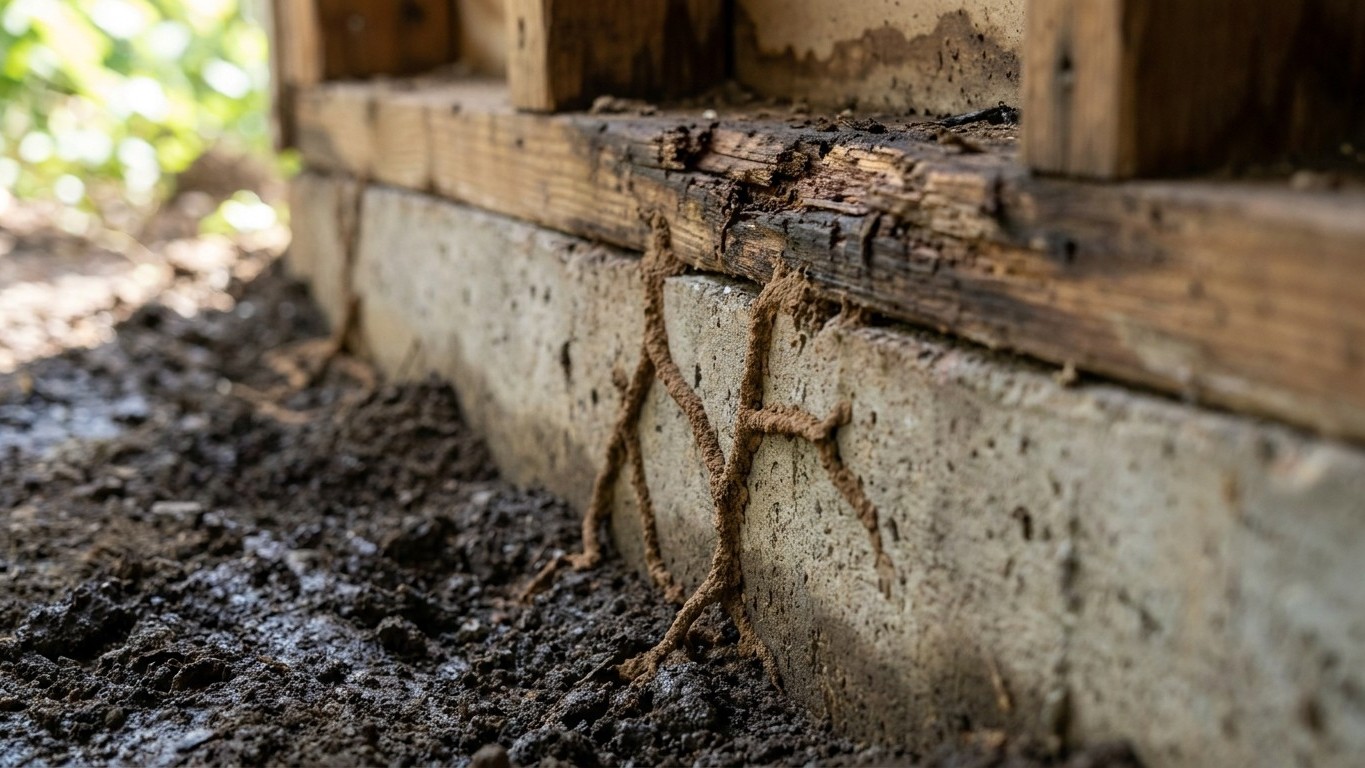

Termites come indoors for one reason: wood in contact with soil, softened by moisture, close enough to a foundation that a mud tube can reach it in a single trip. They are not chasing crumbs on a counter or a bowl left in the sink overnight. A colony operates year-round underground, and the indoors is only worth the trip when it offers the same conditions the colony already has outside: wood and water, without the risk of drying out in open air.
What they are actually looking for

Every indoor pest is working from the same short list: food, water, shelter. What separates species is which item on that list they’ll cross a threshold for. Ants will come for a spilled soda. Termites won’t bother, because sugar isn’t food to them. Cellulose is, and the wood framing a house, especially where it sits low and damp near a foundation, reads to a termite colony as an extension of a fallen log it would have found in a forest.
Moisture is the second half of the equation, and it’s the more decisive one. Subterranean termites, the kind responsible for most structural damage in the United States, need contact with soil moisture to survive; that’s the entire reason for the mud tubes they build climbing up a foundation wall. Wood that stays dry rarely gets touched. Wood that stays damp, whether from a leaking gutter, a grade sloped the wrong way, or a crawl space with no vapor barrier, becomes a standing invitation regardless of how clean the kitchen is.
This is the detail that makes prevention actually work instead of feeling like guesswork. A pest chasing food responds to sanitation. A pest chasing moisture and wood-to-soil contact does not care how tidy the pantry is; it responds to grading, drainage, and the gap (or lack of one) between untreated wood and the ground. The U.S. EPA frames this order deliberately: “As a first line of pest control, IPM programs work to manage the crop, lawn, or indoor space to prevent pests from becoming a threat.” For termites, managing the space means managing wood and water before anything else is considered.
That’s a different job than most people picture when they hear “pest control.” It has more to do with a downspout extension and a wood pile moved off the ground than with anything sprayed. Get the moisture and the wood contact wrong, and no amount of surface treatment inside the house addresses what’s drawing the colony toward the foundation in the first place.
How they get in
Termites don’t need a door left open. Subterranean colonies travel underground and enter through whatever gap connects soil to wood or soil to a void behind a wall. Worth checking in roughly this order:
- Foundation cracks and expansion joints. Even a gap too thin to fit a finger is enough for a colony that’s patient and working in the dark. This is the one most homeowners underestimate; a crack that looks cosmetic on a poured foundation can be a highway underneath.
- Pipe and utility penetrations. Anywhere a plumbing line, gas line, or electrical conduit passes through a slab or foundation wall, the seal around it is often just caulk or nothing at all, and it degrades over years.
- Wood-to-soil contact points. Deck posts set directly in the ground, porch steps, fence sections touching the house, and stored lumber leaning against siding all skip the foundation entirely and offer a direct path to framing.
- Door thresholds and untreated door frames. A door sweep that’s worn or missing lets moisture collect at the sill, and if the frame beneath it is untreated wood sitting close to grade, it becomes an entry point on its own.
- What gets carried in. Firewood stacked against an exterior wall, mulch piled against siding, or old lumber stored in a crawl space can bring an active infestation inside without the colony ever having to build a new tube to get there.
None of these require an open window or a torn screen the way flying or crawling insects do. That’s part of why termite entry goes unnoticed for so long: there’s no obvious breach to spot, just a slow convergence of soil, moisture, and wood that was already there.
When they come, and why
Termite activity tracks moisture and colony maturity more than it tracks a specific point on the calendar. Colonies swarm to reproduce when conditions inside the nest signal it’s time, which for many species lines up with a warm, humid stretch following rain, when winged reproductives (often mistaken for flying ants) leave in large numbers to start new colonies nearby. That swarm is frequently the first visible sign a homeowner gets, even though the colony feeding on wood near the foundation may have been established for a while already.
Drought plays a role too, in the opposite direction. When soil dries out, subterranean termites push deeper or move toward whatever moisture source is left, and a house with a leaking spigot or a poorly drained flower bed can become the most attractive moisture source on the block. Heavy rain does something similar by saturating the soil right up against a foundation, shortening the distance a mud tube has to travel.
Because both the timing of swarms and the seasonal moisture pattern vary by climate and by termite species present in a given region, there’s no single window that applies nationally, and giving one would be misleading. What matters locally is specific enough that it deserves its own answer rather than a guess; the site’s regional termite page covers the swarm patterns and seasonal risk for individual territories.
The practical takeaway holds regardless of timing: activity concentrates wherever moisture and wood-to-soil contact are already sitting there waiting, season after season. Fixing those conditions matters more than trying to predict the exact week a swarm might appear.
Fixing the reason rather than the symptom
A house that offers nothing gets fewer pests, and that’s truer for termites than for almost anything else that gets indoors. Treat the visible damage or the swarm without touching the grading, the leaking gutter, or the wood stacked against the siding, and the colony (or the next one) has every reason to come back to the same spot. The EPA’s own framework for pest management makes this an order of operations, not a menu to pick from: “Before taking any pest control action, IPM first sets an action threshold, a point at which pest populations or environmental conditions indicate that pest control action must be taken,” and “IPM programs work to monitor for pests and identify them accurately, so that appropriate control decisions can be made.” Prevention comes first. Control comes after, and even then it’s ordered: “Effective, less risky pest controls are chosen first, including highly targeted chemicals, such as pheromones to disrupt pest mating, or mechanical control, such as trapping or weeding.” Broad, non-specific treatment is meant to be the exception, not the opener: “Broadcast spraying of non-specific pesticides is a last resort.”
Termites are one of the clearer cases where a homeowner shouldn’t try to handle active control alone. Identifying the species, locating the colony, and applying a registered treatment correctly is work for a licensed pest control professional, not a weekend project; misapplied treatments waste money and can leave a colony intact behind a wall. Pesticides used in termite control are designed to be toxic to the target insect, and the EPA notes they can be toxic to people when used improperly, with children, older adults, and people with compromised immune systems named as especially vulnerable. Questions about a specific product belong to the label and to the National Pesticide Information Center at 1-800-858-7378, not to a general guess.
What a homeowner can control, and what this page has been building toward, is the reason a colony would target the house at all: wood touching soil, moisture pooling near the foundation, gaps around pipes and thresholds left unsealed. The site’s termite control page covers what to do once activity is confirmed. This page is what keeps it from starting again after that work is done.
Common questions
Do termites come inside because of clutter or dirty floors?
No. Termites feed on cellulose, not food waste, so sanitation doesn’t influence whether they enter. Wood-to-soil contact and moisture around the foundation are what draw them.
Can termites get in through a completely sealed foundation?
A truly intact foundation with no cracks, gaps, or wood-to-soil contact removes most entry points, which is why sealing penetrations and correcting grading matters more than any surface treatment.
Are the winged insects swarming near my house termites or ants?
Both termites and ants produce winged reproductives that swarm, and they’re commonly confused. A pest control professional can identify which one is present, which matters for deciding what action, if any, is warranted.
If I fix the moisture problem, will an existing colony leave on its own?
No. Removing the conditions that attracted the colony prevents new activity and future infestations, but an established colony still requires professional identification and treatment to be eliminated.