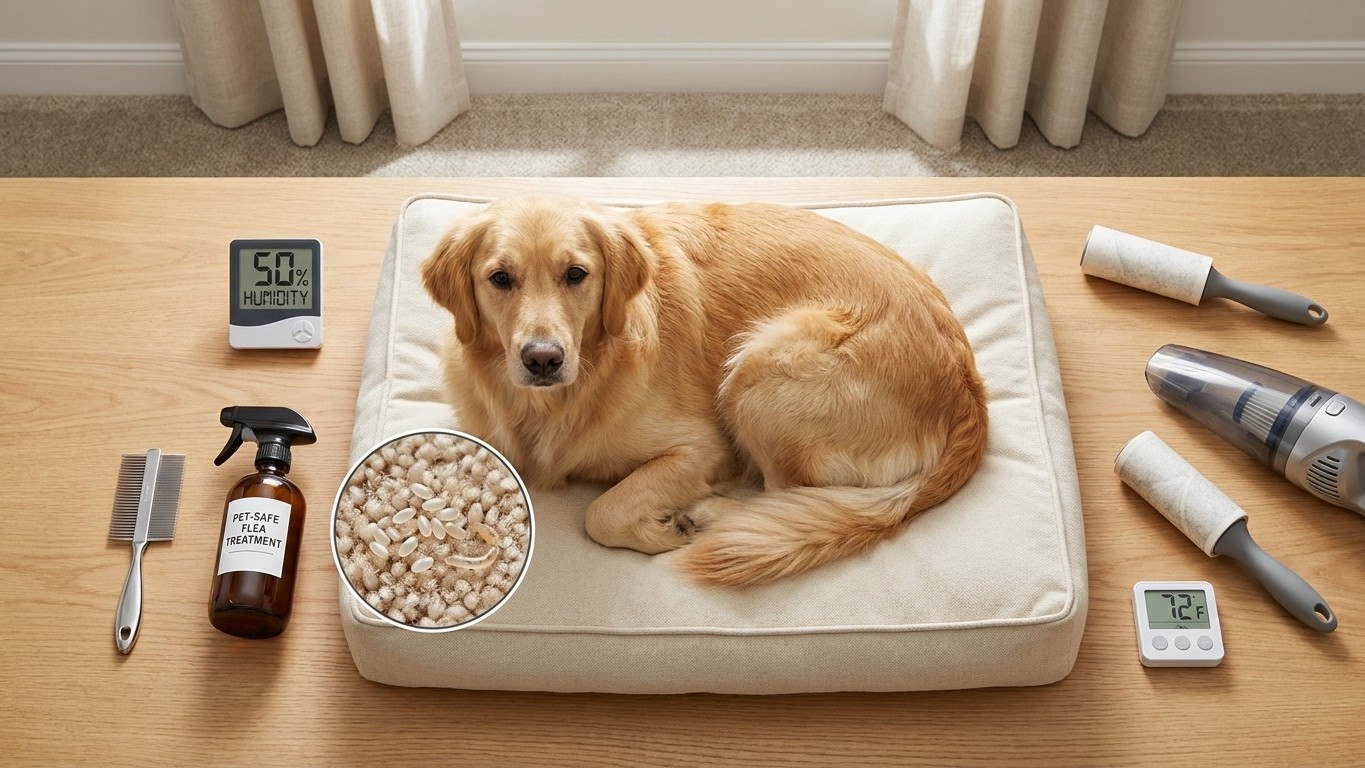

Fleas need three things to survive in a home: a host to feed on, warmth, and enough humidity to let eggs and larvae develop in carpet fibers, pet bedding, or baseboard cracks. Control that works removes those conditions first and treats only what’s left. Skipping straight to a spray without addressing the host animal, the yard, or the humidity means the infestation comes right back within a couple of weeks, because the eggs already laid haven’t hatched yet.
The order that works

The U.S. EPA frames pest management as a sequence, not a single action. The agency describes Integrated Pest Management (IPM) as “an effective and environmentally sensitive approach to pest management that relies on a combination of common-sense practices.” That combination has a specific order, and the order is the part most flea treatments skip.
Step one is a threshold. Before doing anything, IPM “first sets an action threshold, a point at which pest populations or environmental conditions indicate that pest control action must be taken.” For fleas, that threshold is usually obvious: a pet scratching constantly, bites appearing on ankles, or live fleas visible on light-colored socks after walking across carpet. One flea seen once isn’t a threshold. A pet miserable for a week is.
Step two is identification. IPM programs “work to monitor for pests and identify them accurately, so that appropriate control decisions can be made.” Flea bites get confused with bed bug bites, mosquito bites, and scabies often enough that misidentifying the pest wastes money on the wrong product entirely.
Step three, prevention, comes before any control method. “As a first line of pest control, IPM programs work to manage the crop, lawn, or indoor space to prevent pests from becoming a threat.” For a house, that means the vacuuming, the laundering, the yard maintenance covered in the next section.
Only after those three steps does control enter the picture, and even then, the agency is specific about which controls come first: “Effective, less risky pest controls are chosen first, including highly targeted chemicals, such as pheromones to disrupt pest mating, or mechanical control, such as trapping or weeding.” The broadest, least targeted option sits at the bottom of the list on purpose. “Broadcast spraying of non-specific pesticides is a last resort.”
A page, or a household, that opens with a fogger has inverted that doctrine. Treatment applied to a house that still offers food, warmth, and shelter to fleas doesn’t fail because the product was weak. It fails because the conditions supporting the infestation never left. That’s why the same homes spray twice a year and never actually clear the problem.
What works without a pesticide
The EPA’s own hierarchy puts mechanical and targeted controls ahead of broadcast chemicals, and several of those options require no pesticide label at all. None of them alone eliminates an established infestation, but together they cut the flea population enough that whatever comes next has a real chance of working.
Sanitation and physical removal
Vacuuming daily, on carpet, rugs, upholstery, and along baseboards, physically removes eggs, larvae, and adult fleas before they mature. It doesn’t kill everything in the bag or canister, so that debris needs to go straight into an outdoor trash container, not sit in the vacuum for a week. Washing pet bedding, blankets, and any fabric the pet regularly touches at the hottest setting the material allows kills eggs through heat, not chemistry. What it doesn’t do: reach fleas already on the animal, or fleas hiding in a yard.
Moisture and yard management
Flea larvae need humidity to survive outside a host. Mowing the lawn short, raking out leaf litter, and clearing brush piles near the house removes the shaded, damp microclimate larvae depend on. This addresses the outdoor reservoir that keeps reinfesting an indoor space no matter how often it’s vacuumed. It does nothing, though, for fleas already established on carpet or on the pet itself.
Traps
Flea traps, typically a small warmth-and-light source over a sticky surface, catch adult fleas drawn to the heat signature. They’re useful for monitoring, confirming whether an infestation is still active after other steps, but the numbers they catch are small relative to a real infestation. A trap tells you whether fleas are still present. It won’t clear a house on its own.
Exclusion, meaning sealing the gaps where wildlife or stray animals might introduce fleas under a porch or through a crawlspace, matters more for keeping a solved problem solved than for solving an active one. Combined, these steps match the EPA’s stated priority: “Effective, less risky pest controls are chosen first.” They’re also the reason many flea problems in a well-maintained, regularly vacuumed home resolve without ever reaching for a chemical control at all.
When a product is warranted
Once sanitation and yard work are underway and the pet has been treated by a veterinarian, some households still need a residual indoor treatment to knock down an established population fast, particularly in carpet or in homes with a heavy infestation history. That’s a legitimate use case. It’s also the point where the EPA’s caution matters most.
Pesticides are built to be toxic to the organisms they target, and that toxicity doesn’t stop being real once the product is inside a home. The EPA identifies children, older adults, and people with compromised immune systems as especially vulnerable to improper use. That’s not a reason to avoid every option; it’s a reason to read the label as a legal document rather than a suggestion. Application rate, ventilation instructions, re-entry time for people and pets, and storage requirements are all specified because those specifics change the level of risk.
Registered products, and what’s legally allowed in them, differ from state to state and change over time as products are reformulated or reregistered. Because of that, no specific product, brand, or active ingredient is named here; the only label that applies to a given household’s situation is the one printed on the container actually being used. Buying based on a neighbor’s recommendation from three years ago, or a product used successfully in a different state, skips the one document that’s legally binding for that purchase.
For questions about a specific product, whether it’s appropriate for a home with a toddler, how long to keep pets off treated carpet, or what a listed ingredient actually does, the right resource isn’t a forum thread. It’s the National Pesticide Information Center, reachable at 1-800-858-7378. The center exists specifically to answer public questions about pesticide use, and it’s free. A five-minute call before opening a container answers questions that guessing can’t.
Treatment, used this way, is a targeted step at the end of a process, not the process itself. It follows the threshold, the identification, and the prevention work described above. Used before those steps, it’s a repeated expense against a problem that keeps regenerating.
When to stop and call someone
Most flea infestations resolve at home with consistent vacuuming, laundering, yard maintenance, and, when warranted, a correctly applied treatment matched to the label. There’s a clear point, though, where continuing to try the same steps stops being persistence and starts being a waste of time and money.
That point arrives when the infestation survives two full, correctly done treatment cycles, meaning sanitation, veterinary flea control for the pet, and a labeled indoor product applied as directed, with no meaningful drop in flea activity. At that stage, the problem usually isn’t the method; it’s something structural or environmental that a pest control professional can identify and a homeowner typically can’t, like a wildlife entry point under the house or an infestation established in a crawlspace that’s never fully inspected.
Structural conditions are a second clear boundary. If fleas are traced to a crawlspace with standing moisture, an attic with evidence of animal nesting, or wall voids that can’t be reached without opening drywall, that’s beyond what vacuuming and yard work can fix. A professional with access to targeted, licensed treatment options for those spaces is the appropriate next step, not a stronger version of the same over-the-counter product.
Health questions are the third boundary, and they should go to a health authority, not to guesswork. Flea bites can cause allergic reactions in some people and pets, and fleas are documented carriers of certain pathogens in some regions. What’s actually happening in a specific case, whether a rash or illness is flea-related, whether a household member’s symptoms need medical attention, isn’t something to diagnose from an article. That question belongs to the CDC or the reader’s local health department, both of which track documented flea-associated health risks by region and can speak to symptoms with actual authority.
Repeated failure, structural access problems, or a health question are three distinct reasons to bring in help, and none of them reflect a homeowner doing something wrong. They reflect the limits of what sanitation and an over-the-counter label can reasonably be expected to solve.
Common questions
How long does it take to get rid of fleas in a house?
With consistent daily vacuuming, laundering of pet bedding, and treatment of the pet itself, most households see a meaningful drop within two to three weeks. Flea eggs and pupae can remain dormant longer, which is why a single treatment often isn’t enough and follow-through over several weeks matters more than the first few days.
Can fleas live in a house with no pets?
Yes. Fleas can be introduced by wildlife entering a crawlspace, attic, or yard, or carried in on clothing or a previous tenant’s belongings. A pet-free home still needs the same sanitation and moisture-management steps if fleas are present.
Do fleas go away on their own?
Not typically. Without a host, adult fleas die within days to weeks, but eggs and pupae already laid in carpet or bedding can survive much longer and continue the cycle once a host becomes available again. That’s why sanitation, not just waiting, is part of every effective approach.
Is it safe to treat a home for fleas with a baby or elderly person in the house?
The EPA identifies children and older adults as especially vulnerable to improper pesticide use, so any indoor treatment needs to follow the label’s re-entry and ventilation instructions exactly. For specific guidance on a product and a household’s situation, the National Pesticide Information Center (1-800-858-7378) is the resource to call before applying anything.