
House spiders control comes down to sequence, not chemistry. Reduce the food, water and shelter that spiders and their prey insects rely on, seal the gaps they use to get in, then rely on sticky traps and physical removal for what’s left. A store-bought spray is the last tool in that chain, not the first. Most homes never need one at all, because the spiders that show up are chasing insects, not the house itself.
The order that works

The U.S. Environmental Protection Agency lays out pest control as a sequence, and the sequence is the point. “Integrated Pest Management (IPM) is an effective and environmentally sensitive approach to pest management that relies on a combination of common-sense practices,” the agency states. That combination has a specific order, and it doesn’t start with a can of spray.
Step one is deciding whether action is even needed. “Before taking any pest control action, IPM first sets an action threshold, a point at which pest populations or environmental conditions indicate that pest control action must be taken.” One spider in a corner web isn’t a threshold. A dozen webs rebuilding nightly in a damp basement might be.
Step two is figuring out what’s actually there. “IPM programs work to monitor for pests and identify them accurately, so that appropriate control decisions can be made.” A house spider spinning cobwebs in a corner and a wolf spider hunting on the floor call for different responses, and neither calls for the same response as a species that bites.
Step three is prevention, and the EPA puts it ahead of any product: “As a first line of pest control, IPM programs work to manage the crop, lawn, or indoor space to prevent pests from becoming a threat.” Only after that does control enter the picture, and even then it starts small: “Effective, less risky pest controls are chosen first, including highly targeted chemicals, such as pheromones to disrupt pest mating, or mechanical control, such as trapping or weeding.” The broad spray comes dead last. “Broadcast spraying of non-specific pesticides is a last resort.”
A page, or a homeowner, that opens with a spray has inverted that order. It matters because a treatment applied to a house that still offers food, water and shelter doesn’t solve anything, it just resets the clock. Spiders come back because the insects they eat come back, and the insects come back because the crack under the door, the damp corner of the garage, or the pile of cardboard in the basement never changed. Spray without prevention becomes a chore you repeat every few weeks, indefinitely.
What works without a pesticide
The EPA’s own priority, stated plainly, is that “effective, less risky pest controls are chosen first.” For house spiders, several of those controls require no label at all, though they take real effort and none of them is instant.
Exclusion, sanitation and moisture
- Exclusion means sealing the gaps around door thresholds, window frames, foundation cracks and utility penetrations. It stops new spiders and the insects they hunt from entering, but it does nothing for anything already inside, and gaps reopen as caulk ages or a house settles.
- Sanitation means clearing clutter, boxes, and undisturbed piles where webs go unnoticed for months. It removes hiding places but has no effect on a spider that’s simply passing through, and it has to be repeated, since clutter accumulates again within weeks.
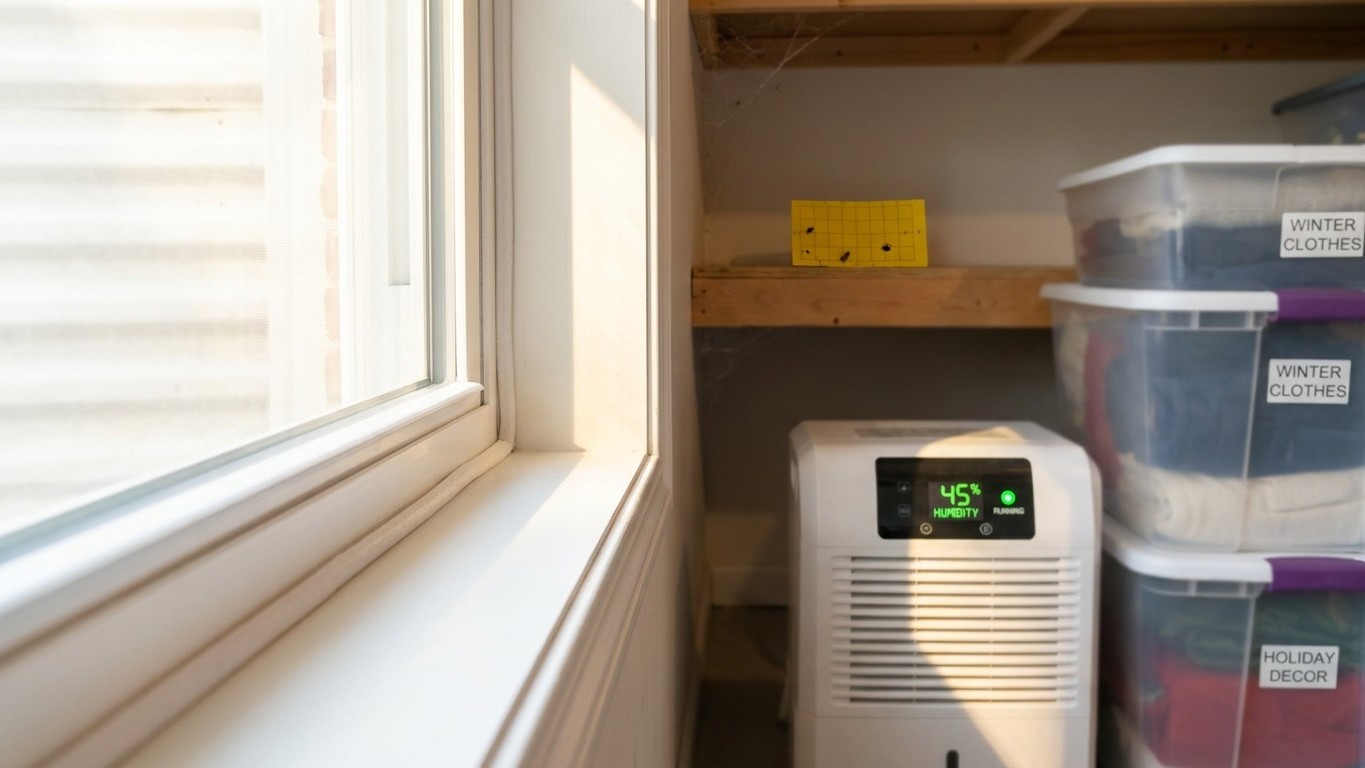
- Moisture control, fixing leaks, running a dehumidifier in a damp basement or crawlspace, cuts down the humidity-loving insects spiders feed on. It’s slower to show results than the other steps, sometimes taking a full season, and it doesn’t touch spiders that came in for shelter rather than food.
Traps and physical removal
Sticky glue traps placed along baseboards and in corners catch wandering spiders and, just as usefully, tell a homeowner what’s actually in the house, since whatever gets caught can be identified. They don’t catch spiders that stay up in a web, and they need periodic replacement once they fill up or lose their stick. Physical removal, a vacuum, a broom, a jar and a piece of paper for the squeamish, is immediate and free, but it’s a one-at-a-time fix. It removes what you can see; it does nothing for what’s behind the water heater.
None of these methods is dramatic, and none finishes the job alone. Combined, and repeated, they address why spiders showed up in the first place, which is the difference between a house that stays clear and one that needs the same fix every month.
When a product is warranted
There’s an honest case for a registered product, and it isn’t “nothing else worked so try everything.” It applies when the action threshold from the EPA’s own framework has actually been crossed, meaning a population, not a single spider, and when exclusion, sanitation, moisture control and traps have been tried and the pattern of activity hasn’t changed after a reasonable stretch of weeks.
Even then, a product is a tool with a cost. The EPA is direct that pesticides are designed to be toxic to pests, and that they can be toxic to people when they’re used improperly. The agency names children, older adults, and people with compromised immune systems specifically as more vulnerable to that exposure. That’s not a reason to panic over a routine label instruction, but it is a reason to read the label fully before opening the container, not after.
This is also where this article stops naming anything specific, deliberately. Registered pesticide products differ from state to state, formulations change, and the label on the container in front of you is the only one that governs how it can legally be used, where, and around whom. A product cleared for use in one state may carry different restrictions in another, and a label reprinted even a year apart can differ. No article, including this one, can substitute for that label.
If there’s a real question about a specific product, a specific ingredient, or how it interacts with a household that includes small children, a pregnant person, or someone with a respiratory condition, the right first call isn’t a search engine. It’s the National Pesticide Information Center at 1-800-858-7378, a service that exists specifically to answer the public’s questions about pesticide products and safe use. That’s a more reliable source than a comment section or a guess, and it’s free.
Used this way, after prevention has already done most of the work, a targeted product closes out a problem instead of just knocking it back for a week. Used as the first move, it tends to become the only move, repeated on a loop.
When to stop and call someone
Some situations are past the point of a homeowner handling it alone, and it’s worth saying so plainly rather than hinting at it. The first is repeated failure: if exclusion, sanitation, moisture control, traps and a properly applied product haven’t changed the pattern of activity after a full attempt at each, something about the source hasn’t been found, and a licensed pest control professional has access to inspection tools and formulations a homeowner doesn’t.
The second is structural damage or a structural entry point that goes beyond caulk and weatherstripping, a gap around a chimney, a rotted sill plate, a gutter problem feeding moisture directly into a wall cavity. That’s a repair job as much as a pest job, and it usually needs a contractor or the same pest professional working alongside one.
The third is a health question, and this is the one line that shouldn’t be answered by a home remedy or, honestly, by this article. If a bite is suspected, if a reaction seems unusual, or if there’s uncertainty about whether a spider found in the house is a species that carries a documented health risk, that question belongs with a doctor, a poison control center, or the local health department, not with a search result. Spiders in most U.S. homes are common house species that pose no real health threat, but confirming that in a specific case isn’t a job for guesswork.
None of this is a failure on the homeowner’s part. It’s simply where the household side of house spiders control ends and a professional’s side begins, and knowing that line in advance saves both money and worry.
Common questions
Do house spiders mean the house is dirty?
Not necessarily. Spiders follow insect prey and undisturbed shelter, which can exist in a clean house with a damp basement or a cluttered garage just as easily as in a messy one.
How long does it take for exclusion and sanitation to reduce spiders?
There’s no fixed EPA figure for this, but since these methods work by removing food and shelter over time rather than killing on contact, expect gradual change over weeks, not overnight results.
Are house spiders dangerous to pets or kids?
Most common house spiders in U.S. homes aren’t a documented health threat. Any concern about a specific bite or reaction is a question for a doctor, veterinarian, or the local health department, not a home guess.
Is it safe to use a pesticide product around children?
The EPA specifically names children among those more vulnerable to improper pesticide exposure. Always follow the label on the product actually in hand, and call the National Pesticide Information Center at 1-800-858-7378 with any specific question before applying anything.