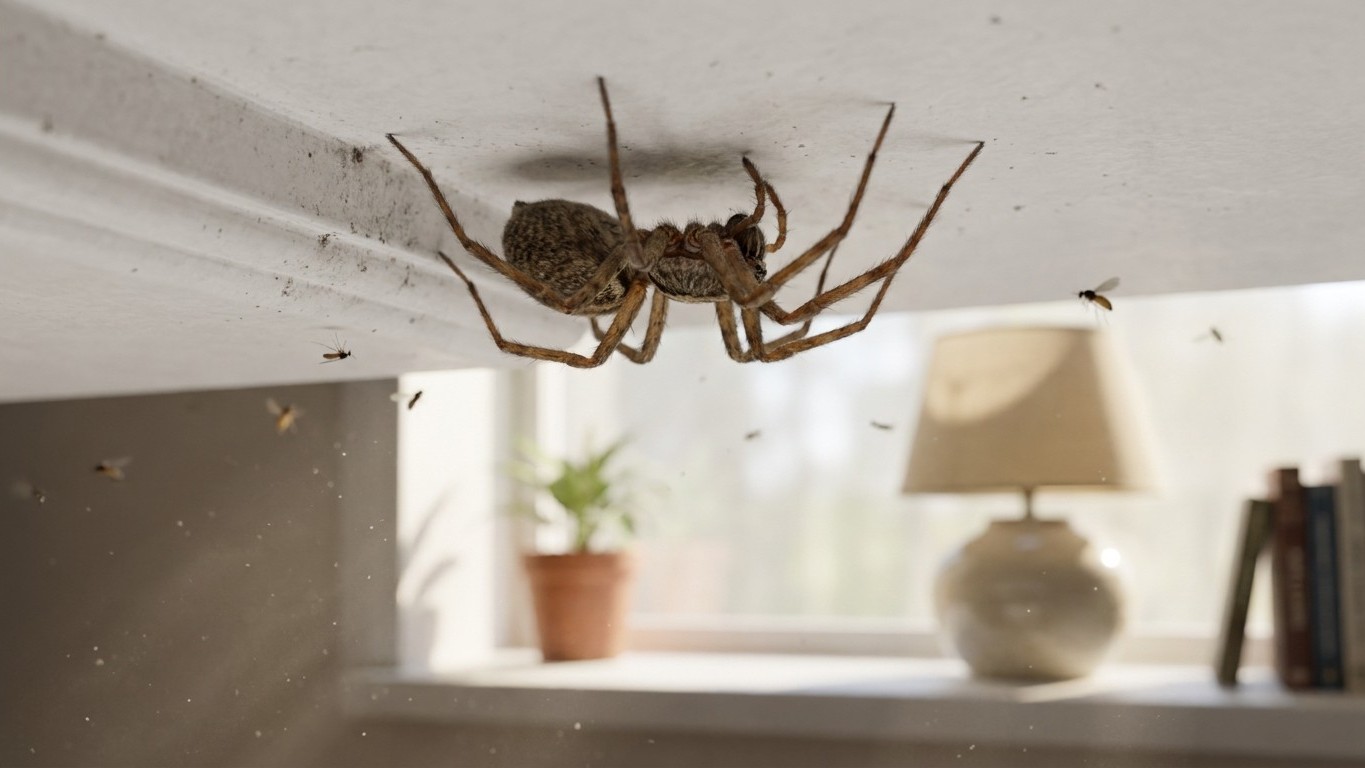

House spiders don’t wander in by accident. They follow food, and in most homes that food is already inside: gnats, fruit flies, silverfish, the odd moth banging against a lamp. Shelter and steady temperature matter too, but for this species, insect activity inside a house predicts spider activity almost one for one. That link changes how you fix the problem. A house already hosting a steady supply of small bugs will keep drawing spiders no matter how often the corners get vacuumed.
What they are actually looking for

Every pest that shows up indoors is chasing one of three things: food, water, or shelter. For rodents it’s often food and warmth together. For termites it’s moisture in wood. For house spiders, the calculation is simpler and more specific. They are not after your leftovers, your pet’s water bowl, or a warm vent. They are after the insects those things attract. A spider in a basement corner isn’t interested in the basement. It’s interested in the gnats breeding in a damp spot, or the moths that got trapped near a window, or the tiny flies drawn to a trash can that sits too long.
This is the detail that trips people up. Standard advice for pantry pests, that sealing food containers solves the problem, does nothing for a spider. Standard advice for ants, wiping counters, doesn’t touch it either. A species that comes for prey is not deterred by a cleaner countertop. It’s deterred by fewer prey. That’s a different fix, and it’s why spider problems often outlast a round of general cleaning that would have solved almost anything else.
Shelter still plays a role
Spiders do want a stable, undisturbed spot, which is why they favor corners, closets, and the space behind furniture where nobody sweeps. But shelter alone doesn’t explain why one house has spiders in every room and the identical house next door has almost none. The variable that moves the needle is what’s already crawling around inside. Reduce the resident insect population and the shelter stops being worth colonizing.
The federal guidance on this lines up with what shows up in practice. The U.S. Environmental Protection Agency states plainly: “As a first line of pest control, IPM programs work to manage the crop, lawn, or indoor space to prevent pests from becoming a threat.” Notice the order. Managing the space comes before any product, trap, or spray gets discussed. For a predator species like a house spider, managing the space means managing its prey, not managing the spider directly. Cut the food supply and the spider count follows it down on its own.
How they get in
House spiders rarely march through a wide-open door. They exploit small, specific weaknesses in a building’s envelope, usually the same handful every time. Walking the outside of a house with this list in hand catches most of them.
- Gaps around pipes and cables. Anywhere a utility line, dryer vent duct, or spigot passes through an exterior wall, the seal around it is often just foam or nothing at all. These gaps are the most common entry point, and they’re frequently far more generous than homeowners expect once someone actually looks with a flashlight.
- Worn door sweeps. The rubber or brush strip along the bottom of exterior doors compresses and cracks over a few years. A gap that looks negligible from standing height is plenty of clearance at floor level, where spiders travel.
- Window screens with tears or gaps at the frame. A screen that fits loosely in its track, or has a small split near a corner, works against you exactly where warm, buggy air tends to collect on a screened porch or an old double-hung window.
- Vents without fine mesh.
- What comes in on its own. Firewood stacks, potted plants brought indoors for winter, cardboard boxes from a garage or storage unit. These carry spiders directly past every sealed gap in the house, which is why sealing alone never gets a home to zero.
The size of the gap that matters most for this species is smaller than most people assume. A crack that wouldn’t let through a marble is still routinely wide enough. That’s less about the spider itself, which can flatten its body surprisingly well, and more about the insects it’s following, many of which need even less clearance.
When they come, and why
Spider activity indoors tracks a handful of pressures outside, and none of them are fixed to a calendar date. Cold weather pushes spiders toward any structure holding steadier warmth. Drought does something similar by drying up the outdoor insect activity they depend on, sending both the prey and the predator toward buildings that still have moisture and food. Heavy rain can flood ground-level burrows and gaps, forcing a move indoors on short notice. And for some species, the end of a breeding season simply means older spiders wandering further than usual looking for a last meal or a place to lay eggs before winter.
None of these triggers land on the same week in Arizona and Vermont, or even in two towns thirty miles apart with different microclimates. A dry spell that pushes spiders indoors in one region might be an ordinary August in another. Rather than attach a date or a temperature to this page, which would be wrong somewhere the moment it’s written, the timing is better checked against conditions specific to where the house actually sits.
What the timing means in practice
The practical takeaway isn’t a countdown. It’s that spider pressure rises when outdoor conditions get harder on insects generally, and falls when they ease. That means the fix described in the next section works year-round, but it pays off fastest right before a known seasonal shift, whatever that shift looks like locally. For a breakdown of pest pressure by region and season, check the seasonal pest calendar for your area rather than relying on a national average that won’t match your climate.
Fixing the reason rather than the symptom
A house that offers nothing gets fewer pests. That sentence sounds obvious, but it’s the entire logic behind the federal approach to pest management, and it’s the piece most home remedies skip. The EPA describes Integrated Pest Management this way: “Integrated Pest Management (IPM) is an effective and environmentally sensitive approach to pest management that relies on a combination of common-sense practices.” The practices aren’t mysterious. They follow a specific order, and the order is the message.
First comes a threshold, not a reaction to the first spider spotted. As the EPA puts it, “Before taking any pest control action, IPM first sets an action threshold, a point at which pest populations or environmental conditions indicate that pest control action must be taken.” Next comes identification, because a house spider, a wolf spider, and a black widow call for very different responses: “IPM programs work to monitor for pests and identify them accurately, so that appropriate control decisions can be made.” Only after that does control enter the picture, and even then, the mildest option goes first: “Effective, less risky pest controls are chosen first, including highly targeted chemicals, such as pheromones to disrupt pest mating, or mechanical control, such as trapping or weeding.” Broad chemical treatment sits at the bottom of the list, not the top: “Broadcast spraying of non-specific pesticides is a last resort.”
That order matters because a treatment applied to a house that still offers everything, still has the gaps, still has the resident insects, has to be repeated. It didn’t remove the reason spiders showed up. Pesticides are made to be toxic to the pests they target, and the EPA notes they can be toxic to people when used improperly, with children, older adults, and people with compromised immune systems named as particularly vulnerable. Anyone with questions about a specific product should call the label first and, if something’s still unclear, the National Pesticide Information Center at 1-800-858-7378 rather than guess. For an infestation that’s gotten ahead of sealing and cleanup, or for a spider that turns out to be venomous rather than a common house species, a licensed pest control professional is the right call, not a home remedy.
For what to actually do this week, the house spider control guide covers sealing, monitoring, and the least-risky steps in the EPA’s order. This page is the piece that keeps it from coming back: fewer resident insects, fewer entry points, and a house that no longer answers the only question a spider is actually asking.
Common questions
Do house spiders mean my house is dirty?
Not necessarily. They mean insects are present somewhere in the house, which can happen in a clean home just as easily through a screen tear, a damp basement corner, or a porch light that attracts moths near a door.
Will killing the spiders I see solve the problem?
It removes individuals, not the reason they arrived. As long as prey insects and entry points remain, more spiders will follow the same path the last ones took.
Are house spiders dangerous?
Most common indoor species are harmless to people. If a spider’s coloring or bite raises concern, identification matters before any decision about control, which is exactly the step the EPA lists before treatment of any kind.
Does sealing every gap guarantee spiders stay out?
No. Some arrive on firewood, plants, or boxes brought in by hand, bypassing any sealed gap entirely. Sealing reduces one pathway; managing indoor insects and inspecting items brought inside covers the rest.