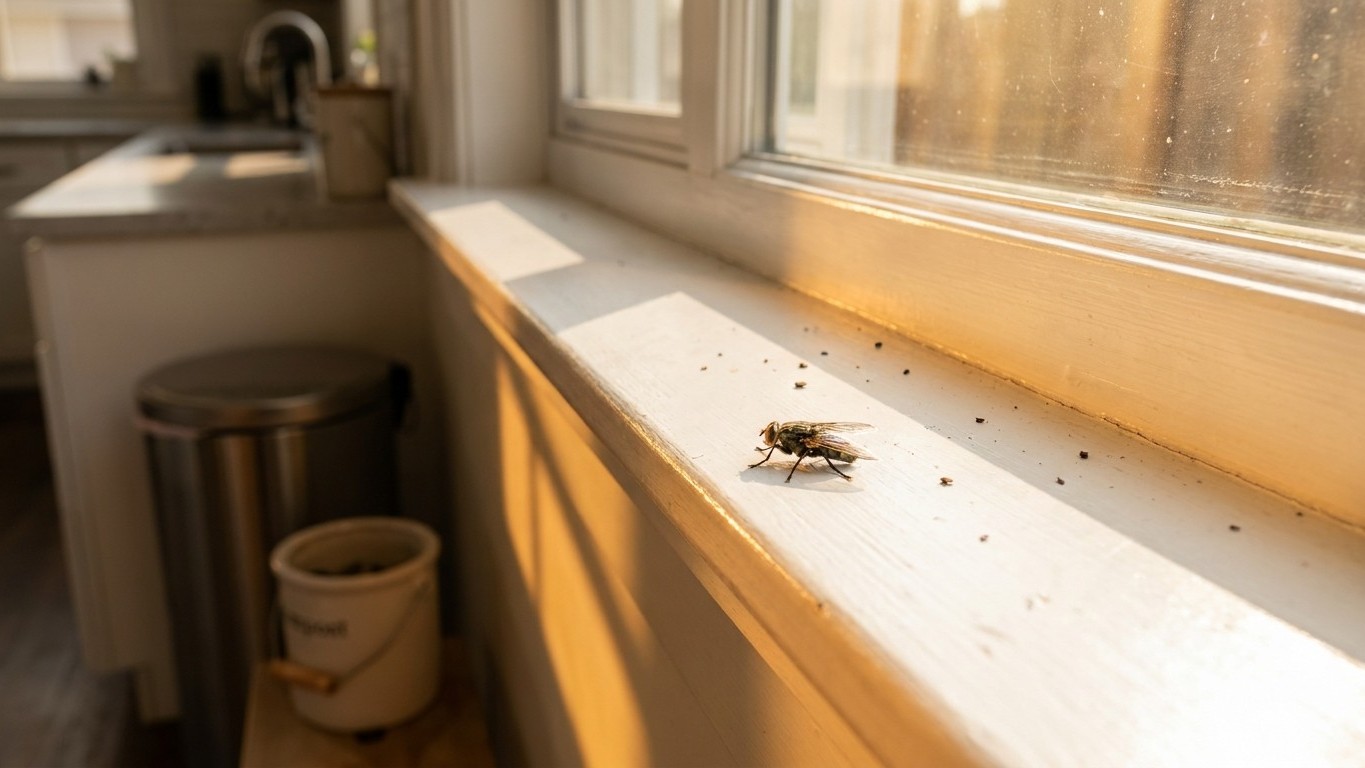

A house fly bumping against your kitchen window is not the problem. It’s the notification. Somewhere within a few hundred feet, and often much closer, something wet and organic has been sitting long enough for eggs to hatch and larvae to finish their business. By the time you’re swatting at adults, the actual breeding site has usually already done its work. Spotting the fly is step one; finding what fed it is the part most people skip.
What you notice first

The most common sign is also the least useful on its own: a single fly, or two, drifting near a window, a light fixture, or the kitchen counter. Adult house flies are drawn to light and warmth, which is why they cluster on the sunny side of a house in the afternoon and disappear toward evening. One or two flies doing this on a random Tuesday tells you almost nothing about where they came from.
The next sign up the ladder is a pattern in the location. If you keep finding flies in the same room, or specifically near a trash can, a compost bucket, a pet’s water dish, or a spot in the yard, that repetition is a clue. Flies don’t wander far from a larval site once they’ve emerged; a female house fly can lay eggs within a few hours of becoming an adult, so proximity to the food/breeding source matters more than most people assume.
A third sign, easy to miss because it looks unrelated, is small dark specks on windowsills, light fixtures, or walls near a suspected source. These are fly specks, a mix of vomit and excrement that adult flies leave wherever they land and feed repeatedly. Clusters of these specks, especially on a ceiling or wall near a trash area, point almost directly at a food source that’s been visited many times.
The most telling sign, and the one that separates a nuisance from an active breeding site, is finding the immature stages themselves: small cream-colored maggots, or the hard, dark, oval pupal casings they leave behind, in garbage, manure, decaying plant matter, or anywhere organic waste has accumulated. Finding maggots means you’ve located an active breeding site, not just a flight path.
Identification has to come before any of this leads to action. As the U.S. EPA puts it, “IPM programs work to monitor for pests and identify them accurately, so that appropriate control decisions can be made.” A homeowner who skips identification and jumps to a trap or spray is often solving the wrong problem, because several other flying insects produce nearly identical symptoms.
What it is confused with
Several household pests get lumped together as “flies” even though they come from different sources and respond to different fixes. Getting this wrong is where money gets wasted, usually on a trap or spray aimed at the wrong breeding site while the real one keeps producing new insects.
| Look-alike | What it might be instead | How to tell |
|---|---|---|
| Fruit flies | Tiny flies breeding in overripe produce, drains, or recycling | Much smaller, tan/amber body, hover near fruit bowls and drains rather than windows |
| Drain flies (moth flies) | Larvae living in the gunk lining a sink or floor drain | Fuzzy, moth-like wings held tent-style over the body; found resting on walls near drains, weak flyers |
| Cluster flies | Overwintering adults that entered walls or attics in fall | Slightly larger, sluggish, appear in large numbers in a single room, usually in cold months |
| Blow flies | Metallic-colored flies breeding on a carcass (rodent in a wall, dead bird in a chimney) | Shiny blue or green body, strong odor of decay often present nearby |
The costliest mix-up is treating what’s actually a drain fly problem as a house fly problem. Homeowners spray around windows and doors, replace door sweeps, and buy outdoor traps, none of which touch the organic film inside a drain pipe where the real breeding is happening. The flies keep coming back, the money’s spent, and the actual source never gets addressed.
Another common error is assuming a sudden indoor swarm is house flies when it’s cluster flies emerging from wall voids on a warm winter afternoon. That’s a structural and seasonal issue, not a sanitation one, and it calls for a different response entirely. Fruit flies get confused with house flies often enough that pest control companies report it as one of the most frequent misidentifications homeowners bring to them, usually because both show up near kitchens.
Size, color, wing shape, and location are the four quick checks. A fly resting on a wall near a drain versus one circling a light fixture across the room; a fuzzy moth-shaped wing versus a clear, veined one; a metallic sheen versus a dull gray-black body: each detail narrows the source before you spend a dollar on a fix.
Telling a sighting from an infestation
One fly getting into the house through a door left open for ten seconds is not an infestation. It’s physics. The judgment call homeowners actually need is harder: how many flies, where, and at what time of day turns a nuisance into a problem worth acting on.
A rough but useful threshold: seeing a handful of flies indoors on a given day, especially concentrated in one room or near one source, and seeing that pattern repeat over several days, suggests an active breeding site somewhere nearby rather than random entry. Seeing flies persist through the morning and evening, not just cluster during the warm afternoon hours, is another signal, since incidental strays tend to follow the sun while a true indoor source produces flies around the clock.
The presence of larvae or pupal casings is the clearest dividing line of all. A stray adult is an event. Maggots in a trash bin, a compost pile, or under a pet’s bedding are evidence of an ongoing life cycle, and that’s the point where a sighting has become an infestation with a specific, findable cause.
Acting too early wastes effort in the other direction. The EPA’s framework for pest management exists precisely to prevent overreaction: “Before taking any pest control action, IPM first sets an action threshold, a point at which pest populations or environmental conditions indicate that pest control action must be taken.” Spraying, fogging, or calling a service after a single fly sighting skips that threshold entirely. It treats an absence of information as if it were evidence, and it usually just delays finding the real source, since the person doing the (unnecessary) treating stops looking once they feel they’ve “done something.”
Timing matters too. A few flies appearing right after taking trash out on a hot day is expected and self-limiting. Flies appearing daily for a week, especially in a room with no obvious trash exposure, means the source is hidden: under an appliance, in a drain, in a wall void, or outdoors near a foundation vent. That gap between “expected” and “unexplained and repeating” is the practical line between a sighting and an infestation.
What to do once you are sure
Once maggots, repeated daily sightings, or a located breeding site confirm this is a real infestation and not a stray, the next steps split into two separate questions: what’s feeding them, and how to reduce the population without wasting money or exposing the household to unnecessary risk.
The EPA’s approach puts prevention ahead of any product: “As a first line of pest control, IPM programs work to manage the crop, lawn, or indoor space to prevent pests from becoming a threat.” For a house, that means locating and removing the organic source, whether it’s a trash can that needs a tighter lid, a compost bin that needs turning, pet waste that’s been overlooked in a corner of the yard, or a drain that needs cleaning. That single step usually does more than any trap or spray.
When further control is needed, the order matters as much as the method. The EPA is specific about sequencing: “Effective, less risky pest controls are chosen first, including highly targeted chemicals, such as pheromones to disrupt pest mating, or mechanical control, such as trapping or weeding,” and only after that, “Broadcast spraying of non-specific pesticides is a last resort.” A homeowner reaching for an aerosol before checking the trash can and the drains has the sequence backward.
House flies do carry a documented health question. They’re known to mechanically transport bacteria and other pathogens on their bodies as they move between waste, decaying matter, and food surfaces, which is why sanitation, not just population control, matters in kitchens and food storage areas. For guidance on what that means for a specific household situation, particularly where young children, older adults, or someone with a compromised immune system is present, the CDC or a local health department is the right source, not a general assumption one way or the other.
Pesticide products, when they are used at all, come with real caution. The EPA notes that pesticides are designed to be toxic to pests and can be toxic to people when used improperly, and it specifically names children, older adults, and people with compromised immune systems as especially vulnerable. Anyone with questions about a specific product, an active ingredient, or how to use one safely should call the National Pesticide Information Center at 1-800-858-7378 rather than guess. Registered products and label instructions vary by state, and the label on the product in hand is the only one that applies.
For a widespread infestation tied to a source that’s hard to reach, a wall void with a dead rodent, a septic issue, a large-scale sanitation problem, a licensed pest professional is a reasonable first call rather than a last resort. For everything upstream of that, the practical next moves are covered separately: what actually draws flies into a house in the first place, and the specific, lower-risk methods for reducing an existing population.
Common questions
How many house flies indoors counts as a real problem?
There’s no fixed number, but a repeating pattern over several days, especially concentrated in one room or near one suspected source, is a stronger signal than a single high count on one day.
Do house flies bite?
No. House flies feed by regurgitating digestive fluid onto food and sponging it up, which is part of why sanitation around food matters even without a bite risk.
Can house flies come from inside the house without any obvious trash?
Yes. Hidden sources like a dead rodent in a wall, a neglected drain, or pet waste in an overlooked corner of a yard can produce flies without an obvious trash source indoors.
Is it worth using a fly trap before finding the source?
Traps can reduce adult numbers, but the EPA’s sequence puts prevention and source removal first; a trap without addressing the breeding site usually just catches a fraction of a population that keeps replenishing itself.