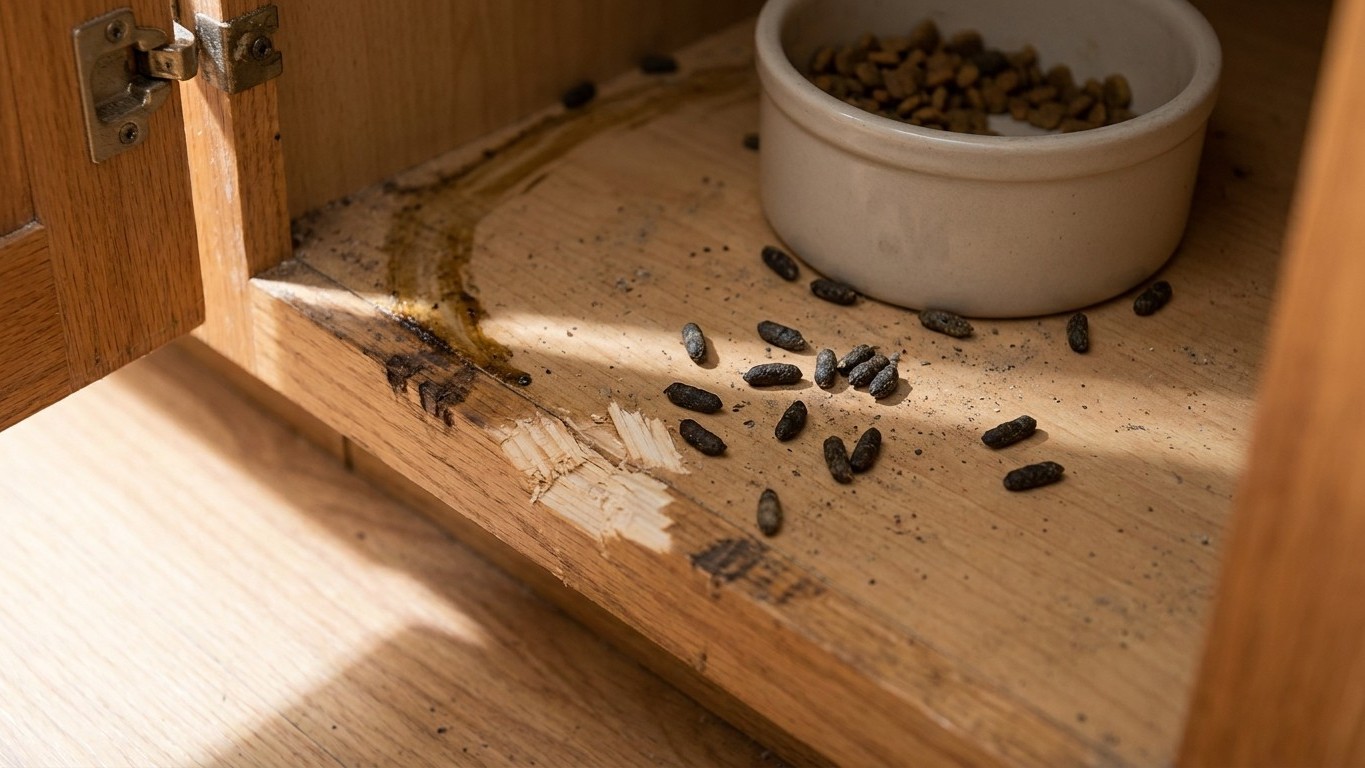

Rats leave evidence before you ever see the animal itself. Droppings near food sources, gnaw marks on wood or wiring, a greasy smear along a baseboard, and scratching sounds inside walls after dark are the most reliable signs. Because rats are mostly nocturnal and stick to the same paths night after night, the marks they leave behind are often easier to find than the rats are.
What you notice first

Rats are neophobic. They avoid anything new in their environment, including a trap, a bait station, or even a piece of furniture moved a few inches. This single trait explains why a freshly placed snap trap often sits untouched for several nights, and why homeowners give up too early thinking the infestation is gone. It isn’t gone. The rats are just waiting the new object out before they’ll go near it.
The most common sign, by far, is droppings. Fresh rat droppings are dark, moist, and about the size of a raisin, capsule-shaped with blunt ends. Older droppings turn gray and crumble when touched. You’ll usually find them clustered along walls, under sinks, inside cabinets, or near a pet food bowl, since rats tend to defecate wherever they stop to feed.
Next in frequency: gnaw marks. Rats’ incisors never stop growing, so they gnaw constantly to file them down, chewing through wood, plastic, soft metal, and electrical insulation. Fresh gnaw marks look pale and rough; older ones darken and smooth out from repeated contact.
The signs people miss
Grease marks are the sign homeowners overlook most often. Rats have oily, dirty fur, and as they travel the same route along a wall or pipe night after night, they leave a dark, greasy smudge at the contact point. It’s subtle, close to the color of dust, and easy to wipe away without ever wondering what caused it.
Sounds are the other underrated clue: scratching or scurrying in walls, ceilings, or under floors, usually most active in the hour or two after dark. A single scratch could be a lot of things. A pattern of scratching at the same time every night, coming from the same location, is a much stronger signal.
Identification has to come before any response, which is exactly the order pest management professionals follow. As the U.S. Environmental Protection Agency puts it, “IPM programs work to monitor for pests and identify them accurately, so that appropriate control decisions can be made.” Guessing at what’s making the noise, or assuming droppings are from something smaller, sends people toward a fix that was never built for the actual problem.
What it is confused with
Rat sign gets mixed up with several other household problems, and the mix-up is expensive. A homeowner who buys mouse-sized snap traps for a rat problem, or calls a termite company because gnaw marks looked like insect damage, spends money solving the wrong thing while the actual pest keeps breeding.
| Could be mistaken for | Key difference | Why the mistake costs money |
|---|---|---|
| Mouse droppings | Mouse droppings are smaller, about 1/8 to 1/4 inch, and pointed at both ends; rat droppings run 1/2 to 3/4 inch with blunt ends | Mouse traps and bait stations are undersized for rats and rarely catch them, so the infestation continues unchecked |
| Termite damage | Termite damage shows smooth tunnels through wood with no wood chips; rat gnawing leaves visible tooth grooves and debris | Homeowners pay for termite treatment that does nothing for the actual rodent problem |
| Squirrel activity in the attic | Squirrels are active during the day and move heavily overhead; rats are nocturnal and travel along wall lines, not open attic floors | Daytime “rat” sightings that are actually squirrels lead to wasted nighttime trapping efforts |
| Roach droppings | Roach droppings are much smaller, resembling coffee grounds or black pepper, and lack the capsule shape | Insecticide treatments for roaches leave the rodent population untouched |
The termite mix-up is the one that drains the most money, since termite inspections and treatments run into hundreds or thousands of dollars and address a completely different structural threat. A close look at the damage, wood chips and visible gouges point to rats, smooth mud tubes point to termites, saves that expense entirely.
The mouse confusion is more common but cheaper to fix. It mostly costs a wasted trip to the store and a few days of continued activity while the right-sized equipment gets sourced.
Telling a sighting from an infestation
One rat is not an infestation. A single sighting, especially outdoors near a shed, woodpile, or compost bin, can be an animal passing through rather than one living in your house. What turns a sighting into a confirmed infestation is a pattern: droppings appearing in multiple rooms rather than one spot, fresh gnaw marks alongside old ones showing ongoing activity, and sounds heard on consecutive nights rather than once.
Location matters as much as quantity. Droppings scattered along a single wall or under one appliance suggest a rat passing through or a small, contained problem. Droppings found in the kitchen, a closet, and the attic all at once suggest an established population moving through the structure on multiple routes.
Timing is a clue too. Rats are most active in the hours right after dusk and again before dawn. Noise or droppings that appear consistently in that window, night after night, point to a nest nearby rather than a one-time visitor.
The breeding signal
The clearest sign of an established infestation isn’t the adult rats at all, it’s finding droppings of different ages and sizes in the same area, including smaller droppings that suggest juveniles. That mix means rats have been present long enough to reproduce on site, not just visit.
Knowing when to act, and when not to, is part of sound pest management. The EPA frames it this way: “Before taking any pest control action, IPM first sets an action threshold, a point at which pest populations or environmental conditions indicate that pest control action must be taken.” A single old dropping found while cleaning out a garage doesn’t meet that threshold. Fresh droppings in three rooms, active gnawing, and nightly noise do.
Acting too early wastes traps and bait on a problem that may have already moved on. Acting too late lets a small number of rats become a breeding population, since a female rat can produce several litters a year. The threshold sits in the middle: enough consistent, fresh, multi-location evidence to justify a response, not a single ambiguous clue.
What to do once you are sure
Once the signs add up to a real infestation rather than a passing visitor, the next useful step is understanding why the rats chose your house in the first place, easy food access, gaps around the foundation, clutter that offers shelter, before deciding how to respond. Sealing those attractants is the first line of defense the EPA describes: “As a first line of pest control, IPM programs work to manage the crop, lawn, or indoor space to prevent pests from becoming a threat.”
From there, the order matters. “Effective, less risky pest controls are chosen first, including highly targeted chemicals, such as pheromones to disrupt pest mating, or mechanical control, such as trapping or weeding,” according to the EPA, and “broadcast spraying of non-specific pesticides is a last resort.” For rats specifically, that generally means targeted trapping and exclusion work before any chemical control is even considered.
Rats carry a documented health question that shouldn’t be minimized or exaggerated. They can transmit disease through droppings, urine, and bites, including hantavirus in some regions. The exact risks and current guidance for your area are best confirmed through the CDC’s rodent health information or your local health department, rather than guesswork.
A rat infestation established inside the structure of a home, in wall voids, insulation, or between floors, is generally beyond what a do-it-yourself approach can fully resolve. That’s a reasonable point to call a licensed pest control professional rather than continuing to trap piecemeal for weeks. If you do use any product yourself, the label on your specific product is the only guide that applies, and the National Pesticide Information Center (1-800-858-7378) can answer questions about a product before you use it.
Common questions
How do I know if it’s rats and not mice?
Droppings are the fastest check. Rat droppings run 1/2 to 3/4 inch with blunt ends; mouse droppings are smaller and pointed. Gnaw marks and noise from rats also tend to be heavier and lower in the walls than what mice produce.
Can rats be in my house without me hearing them?
Yes. A small number of rats, or a nest located deep in insulation or between floors, can go unheard for weeks. Droppings, grease marks, and gnaw damage often show up before any sound does.
Do rat signs mean I have a serious infestation?
Not necessarily. A single old dropping or one distant sighting doesn’t meet the threshold for a confirmed infestation. Fresh signs across multiple rooms, on consecutive nights, with droppings of different ages, do.
Is it safe to clean up rat droppings myself?
The CDC provides specific guidance on safely cleaning rodent droppings to avoid airborne exposure. Check the current CDC rodent guidance before cleaning, particularly in enclosed spaces like attics or crawl spaces.