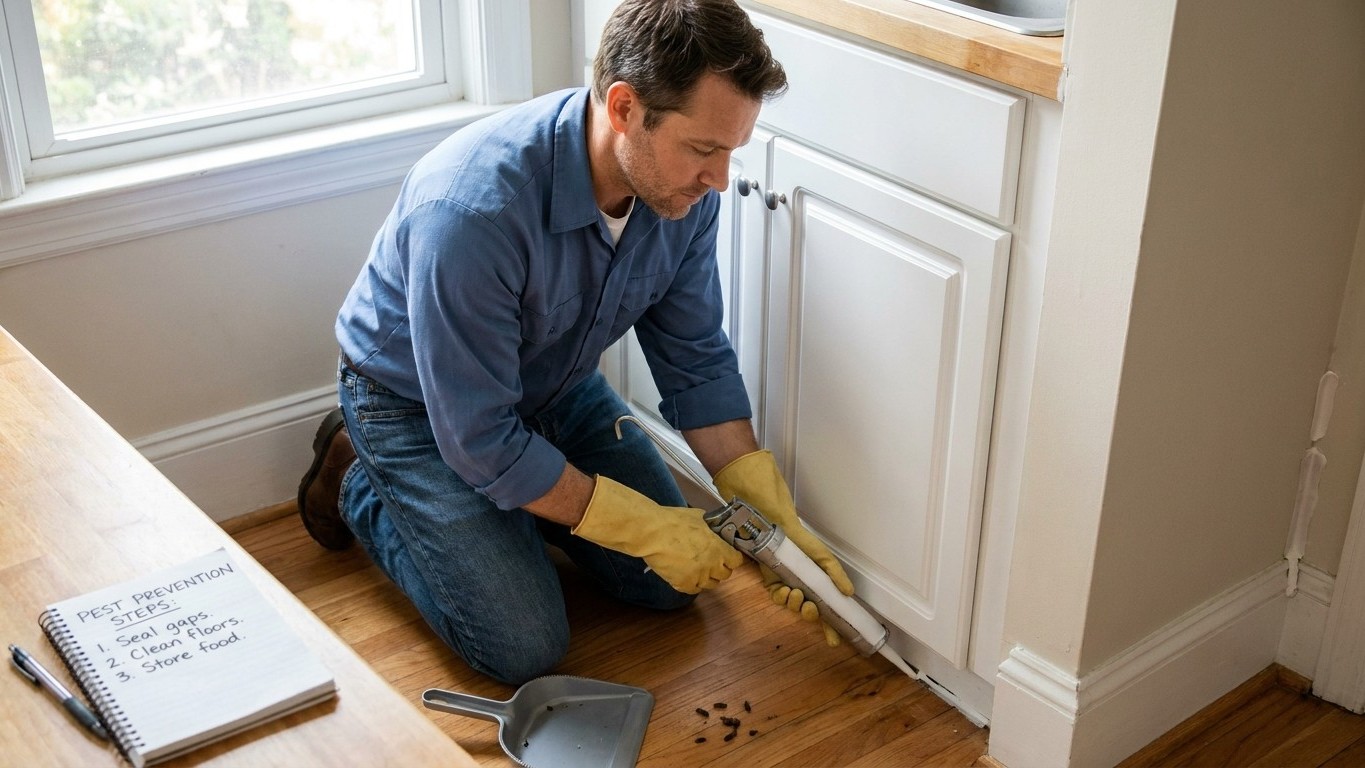

Getting rid of mice for good means closing the entry points, removing what draws them in, and using traps before anything else. Poison bait works, but only as a backup when those steps fail or when an infestation is already established. The order matters more than the tool: skip straight to a chemical solution and you’re treating a symptom while the house keeps offering food, water, and shelter to the next mouse in line.
The order that works

The U.S. Environmental Protection Agency doesn’t leave this to guesswork. Its framework, Integrated Pest Management, lays out a specific sequence, and the sequence is the point. As the EPA puts it, “Integrated Pest Management (IPM) is an effective and environmentally sensitive approach to pest management that relies on a combination of common-sense practices.”
Step one isn’t a trap or a spray. It’s a decision about whether action is even needed yet. The EPA states: “Before taking any pest control action, IPM first sets an action threshold, a point at which pest populations or environmental conditions indicate that pest control action must be taken.” One mouse dropping behind the stove isn’t the same emergency as droppings in three rooms and a chewed pantry box.
Step two is identification, not assumption. “IPM programs work to monitor for pests and identify them accurately, so that appropriate control decisions can be made.” A house mouse, a deer mouse, and a young rat leave different signs and call for different responses, so guessing wrong wastes time and money.
Step three is prevention, and it’s supposed to happen before any product touches the house. The EPA is direct about this: “As a first line of pest control, IPM programs work to manage the crop, lawn, or indoor space to prevent pests from becoming a threat.” Sealing gaps, storing food properly, and fixing moisture problems fall here, and they’re not optional extras tacked onto a treatment plan. They’re the plan.
Only after prevention comes control, and even then, the least aggressive option comes first. “Effective, less risky pest controls are chosen first, including highly targeted chemicals, such as pheromones to disrupt pest mating, or mechanical control, such as trapping or weeding.” For mice in a home, that mechanical control usually means snap traps or enclosed bait stations placed with intention, not a fog of product sprayed around a kitchen.
The last resort, by the agency’s own language, is broad and untargeted: “Broadcast spraying of non-specific pesticides is a last resort.” A page, or a homeowner, that opens with a spray has run the doctrine backward. Treatment applied to a house that still has an open utility gap, spilled birdseed, or a leaking pipe under the sink doesn’t solve anything. It just delays the next mouse by a few weeks, and the cycle starts over.
What works without a pesticide
Most of the actual work in mice control happens before any product is considered, and none of it requires a label or a warning icon. The EPA’s own priority, again, is that “effective, less risky pest controls are chosen first,” and for mice that mostly means physical and structural fixes rather than chemistry.
| Method | What it does | What it doesn’t do |
|---|---|---|
| Exclusion | Seals gaps larger than a quarter-inch around pipes, vents, foundations, and door thresholds with steel wool, hardware cloth, or caulk | Won’t remove mice already inside; won’t help if gaps go unfound |
| Sanitation | Removes food sources: sealed containers, cleaned crumbs, secured pet food and birdseed, tight-lidded trash | Won’t stop mice from entering if the structure is still open |
| Moisture control | Fixes leaking pipes, damp crawl spaces, and standing water that mice rely on | Won’t address food or entry issues on its own |
| Traps | Removes mice already present; snap traps and enclosed mechanical traps work fast when placed along walls and near droppings | Won’t prevent new mice from entering after the current ones are gone |
| Physical removal | Cleaning up nesting material, droppings, and gnawed debris once mice are cleared out | Won’t fix the underlying entry point or attractant that let them in |
Exclusion is the least glamorous and the most effective long term. A mouse can squeeze through a gap the width of a pencil, so the work is tedious: checking foundation vents, garage door seals, dryer vent housings, and the spots where pipes pass through exterior walls. It takes an afternoon or two on a typical house, sometimes a weekend on an older one, and it has to be redone if new gaps open from settling or weather.
Sanitation and moisture control are maintenance, not a one-time fix. Birdseed left in an open garage bag or a slow drip under a bathroom sink will undo weeks of trapping progress. Traps, meanwhile, are honest about their limits: they remove the mice that are already there, but they do nothing to stop the next one from walking through the same gap next month. That’s why exclusion and sanitation have to run alongside trapping, not after it.
When a product is warranted
There’s a point where trapping and sealing aren’t keeping pace, usually a breeding population inside wall voids or an infestation that’s been building for months before anyone noticed. That’s where a registered rodenticide product becomes a reasonable option, not a first move but a next one, chosen because the less risky controls described by the EPA weren’t enough on their own.
What that product should be isn’t something a general-interest article can specify. Registered rodenticides vary by state, by formulation, and by year, and the products legally sold and approved for use change over time. The label on the package a homeowner actually buys is the only rule that applies to that purchase, and it’s a legal document, not a suggestion. Following it, including where it can be placed, how much to use, and what precautions apply, isn’t optional.
The reason for that caution isn’t bureaucratic. The EPA is clear that pesticides are built to be toxic to the pests they target, and that toxicity doesn’t disappear once the goal is human safety. These products can be harmful to people when they’re used incorrectly, and the agency singles out children, older adults, and people with compromised immune systems as facing the highest risk. That’s not a small print warning, it’s the core reason placement and storage matter as much as the product itself: locked bait stations, placement out of reach of kids and pets, and disposal according to the label.
Anyone with a specific question about a product they’re holding, whether it’s safe to use in a kitchen, how long to wait before cleaning near a bait station, or what to do after accidental exposure, has a direct resource built for exactly that. The National Pesticide Information Center takes calls from the public at 1-800-858-7378. That’s a better source than a guess, an old bottle’s memory, or an internet forum, because it’s staffed to answer for the specific product and situation in front of the caller, not a generic case.
When to stop and call someone
There’s a line past which trapping harder or buying a stronger product stops being the answer. It shows up in a few recognizable ways, and it’s worth naming plainly rather than hedging around it.
Repeated failure is the clearest sign. If traps have been placed correctly, entry points sealed, and food sources locked down for several weeks, and mice are still active, the population size or the number of undiscovered entry points is likely bigger than a single household effort can handle. That’s not a failure of technique, it’s a scale problem, and a licensed pest control professional has tools, including thermal inspection and access to different trap and bait configurations, that go beyond what’s available at a hardware store.
Structural damage is the second trigger. Mice gnaw through wiring insulation, wall insulation, and occasionally structural wood, and electrical damage from rodent activity is a documented fire risk that isn’t something to assess by eye through a wall cavity. If there’s chewing near wiring, insulation pulled apart inside walls, or damage in a crawl space that’s hard to fully inspect, that’s a job for someone who can open the structure safely and knows what they’re looking at.
Health questions are the third, and they deserve a straight answer rather than reassurance either way. Rodents, including mice, are documented carriers of disease that can affect humans through droppings, urine, or direct contact, and the specifics of exposure risk and symptoms are best answered by public health authorities rather than a general home-improvement source. The Centers for Disease Control and Prevention and local health departments track and document these risks directly, and anyone with a specific health concern, a bite, unexplained symptoms after cleanup, or questions about a heavy infestation in an occupied space, should go to those sources rather than guessing at a home remedy.
None of these three situations mean the earlier steps, exclusion, sanitation, moisture control, and trapping, were wasted effort. They’re still the reason a professional’s job gets easier once the household side is already handled. But they mark the point where continuing to DIY a solution stops being resourceful and starts being a delay.
Common questions
How long does it take to get rid of mice using traps alone?
It depends on the size of the population and how thoroughly entry points are sealed at the same time. A single mouse or two can be caught within days once traps are placed correctly along walls and near droppings, but an established population inside a wall void can take several weeks, especially if new mice keep entering through gaps that haven’t been closed yet.
Do ultrasonic repellent devices work for mice control?
They aren’t part of the EPA’s IPM framework, which prioritizes sealing, sanitation, and mechanical trapping as the less risky controls chosen first. Homeowners considering any device or product should check its specific claims and registration status rather than assuming it replaces exclusion and trapping.
Is it safe to clean up mouse droppings myself?
Cleanup methods and precautions are a health question best answered by the CDC or a local health department, since documented risks vary with the amount of droppings, ventilation, and exposure. Rather than guessing at a safe method, checking current guidance from those sources before cleaning an affected area is the safer route.
What’s the difference between a house mouse and a deer mouse for control purposes?
Accurate identification is the second step in the EPA’s IPM approach, because different species can call for different trap placement and exclusion priorities. A pest control professional or local extension office can confirm which species is present if droppings or sightings alone leave it unclear.