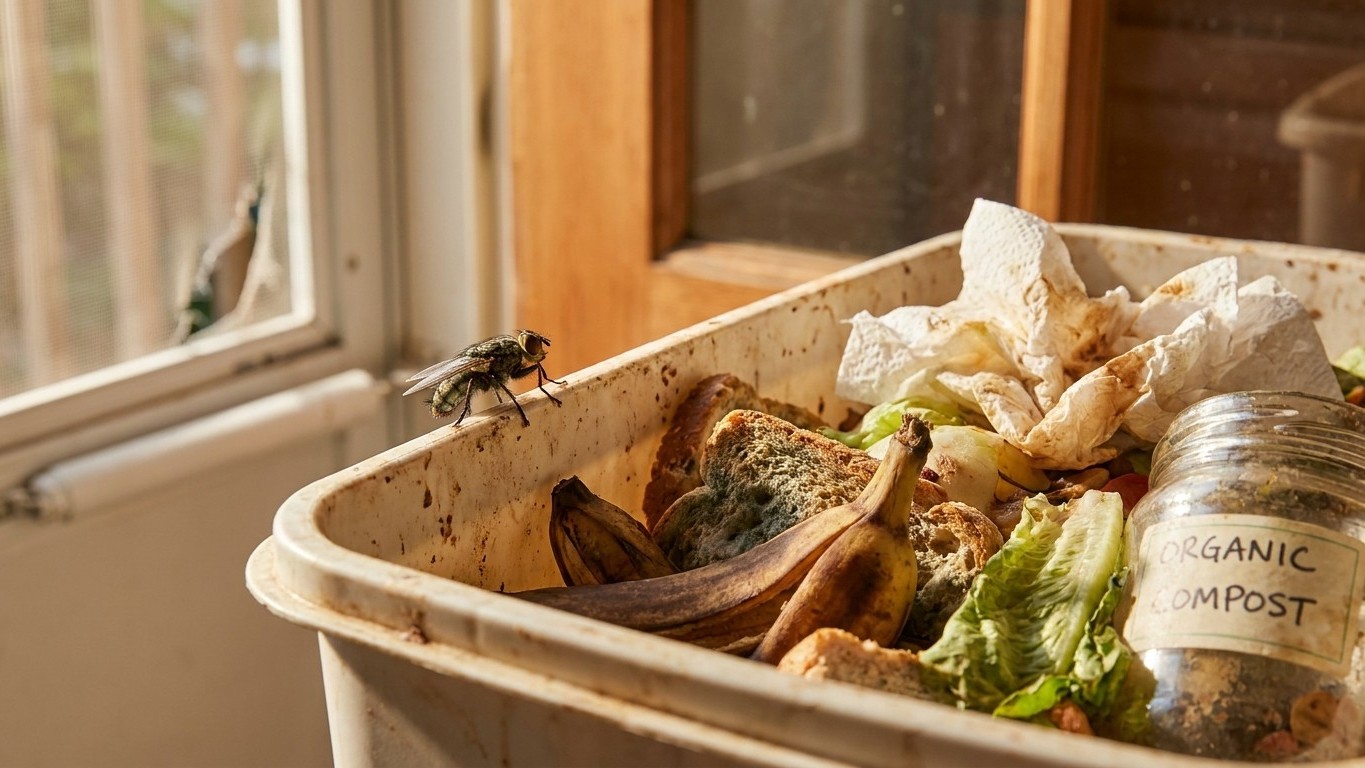

A house fly indoors is not exploring. It’s following a trail of odor left by garbage, pet waste, rotting produce, or a spill nobody wiped up fast enough, and it got in through a gap that’s been open longer than anyone noticed. The fly doesn’t care about your house. It cares about what’s decomposing in it, and about the door or screen that let it walk right past your defenses.
What they are actually looking for

Every indoor pest shows up chasing one of three things: food, water, or shelter. Some species split their attention pretty evenly across all three. House flies don’t. They’re overwhelmingly driven by food, and specifically by decaying organic matter, garbage, pet waste, compost, spilled soda, grease residue on a stovetop, anything with an odor that signals “something is breaking down here.” Water matters far less to them than it does to, say, cockroaches or silverfish. Shelter matters even less, since they’re not trying to nest in your walls or hide in a crack for months. They’re passing through, feeding, laying eggs if the conditions are right, and leaving again if nothing keeps them.
This distinction is the whole reason prevention works differently for flies than it does for a species chasing moisture. A homeowner who fixes a leaky pipe but leaves an open trash can with food residue has solved a problem that never mattered to this particular pest. Flies don’t care about your plumbing. They care about the smell coming from the kitchen trash, the diaper pail, the bird feeder spillage under the window, or the compost bin nobody’s turned in two weeks. A species that comes for water isn’t deterred by cleaning up crumbs, and a species that comes for waste isn’t deterred by fixing a drip.
That’s also why the federal guidance on pest management leads with the indoor environment itself, not with a product. The U.S. Environmental Protection Agency puts it this way: “As a first line of pest control, IPM programs work to manage the crop, lawn, or indoor space to prevent pests from becoming a threat.” For a house fly, managing the indoor space means managing waste, which is the single biggest lever a household has. Sealed trash lids, quickly cleaned spills, pet waste picked up daily, ripe fruit refrigerated instead of left on a counter, none of it is glamorous, but it’s the piece that actually changes whether flies keep showing up or stop bothering.
Open doors deserve their own mention here, because they function almost like a food source in how reliably they bring flies in. A screen door propped open for five minutes while someone carries in groceries is often all it takes, especially if there’s an odor source anywhere near the entrance. The fly isn’t breaking in. It’s walking through an invitation.
How they get in
Most house fly entry points aren’t dramatic. They’re small, ordinary, and usually already there before anyone thinks to check. Working through them in order, from most common to most overlooked, gives a homeowner an actual walk-through rather than a vague warning.
- Gaps at pipes and cables where they pass through exterior walls. Plumbing penetrations, dryer vent lines, and cable or conduit entries are rarely sealed as tightly as the wall around them, and the gap doesn’t need to be large. This species can exploit openings that look too small to matter, which is part of why they’re consistently underestimated as an entry route.
- Door sweeps that no longer sit flush against the threshold. Weatherstripping compresses and warps over time. A quarter-inch gap under a back door, especially one near a trash area or grill, is a standing invitation.
- Window screens with tears, gaps at the frame, or screens left out of a window entirely during warm months. A screen that looks fine from across the room can have a corner pulled loose from the frame, which is enough.
- Vents, particularly attic, soffit, and bathroom exhaust vents, that lack fine mesh covering. These openings are built for airflow, not pest exclusion, and are often the least-checked point in the whole house.
- The flies people carry in themselves, riding in on produce brought from outside, on a garbage bag on its way to the curb, or simply following a person through an open door at the exact moment they’re walking through.
The pipe and cable gaps are the ones worth taking most seriously, because homeowners consistently assume a fly needs a door-sized opening and it doesn’t. A gap that a person couldn’t fit a finger through is often more than enough. Walking the exterior of a house once and running a bead of caulk or a scrap of fine mesh over these small penetrations closes a route that a can of spray never touches.
When they come, and why
Fly activity indoors isn’t random through the year. It tracks a handful of pressures outside: temperature swings, drought, heavy rain, and the natural rhythm of a colony’s life cycle as a season winds down. When outdoor conditions get harsh, whether that’s a stretch of extreme heat, a dry spell that dries up outdoor food and water sources, or the first cold snap of the year, flies look for a more stable environment, and a house offers exactly that. Heavy rain has the opposite effect in a different way: it can flood breeding sites and push adult flies to seek shelter fast, sometimes in large, sudden numbers.
There’s also a life-cycle component that has nothing to do with weather directly. As a colony’s active season comes to an end, activity often spikes before it drops off, a last push of feeding and egg-laying that can look, from inside a house, like things suddenly got worse right before they got quiet again. That pattern confuses a lot of homeowners who assume they did something wrong, when really they’re just watching a natural seasonal curve play out.
None of this maps to a single date or a specific temperature that applies everywhere. A cold snap that triggers indoor fly pressure in one region shows up weeks earlier or later somewhere else, and drought conditions that push flies indoors in one climate zone might barely register in another. This site keeps a page for exactly that regional variation, because the honest answer to “when will I see them” depends far more on local climate patterns than on a national average.
What this means practically is that timing prevention work to a calendar is less useful than timing it to conditions. Sealing entry points and tightening up waste management before a known seasonal shift, whatever that shift looks like locally, does more than reacting once flies are already inside.
Fixing the reason rather than the symptom
A house that offers nothing gets fewer pests. That’s the entire logic this page has been building toward, and it’s also the logic the federal government’s own pest management framework follows, in order. The U.S. EPA describes Integrated Pest Management as “an effective and environmentally sensitive approach to pest management that relies on a combination of common-sense practices.” The sequence matters as much as the description. First comes a threshold: “Before taking any pest control action, IPM first sets an action threshold, a point at which pest populations or environmental conditions indicate that pest control action must be taken.” Then identification: “IPM programs work to monitor for pests and identify them accurately, so that appropriate control decisions can be made.” Only after that does prevention through managing the space come in, followed by “effective, less risky pest controls,” including “highly targeted chemicals, such as pheromones to disrupt pest mating, or mechanical control, such as trapping or weeding.” Broad spraying sits at the very end of that list, described plainly: “Broadcast spraying of non-specific pesticides is a last resort.”
A page, or a household routine, that starts by reaching for a spray has inverted that entire order. It skips the threshold, skips the identification, skips the prevention, and jumps straight to the step meant to be used last. And it doesn’t even solve the underlying problem: a spray treats flies that are already inside a space that still has open garbage, a torn screen, and a gap under the door. New flies keep finding the same conditions, so the treatment has to be repeated, week after week, season after season.
Pesticides are built to be toxic to the pests they target, and the EPA is clear that they can be toxic to people too when they’re used improperly, with children, older adults, and people with compromised immune systems named specifically as more vulnerable. That’s a reasonable argument for making prevention do most of the work, and for reading a product’s label carefully rather than guessing. Anyone with a specific question about a pesticide product can call the National Pesticide Information Center at 1-800-858-7378 rather than relying on a stranger’s opinion online.
For what to actually do about flies that are inside a home right now, the site’s control page walks through the practical steps. This page is the one that keeps them from coming back: seal the pipe and cable gaps, fix the door sweep, patch the screen, mesh the vents, and above all, take away the waste and spilled food that brought them in the first place. Treatment without that groundwork is a cycle. Prevention is what breaks it.
Common questions
Do house flies come inside for water rather than food?
Not primarily. Food, particularly decaying organic matter and garbage, is the dominant draw for this species. Water plays a much smaller role for house flies than it does for pests like cockroaches, so fixing moisture issues alone won’t resolve a fly problem.
Can a house fly get in through a gap that small around a pipe?
Yes. Gaps at plumbing and cable penetrations are consistently underestimated, and openings that look too small to matter are often enough for this species to pass through.
Is a spray the fastest way to deal with flies indoors?
It’s the last step in the federal government’s own recommended order, not the first. The EPA’s IPM framework starts with setting a threshold and identifying the pest, then moves to preventing pests by managing the space, and only then to less risky targeted controls, with broad spraying described as a last resort.
Why do flies seem worse right before they disappear for the season?
That spike often reflects the end of a colony’s active life cycle, a last burst of feeding and egg-laying activity before the season winds down, rather than a sign that conditions indoors have gotten worse.