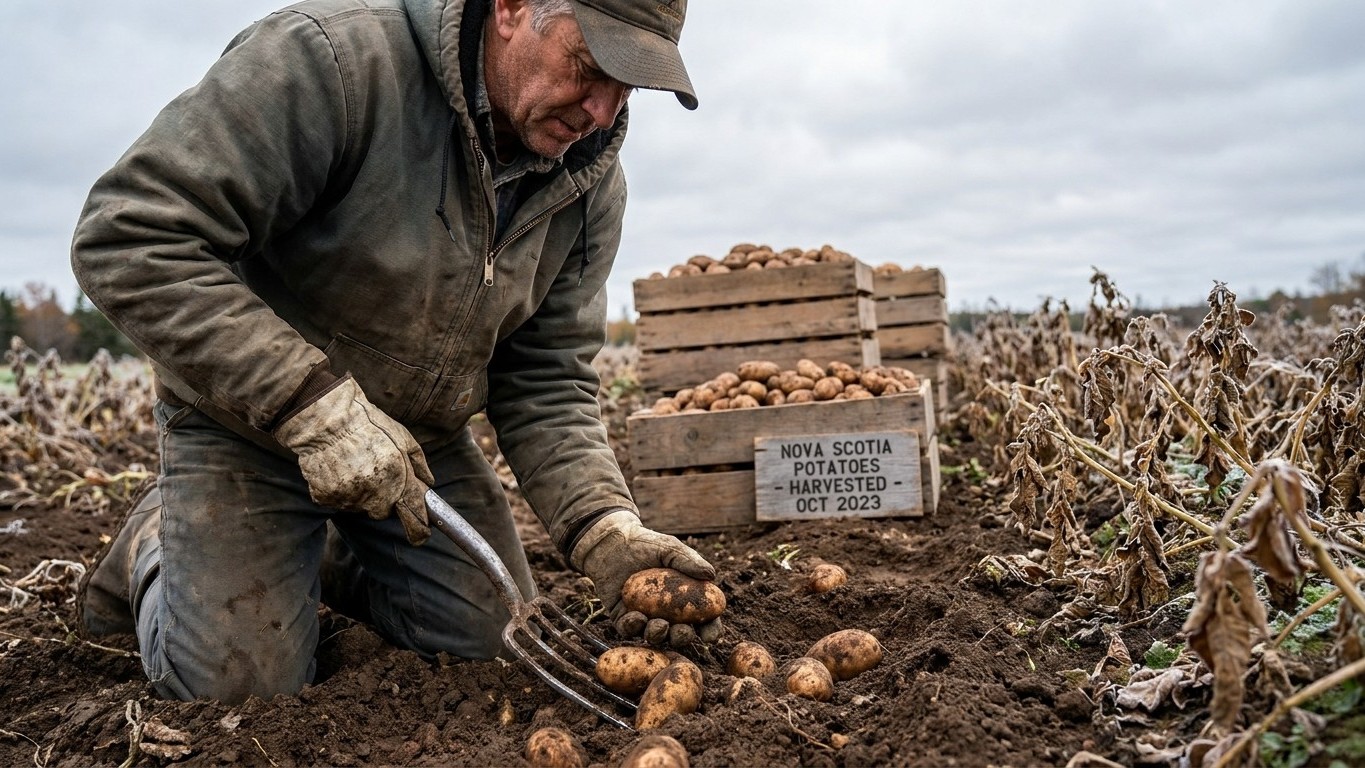

Nova Scotia growers dig potatoes ahead of the average first fall frost, October 18, and move the crop straight into curing before it ever touches a storage shelf. An unheated shed will not carry potatoes through winter here, the coldest month averages down to a mean minimum of 13.3°F, well below the temperature that ruins a potato — so storage has to happen somewhere insulated: a cellar, a basement corner, or a garage bay that never truly freezes.
The short answer
Two numbers set the whole calendar for potato growers in this province. The first is October 18, the average date of the first fall frost at Halifax Stanfield, drawn from the Canadian Climate Normals covering 1981-2010. The second is 13.3°F, the mean minimum temperature of the coldest month at that same reference station. Neither number is a guarantee, the frost date in particular is a midpoint, not a promise. In one year out of two, frost arrives after October 18, sometimes by a week or two, sometimes more. Growers who wait for a “safe” date and treat October 18 as a deadline are gambling on the wrong side of a coin flip half the time.
What that means in practice: potatoes should come out of the ground before the vines are killed by frost, and well before that October 18 midpoint if the season allows it. Foliage that blackens from frost stops feeding the tubers, and tubers left in cold, wet soil after that point are exposed to rot organisms that thrive once the ground cools and dampens. Most growers here watch the vines rather than the calendar: once the tops die back naturally or are killed by an early frost, the tubers are mature enough to lift.
The second figure, 13.3°F, answers a different question: can you just leave the harvested crop somewhere unheated once it is out of the ground? The answer is no. A garden shed, an open porch, or an uninsulated garage in this province will track outdoor air closely enough that indoor temperatures fall well below freezing for stretches of the coldest month. Potato flesh turns to mush once it freezes solid, and there is no recovering it. Both Utah State University Extension and the University of Maine Cooperative Extension set storage targets in the 38°F to 45°F range, comfortably above freezing but well below room temperature. Hitting that band through a Nova Scotia winter means finding or building a space with some insulation and, ideally, a bit of ground contact to buffer the swings that an unheated structure cannot resist on its own.
Curing, and where
Freshly dug potatoes are not ready for the root cellar. Their skins are thin, easily scuffed, and full of small wounds from the fork or the digger. Utah State University Extension recommends curing at 55°F to 60°F with high humidity for two to three weeks before long-term storage, a period that lets the skin thicken and seals over cuts and bruises so the crop doesn’t rot from the inside during the months ahead.
At harvest time in mid-October, outdoor air in Nova Scotia is already trending cool and damp, which rules out curing outdoors on open ground. Finding 55-60°F indoors, though, is usually manageable, since that range sits close to a mild fall room temperature. Here’s the order that works with what this climate offers at digging time:
- Dig on a dry day if at all possible, and let the tubers sit on top of the soil for an hour or two to dry the surface dirt before handling.
- Brush off loose soil by hand rather than washing the potatoes, moisture on the skin at this stage invites the rot that curing is meant to prevent.
- Move the crop indoors immediately to a space that holds roughly 55°F to 60°F: an enclosed, unheated porch in mild fall weather, a basement room away from the furnace, or a heated garage corner all work, provided the space doesn’t swing into the 40s overnight once October cools further.
- Keep the air humid but not wet, a damp cardboard layer under the potatoes or a loosely closed door to hold moisture in works better than an open, drafty space.
- Hold that temperature and humidity for two to three weeks, checking periodically for any tubers that have gone soft, and pulling them out before they spread rot to the rest.
- Once the skins have set (they no longer scuff easily when rubbed with a thumb), move the batch to its winter storage spot.
An open porch loses its value fast once nighttime lows start dropping toward the 30s, which can happen even before that October 18 average frost date. A dry basement corner away from heating ducts is usually the most reliable curing spot in this province, since it holds a steadier temperature than anything exposed to outside air.
Storing through this winter
Once cured, potatoes need a different environment than the one that cured them. Utah State University Extension lists 40°F to 45°F, in the dark, as the storage target. The University of Maine Cooperative Extension gives a tighter figure for longer-term keeping: 38°F at 95% relative humidity. Both sources agree on the essentials, cold, dark, and humid, but never near freezing and never warm enough to wake the tubers into sprouting.
Nova Scotia’s winter makes hitting that band harder than it might sound. With the coldest month averaging a mean minimum of 13.3°F, any storage space with meaningful exposure to outside air will spend long stretches well under the 38-45°F target, cold enough to freeze the crop solid rather than just chill it. A detached, uninsulated shed is essentially a freezer for four or five months of the year here. On the other end, a basement room too close to a furnace or heating duct can easily sit in the 60s, which is warm enough to trigger early sprouting and shrivel the tubers from the inside out as they spend stored energy growing shoots nobody wants.
The spaces that actually thread this needle in this climate share a few traits: some insulation from outside air, some contact with the ground (which stays warmer than the air once the frost sets in), and no direct heating source nearby. A cellar dug into a bank, an insulated crawl space, or a basement room with an exterior wall but no ductwork running through it tend to land closest to that 38-45°F range through the depths of winter. Root cellars built specifically for this purpose, with a vent that can be opened on mild days and closed during a cold snap, give growers the most control, letting them nudge the space warmer or colder as outdoor conditions change through the season.
Darkness matters as much as temperature. Light exposure turns potato skins green and triggers solanine production, a compound that makes the tubers taste bitter and, in enough quantity, unsafe to eat. A storage space that meets the temperature target but sits near a window undoes half the benefit.
What goes wrong here
- Leaving potatoes in the ground past frost damage to the vines. Frost-killed foliage stops feeding the tubers and signals it’s time to dig, but tubers left in cold, saturated soil afterward pick up rot organisms fast. Dig as soon as the vines die back, rather than waiting for a calendar date that may already be too late in a given year.
- Curing outdoors once fall cools past mid-October. An open porch that felt mild during digging season can drop into the 30s overnight within a couple of weeks, undoing the curing process. Move curing indoors to a steadier room once evening temperatures start falling.
- Storing in an unheated shed or garage. With the coldest month averaging a mean minimum of 13.3°F, an uninsulated outbuilding will freeze the crop solid at some point most winters. Choose a space with insulation or ground contact instead, a basement, an insulated cellar, or a buffered crawl space.
- Storing too close to a heat source. A furnace room or a spot near heating ducts can sit well above 45°F, prompting early sprouting and soft, shriveled tubers by midwinter. Pick a corner of the basement away from ductwork, or partition off a cooler section.
- Storing in light. A well-chilled space near a window or under a bare bulb left on still turns skins green over time. Keep the storage area dark, covering bins or using a windowless room.
- Skipping the curing period entirely. Potatoes moved straight from the field into cold winter storage without two to three weeks at 55-60°F, as Utah State University Extension recommends, tend to develop rot at wound sites that never had the chance to seal over.
- Ignoring damp conditions during a wet harvest. A rainy stretch around digging time is common in this province by mid-October. Potatoes dug wet and stored wet, without adequate drying and air circulation, are far more prone to soft rot regardless of temperature control, and appropriate fungicide use during the growing season doesn’t compensate for poor post-harvest handling.
Common questions
When should potatoes be dug in Nova Scotia?
Growers generally dig once the vines die back naturally or are killed by frost, rather than waiting for a fixed date. Since the average first fall frost at Halifax Stanfield is October 18, and that figure is a midpoint rather than a guarantee, some years call for digging earlier and some later, depending on how the vines respond.
Can potatoes be stored in a garage over winter in Nova Scotia?
Only if the garage is insulated enough to stay within the 40-45°F range that Utah State University Extension recommends. Given a coldest-month mean minimum of 13.3°F, an uninsulated garage will likely freeze stored potatoes at some point during the winter.
How long does curing take before storage?
Utah State University Extension recommends two to three weeks at 55°F to 60°F with high humidity before moving potatoes into long-term storage.
What temperature and humidity should potatoes be stored at once cured?
Utah State University Extension recommends 40°F to 45°F in the dark, while the University of Maine Cooperative Extension specifies 38°F at 95% relative humidity for longer-term storage. Either target keeps tubers from freezing, sprouting, or drying out.