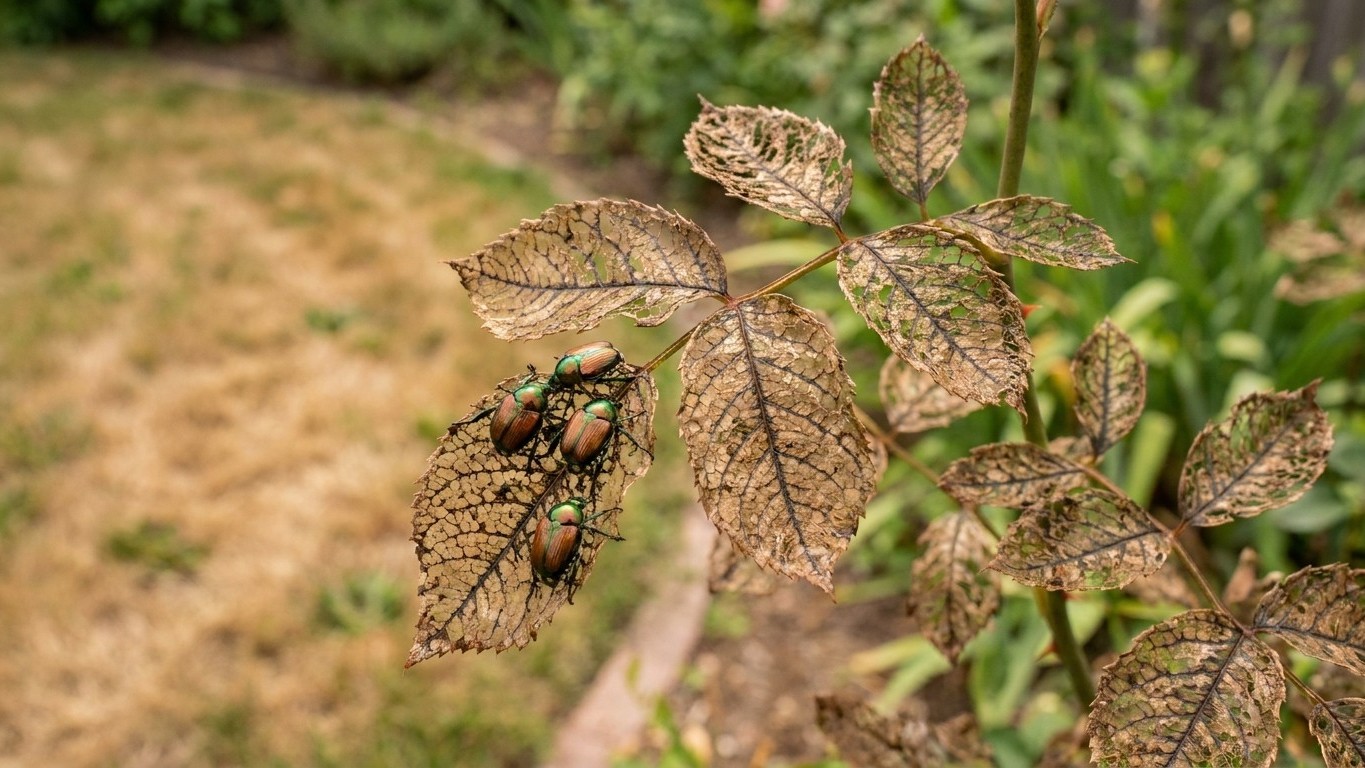

The tell-tale sign is skeletonized leaves, veins left standing alone like lace, on roses, beans, grapevines, or linden trees, paired with brown, spongy patches of lawn that peel back like carpet. That combination, foliage damage above ground and root damage below, points to one insect working two jobs at once: the Japanese beetle, Popillia japonica.
What the damage looks like
From across the yard, the first clue is usually a rose bush or a young apple tree that looks scorched, even though nothing has been sprayed and the weather has been fine. Leaves take on a brown, papery cast from a distance, as if someone held a lighter too close to the canopy. Walk closer and the scorched look resolves into something more specific: leaf tissue is gone between the veins, leaving a skeleton of ribs where a solid leaf used to be. This is the signature of adult Japanese beetles feeding in groups, and it is different from a chewed-edge or a punched hole. They eat the soft tissue and leave the tougher veins behind, which is why the damage reads as lace rather than as random bites.
Roses tend to show it worst on flower buds and open blooms, where petals get shredded along with the foliage. Grapevines, linden and birch trees, and beans often show whole clusters of leaves reduced to brown lace within a matter of days when a feeding aggregation settles in, because adult beetles release a scent that draws more beetles to an already-damaged plant. That clustering is part of the identification: healthy, undamaged leaves sit right next to skeletonized ones, rather than the more even, scattered damage typical of many other leaf-feeders.
The other half of the damage, underground
The second sign shows up in turf, not on ornamental plants, and it is easy to miss the connection. Irregular brown patches appear in lawns, often in late summer or fall, and the grass in those patches lifts away from the soil in a loose mat, almost like a rug that was never tacked down. That loose, rootless feel is the grub stage at work, chewing through turfgrass roots just below the surface. Skunks, raccoons, and birds sometimes do the diagnostic work for you by tearing up those same patches at night, hunting for the grubs as a food source. Seeing both problems on the same property, lace-eaten roses in July and spongy turf in September, is a strong indicator that one insect population, not two, is responsible.
What it is confused with
Several other insects produce damage that looks similar enough to send a homeowner toward the wrong response, whether that means an unnecessary spray, a treatment aimed at the wrong life stage, or, worse, treating a lawn problem that was never an insect problem at all.
| What it could be | How to tell them apart | Why it matters |
|---|---|---|
| Rose chafer (Macrodactylus subspinosus) | Tan or fawn-colored beetle with noticeably long, spindly legs, versus the Japanese beetle’s metallic green body with copper-brown wing covers and small tufts of white hair along the abdomen | Rose chafers concentrate in areas with sandy soil and their grubs feed differently; treating for the wrong species wastes a season’s timing |
| June beetles / May beetles (Phyllophaga spp.) | Larger, dull brown, and active at night rather than during the day; their grubs are bigger and take longer to mature underground | Nighttime beetles chewing notches, rather than skeletonizing, points away from Japanese beetle and toward a different grub timeline for lawn treatment |
| Green June beetle (Cotinis nitida) | Larger and more uniformly metallic green, and it flies low over lawns in a loud, buzzing pattern; its grubs feed mostly on organic matter, not living turf roots | This species does far less root damage, so aggressive turf treatment aimed at it is often unnecessary |
| Drought stress or dog urine spots | No loose, rootless mat when you tug the grass; the soil underneath is intact and roots are still attached | This is the most common wrong diagnosis: homeowners treat for grubs when the real issue is watering or a pet’s habits, and no insecticide will fix it |
The drought-stress mix-up deserves particular attention, because it leads to the most wasted effort. A lawn stressed by heat and inconsistent watering can brown in patches that look, from a distance, exactly like grub damage. The only reliable way to separate the two is physical: grub-damaged turf lifts away with almost no resistance, since the roots have been eaten off, while drought-stressed turf stays anchored even though it looks discolored.
Where to look to confirm
Confirming the adult stage means checking plants during the part of the day when beetles are actually feeding, which is daylight hours, with activity typically heaviest in the warmer part of the afternoon. Look first at the top and outer leaves of the plant, in full sun, since Japanese beetles favor the sunniest, most exposed foliage before moving inward. Roses, grapevines, linden trees, and beans are the classic places to check, and a cluster of skeletonized leaves is often surrounded by other beetles still actively feeding nearby, since the aggregation behavior means finding one beetle usually means finding several more within reach.
Flip a few damaged leaves over and check the underside as well as the top, and look at flower buds directly, since beetles often tunnel into unopened rose buds where the damage isn’t visible until the bud fails to open properly. A hand lens isn’t necessary. The adult beetle is roughly the size of a coffee bean, easy to see with the naked eye, and its metallic green head paired with copper wing covers is distinctive enough that misidentifying the adult stage is uncommon once you know what to look for.
Confirming the grub in turf
For the underground stage, the method is physical rather than visual: cut a section of turf where the ground feels spongy or where a patch has browned, and peel it back like a piece of carpet. Grubs will be visible in the top few inches of soil, curled into a C-shape, whitish or grayish, with a distinct brown head capsule. Checking several spots across a suspect area gives a better picture than a single sample, since grub populations are rarely spread evenly across a lawn.
What is deliberately left out here is a specific number to compare against. Extension services set their own action levels for how many grubs per square foot justify treatment, and those thresholds shift depending on soil type, turfgrass species, and regional grub pressure, so a number that applies in one state can be misleading in another. The right move is confirming presence and general density, then checking guidance specific to your area rather than relying on a single nationwide figure.
What to do once you are sure
Once skeletonized foliage and spongy turf both point to Japanese beetle, timing becomes the next question, and timing is exactly where this species varies most by location. Adult emergence, egg-laying, and grub development all shift by weeks depending on regional climate and soil temperature, which is why a treatment window that works in one part of the country can miss the mark entirely somewhere else. The site’s life-cycle page walks through each stage in sequence and explains when adults are active, when eggs are laid, and when grubs are feeding closest to the surface, all of which determines when any intervention actually has a chance of working.
Biological control is worth understanding here, because for this species it genuinely outperforms a reflexive spray. Two natural enemies matter most: the spring tiphiid wasp (Tiphia vernalis), which parasitizes grubs underground, and the winged tachinid fly (Istocheta aldrichi), which lays eggs directly on adult beetles and whose larvae kill the host beetle from the inside. Milky spore disease, caused by a naturally occurring soil bacterium, can also suppress grub populations over several seasons once established, though it works slowly and unevenly depending on soil conditions. Preserving these natural enemies means avoiding broad, unnecessary insecticide applications that kill parasitic wasps and flies along with the target pest, which is one more reason accurate identification matters before reaching for any product.
For what actually works once identification and timing are both confirmed, the site’s control page breaks down the options for both the adult and grub stages, including which approaches fit a home garden versus a larger lawn. And because emergence dates and treatment windows are set locally, the territory page for your state names the university extension service responsible for that guidance, along with a direct link to their current recommendations, which is a more reliable source than any general timeline.
Common questions
Can Japanese beetle damage kill a plant outright?
Repeated, heavy skeletonizing weakens a plant and reduces flowering or fruiting, but most established shrubs, roses, and trees survive a season of feeding. Young plants or those already stressed by drought are more vulnerable to lasting damage.
Does grub damage always mean Japanese beetle, and not another species?
No. Several white grubs, including June beetle and masked chafer larvae, look similar and cause comparable turf damage. Checking the size, head capsule pattern, and the rear-end hair pattern of the grub, or simply waiting to see which adult beetle emerges, helps confirm the species.
Why do Japanese beetles show up on the same plants year after year?
Feeding beetles release an aggregation scent that draws more beetles to already-damaged foliage, and female beetles often lay eggs in turf near the same host plants, which keeps both problems concentrated on one part of a property season after season.
Is it worth treating the lawn if I only see damage on my roses?
Not necessarily right away. The two stages are connected, but grub density in turf and adult feeding pressure on ornamentals don’t always track evenly on a single property. Confirming grubs are actually present in the lawn, rather than assuming from leaf damage alone, avoids treating turf that doesn’t need it.