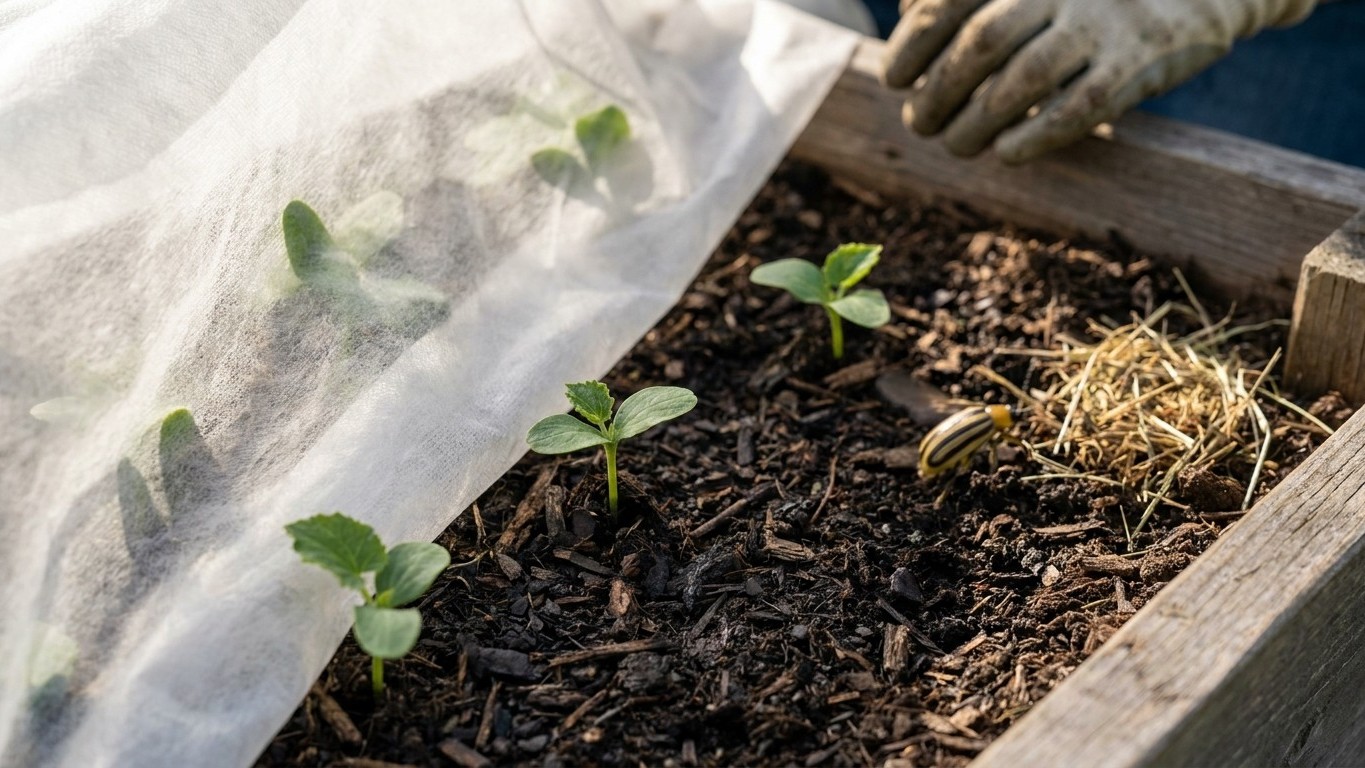

The short answer: timing and biology beat any spray you can buy. Physical barriers during the first two weeks after planting, hand removal on small plots, and preserving natural predators do more for striped cucumber beetle control than most bottled products. Chemical treatment only earns its place when populations spike past what covers and cleanup can handle, and even then, what’s legal to use depends entirely on where you garden.
Timing beats product
Here’s what most advice skips: a treatment applied at the wrong moment in the striped cucumber beetle’s life does nothing, no matter how strong it is. Spray adult beetles after they’ve already fed for a week and you’ve protected nothing. Treat soil for larvae after adults have already laid eggs and moved on, and you’re chasing a stage that’s already left the building.
The feeding damage itself, chewed leaves, scarred rinds, nibbled blossoms, is almost a side issue. What actually kills plants is bacterial wilt, caused by Erwinia tracheiphila, which the beetle carries in its gut and injects into wounds as it feeds. A cucumber or squash plant can look fine one week and collapse the next, wilting from a single vine outward, because the bacteria clogs its vascular system. Once a plant shows that wilt pattern, no product reverses it. The only leverage is preventing the beetle from feeding on young, vulnerable tissue in the first place.
That’s why every tactic in this article is organized around the insect’s stage, not around a calendar date that works the same everywhere. Emergence timing, the number of generations per season, and how long adults stay active before egg-laying all shift by region and by year’s weather. Before doing anything else, check the striped cucumber beetle life cycle page on this site. It breaks down exactly when adults emerge, when they mate and lay eggs at the base of plants, and when larvae feed on roots underground, the stage most home gardeners never see. Get that sequence wrong and every tactic below loses most of its value.
One practical marker growers use: seedlings are most at risk in the two to three weeks after they emerge or transplant, before they’ve grown enough leaf tissue to absorb some feeding without real harm. That window, not a fixed date on the calendar, is what determines when protection matters most.
What works without a product
Several tactics need no label, no permit, and no trip to the store, but they only work if timed to the beetle’s behavior.
- Row covers and barriers. Lightweight fabric or mesh laid over seedlings right at planting, and sealed at the edges with soil or stakes, blocks adults from ever reaching the leaves. It has to come off once flowers open, though, or pollinators can’t reach the blossoms either. Miss that removal window and you trade one problem for another.
- Hand removal. Early morning, when beetles are sluggish from cool temperatures, is the time to knock them into a jar of soapy water. It’s tedious and only realistic on a few dozen plants, but on a home garden scale it can meaningfully cut numbers if done daily during peak emergence.
- Trap crops. Planting a more attractive squash variety a short distance away, and treating or removing beetles concentrated there, pulls pressure off the main crop. This only pays off if the trap crop goes in early enough to bloom and attract beetles before your main planting is vulnerable.
- Delayed or staggered planting. Pushing transplant dates past the first heavy emergence wave, when local conditions allow it, means seedlings meet fewer beetles during their most fragile stage. It’s a gamble against your own growing season length, so it fits warmer regions better than short ones.
- Fall cleanup. Removing old vines, fruit debris, and mulch after harvest strips away the shelter adults use to overwinter nearby. This only matters if it happens before winter, not the following spring when beetles have already found a place to hide.
None of these are quick fixes. Covers demand attention at exactly the right moment, hand removal demands daily repetition, and cleanup demands follow-through in a season when most gardeners have already moved on mentally. They work because they interrupt a specific stage, not because they’re easy.
The allies you already have
A garden that hasn’t been sprayed broadly usually has help already working against striped cucumber beetle without any effort from you. Ground beetles, active at soil level, prey on beetle eggs and newly hatched larvae before they ever reach the roots. Soldier beetles and assassin bugs take adults and eggs on the plant itself. Parasitic tachinid flies lay eggs on adult beetles, and their larvae develop inside the host, eventually killing it, a slower but real check on adult numbers over a season. Spiders and predatory mites add pressure at the margins, especially in gardens with some undisturbed ground cover or mulch where they can shelter.
None of these predators show up in the numbers needed to eliminate a heavy beetle population on their own. What they do is keep pressure low enough, season over season, that populations don’t build to the point where a plant collapses from wilt before you notice anything wrong.
The part that gets skipped in most advice: a broad-spectrum insecticide applied against the beetles kills these predators just as thoroughly as it kills the pest. Ground beetles living in soil, tachinid flies searching for hosts, soldier beetles patrolling foliage, all die from the same application meant for the cucumber beetle. The beetle population often rebounds faster than its predators do, because beetles reproduce quickly and can fly in from neighboring fields, while a wiped-out predator population takes a full season or more to rebuild. That’s the exact mechanism behind a second, worse outbreak a few weeks after a spray that seemed to work at first: it’s not that the product failed, it’s that it removed the one thing keeping the population in check long-term.
Preserving these allies costs nothing extra. It means avoiding routine, preventive spraying on a schedule, leaving some mulch or leaf litter where ground beetles shelter, and reserving any broad treatment for situations where damage has actually crossed a level that matters, not just because beetles are visible.
When a product is the answer
There’s an honest case for chemical control, and it holds up under specific conditions. Seedlings and young transplants, in that first two-to-three-week window before they’ve built enough leaf area to tolerate feeding, are the stage where treatment does the most good. Older, established plants with full canopies usually shrug off adult feeding without measurable yield loss, which makes treating them mostly wasted effort and wasted money.
The timing has to match the beetle’s stage, not a general worry that beetles are around. A treatment aimed at adults feeding on foliage does nothing against larvae already established on roots underground, and the reverse is true too. This is the same logic from the first section: product choice matters far less than hitting the right stage at the right moment, which is exactly what the life cycle page is built to help identify.
What’s legal and effective to use is not the same from one state to the next, and it changes between seasons as products get reevaluated, restricted, or replaced. A product labeled and permitted in one region may be restricted or unavailable in another, and application timing tied to degree-days or local emergence dates varies by climate zone. There is no single national answer here, and any source claiming otherwise is oversimplifying a system that’s deliberately regional.
The right move is checking with your state’s cooperative extension service, the authority that tracks local emergence timing, current action thresholds, and which products are currently permitted in your area. This site carries a dedicated page for regional control options that names the extension resources and current guidance for different territories, built specifically because a single blanket recommendation would be wrong for a meaningful share of readers. Start with identification and life stage, confirm timing against local data, and only then decide whether a treatment is warranted or whether the barriers, removal, and predator conservation covered above are already doing the job.
Common questions
Does striped cucumber beetle only affect cucumbers?
No. Adults feed on squash, melons, pumpkins, and other cucurbits, and they’re drawn to blossoms and young fruit across that whole family of plants, not just cucumber vines specifically.
Can one beetle really kill a whole plant?
A single feeding beetle rarely kills a healthy, established plant on its own. The real danger is bacterial wilt transmission on young seedlings, where even light feeding by an infected beetle can introduce Erwinia tracheiphila and cause the plant to collapse within days to weeks.
Why did beetles come back worse after I sprayed?
Broad-spectrum products often kill the ground beetles, tachinid flies, and other predators that were suppressing the population, while surviving or newly arriving beetles reproduce quickly. The pest rebounds faster than its natural enemies do, which can make numbers look worse a few weeks later.
How do I know if it’s really this beetle and not another pest?
Striped cucumber beetle (Acalymma vittatum) has a distinct pattern: yellow-to-orange body with three bold black stripes running down its back, roughly a quarter inch long. Confirming that identification before choosing a control method matters, since other cucurbit pests require different timing and different responses.