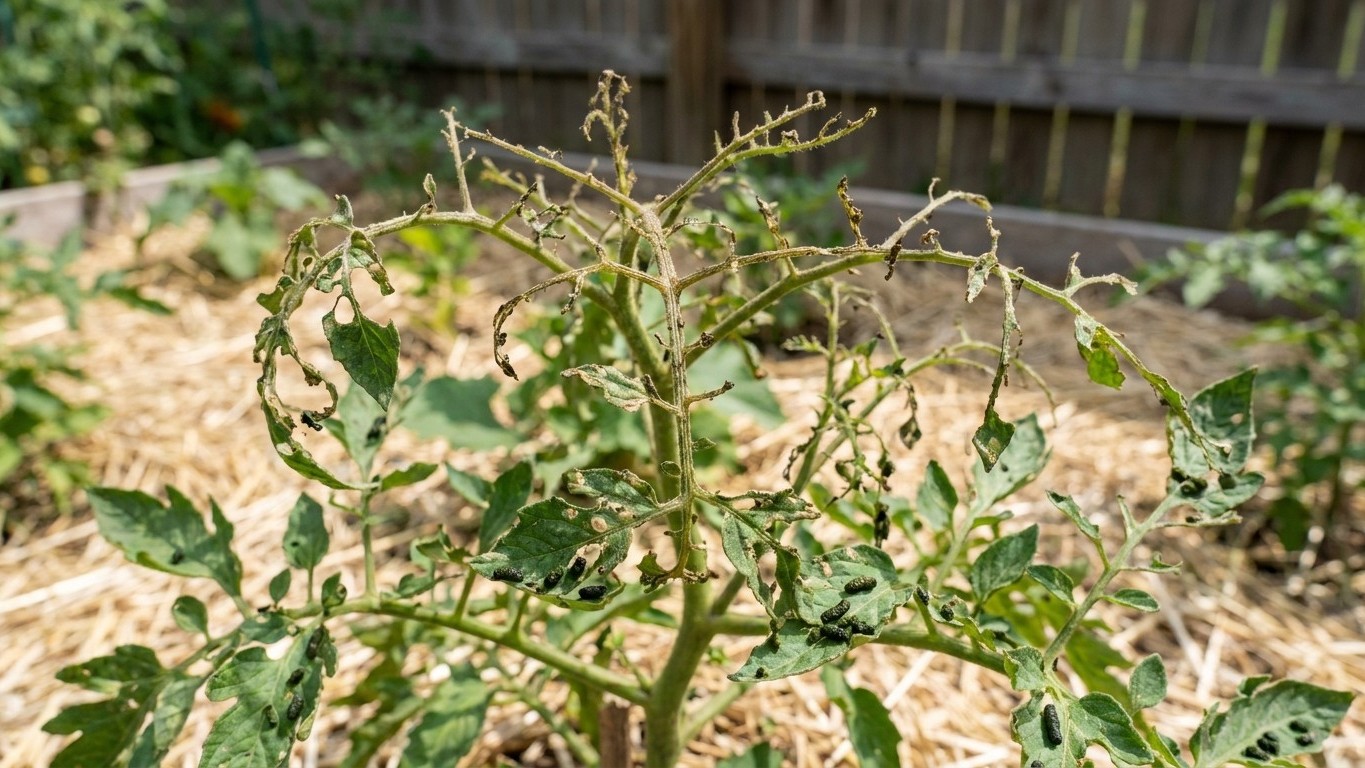

Skeletonized leaves near the top of the plant, chewed-off stems where the leaflets used to be, and small dark pellets scattered on the foliage below are the classic signs of tomato hornworm damage. The caterpillar itself, despite being one of the largest garden pests you’ll ever meet, is often the last thing you spot. Its green body blends so well with tomato and pepper foliage that most gardeners find the damage days before they find the culprit.
What the damage looks like
Step back and look at the plant as a whole first. A tomato or pepper plant under attack shows a lopsided, gutted look, usually starting near the top growth where the foliage is tender. Whole branches can go from leafy to bare in what feels like overnight, while the lower half of the same plant looks untouched. That top-down pattern is one of the first tells, because the caterpillar tends to work its way through the newest, softest leaves before moving down.
Move in closer and the picture sharpens. Leaves aren’t just nibbled at the edges, they’re gone entirely, sometimes leaving nothing but the stripped midrib sticking out like a bare wire. Scattered across the remaining leaves, and often on the ground or mulch directly below the damage, you’ll find dark green to black droppings, roughly the size of a peppercorn. Gardeners frequently notice this frass before they notice the insect responsible for it, since the pellets are conspicuous against pale mulch or a patio stone.
The insect behind it
The species responsible is the tomato hornworm (Manduca quinquemaculata), a caterpillar that can stretch close to four inches long by the time it’s done feeding. A close relative, the tobacco hornworm, causes the same kind of damage on the same plants, so distinguishing the two species matters far less than confirming a hornworm is present at all. What makes this pest unusual is the mismatch between its size and how easily it disappears. A caterpillar that big should be obvious, yet its lime-green body, faint white stripes, and habit of resting motionless against a stem let it vanish in plain sight.
Fruit damage, when it happens, shows up as deep gouges on tomatoes and peppers still on the vine, usually on the side facing the plant’s interior rather than the sun. Not every infested plant reaches that point. In many gardens, natural enemies intervene before the caterpillar does serious harm to fruit, which is why checking for parasitism, covered further down, is worth doing before reaching for any treatment.
What it is confused with
Because the frass and the leaf stripping look dramatic, it’s tempting to assume the worst pest is at work, or to blame something else entirely. Several other garden problems produce damage that overlaps with hornworm feeding, and treating the wrong one wastes effort or, in at least one case below, causes an injury of its own.
| What it could be | How to tell them apart | Why it matters |
|---|---|---|
| Fall armyworm | Larvae are smaller, striped lengthwise, and cluster in the whorls of new growth rather than resting singly on a stem; frass pellets are noticeably smaller than hornworm droppings | Armyworms often need different timing for control since they move in groups and target seedlings, unlike the solitary hornworm |
| Blister beetle | Adults are visible in clusters on foliage, narrow-bodied and often striped or metallic, with no frass pellets accompanying the damage | Handling blister beetles with bare hands can cause skin blistering from a chemical they release, something a hornworm never does |
| Tomato fruitworm (corn earworm) | Damage centers on the fruit itself, boring in through the stem end, rather than stripped stems and skeletonized leaves | Fruitworm larvae hide inside the fruit, so foliage-focused hand removal used for hornworms won’t reach them |
| Early blight or bacterial spot | Dark specks on leaves are flat lesions embedded in the tissue, not raised pellets that can be brushed off | Mistaking hornworm frass for disease spots leads some gardeners to spray a fungicide that does nothing for the actual pest |
That last mix-up is the one worth flagging most. Frass sitting on the leaf surface looks superficially like the speckled lesions of a fungal or bacterial disease, especially in low light or on a quick pass through the garden. A fungicide applied in response won’t touch a hornworm, and the caterpillar keeps feeding while the gardener assumes the treatment is working. Brushing a suspicious dark speck with a finger settles it fast: frass falls away loose, a lesion doesn’t.
Where to look to confirm
Confirming a hornworm is behind the damage means checking the right part of the plant at the right time, not just glancing at the leaves. Early morning or evening tends to be the easiest window, since the caterpillar is often still positioned where it fed overnight, before the day’s heat pushes it into deeper cover.
Start at the top third of the plant, where the newest growth is, and scan the stems rather than just the leaves. Hornworms rest lengthwise along a stem, body oriented the same direction, and their pale green color matches an unripe tomato stem closely enough that a slow, deliberate scan works better than a quick scroll of the eyes. Check the undersides of the remaining leaves too, since the caterpillar sometimes tucks against the leaf’s midrib during the brightest part of the day.
Frass is the easier clue to spot first, and it doubles as a locator. Pellets accumulate directly below the feeding site, so tracing them upward, leaf by leaf, usually leads straight to the caterpillar responsible. On the ground or mulch, a scattering of pellets under a particular plant, with none under its neighbors, narrows the search to that one plant fast.
What stage you’ll actually find
By the time damage is visible, the caterpillar is typically in a later larval stage, since the smallest instars do little visible harm. You won’t find a pupa on the plant. Hornworms drop to the soil to pupate, burrowing in rather than forming a cocoon on the foliage, so a caterpillar you can’t locate on the plant may have already moved on to the ground beneath it. This site doesn’t set a fixed count or action threshold for when damage becomes worth treating, because that call is made by university extension services and it varies by state and by season. The territory-specific page on this site names the extension office to contact for that guidance.
What to do once you are sure
Once a hornworm is confirmed, the next two questions are timing and method, and both are covered elsewhere on this site rather than repeated here. The life-cycle page lays out when adults emerge and lay eggs, which determines when scouting actually pays off, and the control page covers what has been shown to work against this pest without wasting effort on approaches that don’t.
One thing worth checking before doing anything else: look at the caterpillar’s back for small white oval cocoons, standing upright like grains of rice. That’s the work of a parasitic wasp, Cotesia congregata, which lays its eggs inside the hornworm. A caterpillar carrying these cocoons is already dying and will soon release a new generation of wasps that seek out other hornworms in the same garden. Removing or destroying a parasitized caterpillar wipes out that free control before it can do its job, so the better move is to leave it in place.
Preserving that natural control matters more than it might seem, since broad-spectrum insecticides applied for the hornworm itself can also kill the wasps and any other predators, including birds, that would otherwise keep the population in check over the rest of the season. Anyone dealing with hornworm damage in a specific state should check the local page on this site, which names the extension service for that territory and links to its current guidance on timing and products.
Common questions
Can tomato hornworm damage tomato fruit directly, not just leaves?
Yes. Once foliage is stripped, hornworms will feed on exposed fruit, leaving deep gouges usually on the side facing the plant’s center rather than the sun-exposed side.
Are the caterpillars poisonous or dangerous to touch?
No. The horn at the rear end looks alarming but is soft and harmless, and the caterpillar doesn’t sting or release any irritating substance, unlike the blister beetle it’s sometimes confused with.
How fast can a hornworm defoliate a tomato plant?
A single large larva can strip a significant portion of a plant’s upper foliage within a matter of days once it reaches its final growth stage, which is why the top-down damage pattern often seems to appear suddenly.
Does tomato hornworm damage always mean I have hornworms and not another pest?
Not necessarily. The table above covers the main look-alikes, and checking for frass pellets alongside stripped stems is the fastest way to rule out armyworms, blister beetles, or disease before assuming a hornworm is responsible.