
Tomato hornworm larvae hatch from eggs, feed for three to four weeks as caterpillars, pupate in the soil, and emerge as large moths that start the cycle again. In most of the country that whole sequence runs once or twice between late spring and early fall, with exact timing tied to local soil warmth rather than a fixed date. Gardeners almost never see the eggs or the moth; they see the damage the larva leaves behind.
The stages, in order
Four stages make up the life of Manduca quinquemaculata, the tomato hornworm, and each one lives in a completely different place. The female moth glues single, round, pale green eggs to the underside of tomato leaves. They’re small, smooth, and easy to miss even when you’re looking for them, which is one reason infestations seem to appear overnight.
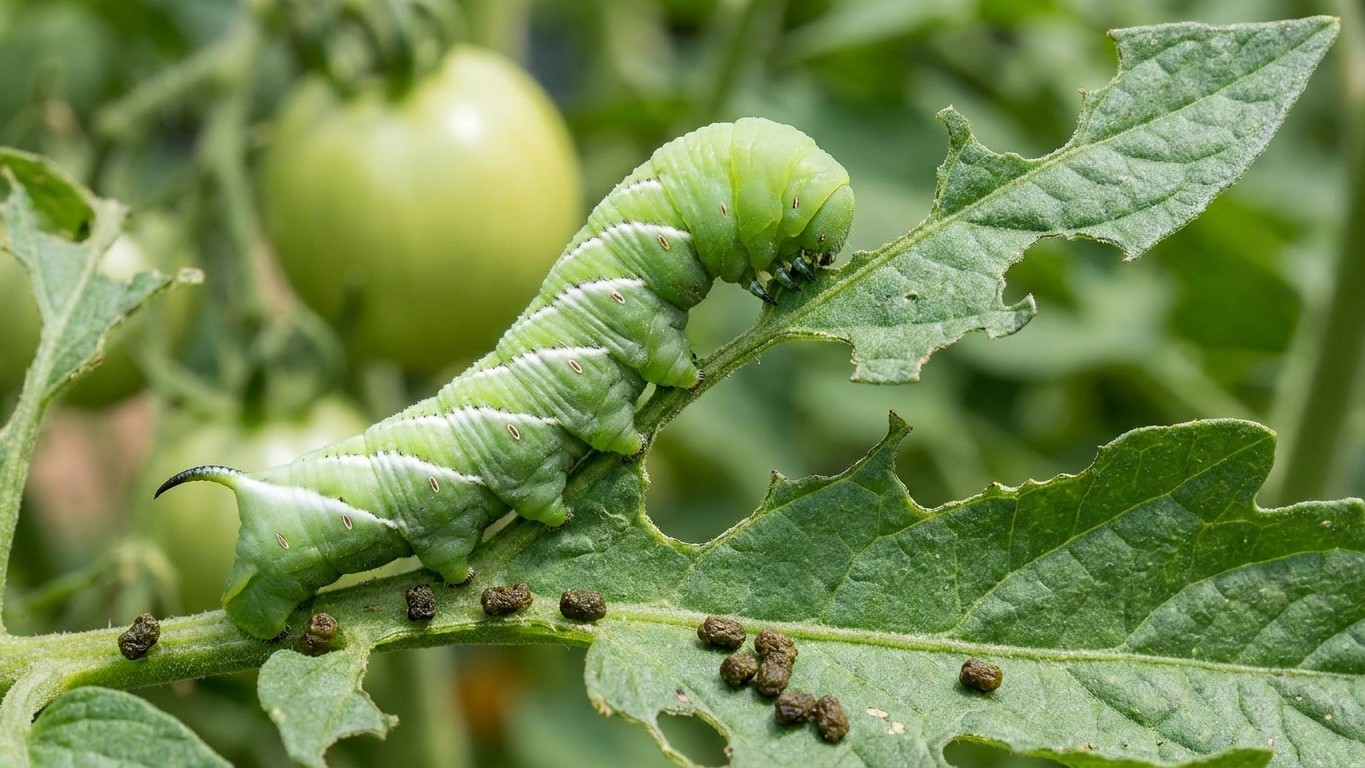
The larva is the stage that does every bit of the visible damage, and it’s the one gardeners actually find, usually by the pile of dark, pellet-shaped droppings on a leaf below a stripped branch. It hatches tiny, then molts through several instars over three to four weeks, growing from a sliver to a caterpillar the length of a finger. Full-grown, it’s thick-bodied, bright green, marked with pale diagonal stripes down each side, and tipped with a curved black or reddish horn on the rear end that looks threatening but is harmless. Despite that size, a hornworm’s coloring blends so well with tomato foliage that many gardeners spot the stripped stems before they ever spot the worm itself.
When the larva finishes feeding, it drops to the ground and burrows a few inches into the soil to pupate. The pupa is dark reddish-brown, several inches long, and easy to recognize by a curved handle-like structure at one end, a sheath protecting the developing moth’s long feeding tube. This stage is entirely underground and entirely invisible from the surface, which is exactly why soil disturbance matters later in the season.
The adult that eventually emerges is a five-spotted hawk moth, a heavy-bodied, gray-brown flyer with a wingspan that can stretch close to five inches. It’s active at dusk, feeds on flower nectar rather than foliage, and does no garden damage at all. Most gardeners never connect this moth, which looks almost like a small hummingbird at dusk, to the caterpillar that ate their tomato plants weeks earlier.
One more player belongs in this stage-by-stage picture: parasitic braconid wasps, particularly Cotesia congregata. Females lay eggs inside a feeding hornworm, and the wasp larvae eventually emerge to spin small white cocoons across the caterpillar’s back, a sight many gardeners mistake for eggs or a fungus. A hornworm carrying those cocoons is already dying and has stopped feeding, and it should be left in place rather than destroyed, since it’s doing more pest control than any spray at that point.
When it appears, and why that varies
Hornworm moths don’t watch a calendar. Their emergence from overwintering pupae depends on accumulated soil and air warmth, the same accumulated-degree logic that drives most caterpillar pests, so the “start date” for hornworm season shifts by weeks depending on how quickly a region’s spring warms up.
That’s why a gardener in a warm southern state can be finding half-grown larvae while a gardener in the upper Midwest hasn’t seen a moth yet. It isn’t that one region has a worse hornworm problem than the other; it’s that the insect’s internal clock runs on temperature, and temperature accumulates at a different pace almost everywhere. A mild, early spring can pull emergence forward by a couple of weeks compared to a cold, late one in the very same county, which is part of why relying on last year’s timing to predict this year’s often backfires.
Soil temperature specifically matters more than air temperature for this insect, since the pupa sits below ground and only responds once the surrounding soil crosses its own warming threshold. A cool, wet spring that keeps soil temperatures suppressed can delay emergence even when air temperatures feel warm during the day. Mulched beds and beds that stay shaded longer into spring also tend to lag behind bare, sun-exposed soil in the same yard, so timing can differ from one garden bed to the next.
Because the actual degree-day thresholds and typical emergence windows are tracked and published at the state level, not nationally, the honest answer to “when will hornworms show up here” comes from a local land-grant university extension office rather than a general gardening guide. Extension entomologists in each state track regional degree-day accumulation specifically for hornworm moths and post updated emergence estimates as the season develops. Checking scouting reports from your own state’s extension service, rather than a national average, gives a far more useful answer than any single calendar date could.
What stays constant everywhere is the sequence, not the schedule: warming soil triggers pupal development, adult moths emerge and mate, and egg-laying follows within days. Watching for the moths themselves at dusk near tomato plantings, rather than waiting for visible larval damage, is the earliest practical signal that a local emergence window has opened.
One generation or several
Whether a pest produces one generation a year or several changes how a gardener should think about the whole growing season, and tomato hornworm falls into a genuinely variable category depending on where it lives.
In cooler, shorter-season regions, tomato hornworm typically completes a single generation per year. Moths emerge in late spring or early summer, lay eggs, and the resulting larvae feed through mid-summer before pupating and settling into the soil to overwinter. Once that one wave of larvae has been dealt with, that year’s pressure from this pest is essentially finished; there’s no second wave to watch for on the same plants.
In warmer regions with longer growing seasons, the species commonly completes two generations in a single year. The first generation follows the same spring emergence pattern, but instead of overwintering, the pupae from that first wave can develop quickly enough to produce a second flight of moths by late summer, triggering a second round of egg-laying and larval feeding into early fall. That second generation is often the one that surprises gardeners who assumed the danger had passed after dealing with early-summer caterpillars.
This is the practical difference that matters most: a one-generation year means vigilance can relax noticeably after the first wave of larvae is controlled and pupated. A two-generation year means scouting needs to continue through late summer, because a plant that looked clean in July can carry a fresh batch of larvae in September. Gardeners in regions where two generations are typical shouldn’t treat a mid-season lull as the end of the story.
Since the number of generations a given area experiences ties directly back to how much cumulative warmth that region typically receives across a full season, it’s really the same mechanism from the previous section playing out over months instead of weeks. A longer window of warm soil and air temperatures doesn’t just shift when the first generation appears; it can allow enough extra development time to squeeze in a second one before winter. That’s also why the same species can behave like a single-window pest in one state and a recurring, season-long nuisance in another, without anything about the insect itself being different.
Where it spends the winter
Every hornworm season actually ends the same way it began: underground. When mature larvae finish feeding in late summer or fall, they burrow several inches into the soil beneath the plants they were feeding on and pupate there, and in regions with only one generation per year, that pupa simply stays put through the cold months rather than emerging as a moth right away.
That single fact is what makes fall garden cleanup genuinely useful against this pest rather than just tidy housekeeping. Because the overwintering pupae sit in the top several inches of soil directly under last season’s tomato bed, tilling or turning that soil in fall exposes pupae to freezing temperatures and to birds, both of which reduce the population that survives to emerge the following spring. Leaving old tomato debris and the surrounding soil undisturbed does the opposite: it protects the pupae exactly where they need to be to survive winter and start the cycle again close to the same spot.
Unlike pests that overwinter as eggs on twigs or as adults tucked into bark, tomato hornworm has no meaningful indoor overwintering pathway and doesn’t rely heavily on a separate wild host plant to get through the cold months in most home gardens; the soil beneath the previous crop is the main wintering site. That makes this species somewhat more predictable from year to year than pests that can hide in multiple habitats, since the population carrying over into next season is largely tied to the ground where tomatoes, and their wild relatives like nightshades, grew the season before.
It also explains why crop rotation carries some weight against this pest. Moving tomatoes, peppers, and other nightshade-family plants to a different part of the yard the following year means emerging moths have to travel farther to find a host, and light tilling of the previous bed in fall or early spring further disrupts pupae before they can complete development. None of this eliminates the population entirely, since adult moths fly well enough to find new host plants a short distance away, but it does shift the odds in the gardener’s favor before the next warm season even starts.
Common questions
How long does a tomato hornworm stay in the caterpillar stage?
The larval stage typically lasts three to four weeks from hatching to full size, though the exact pace depends on temperature and food availability, with warmer conditions generally speeding development along.
Do tomato hornworms turn into butterflies?
No. The adult that emerges from the pupa is a moth, specifically the five-spotted hawk moth, a large, heavy-bodied, nocturnal flyer that feeds on nectar and causes no damage to garden plants.
If I till my garden in fall, will that reduce hornworms next year?
Fall tilling exposes overwintering pupae in the soil to cold and predators, which can meaningfully reduce the population that survives to emerge in spring, making it one of the more effective non-chemical steps a gardener can take.
Should I remove a hornworm covered in small white cocoons?
No. Those cocoons belong to parasitic braconid wasps that have already killed the caterpillar from the inside; leaving it in place lets the wasps complete their cycle and adds more natural hornworm control to the garden for the rest of the season.