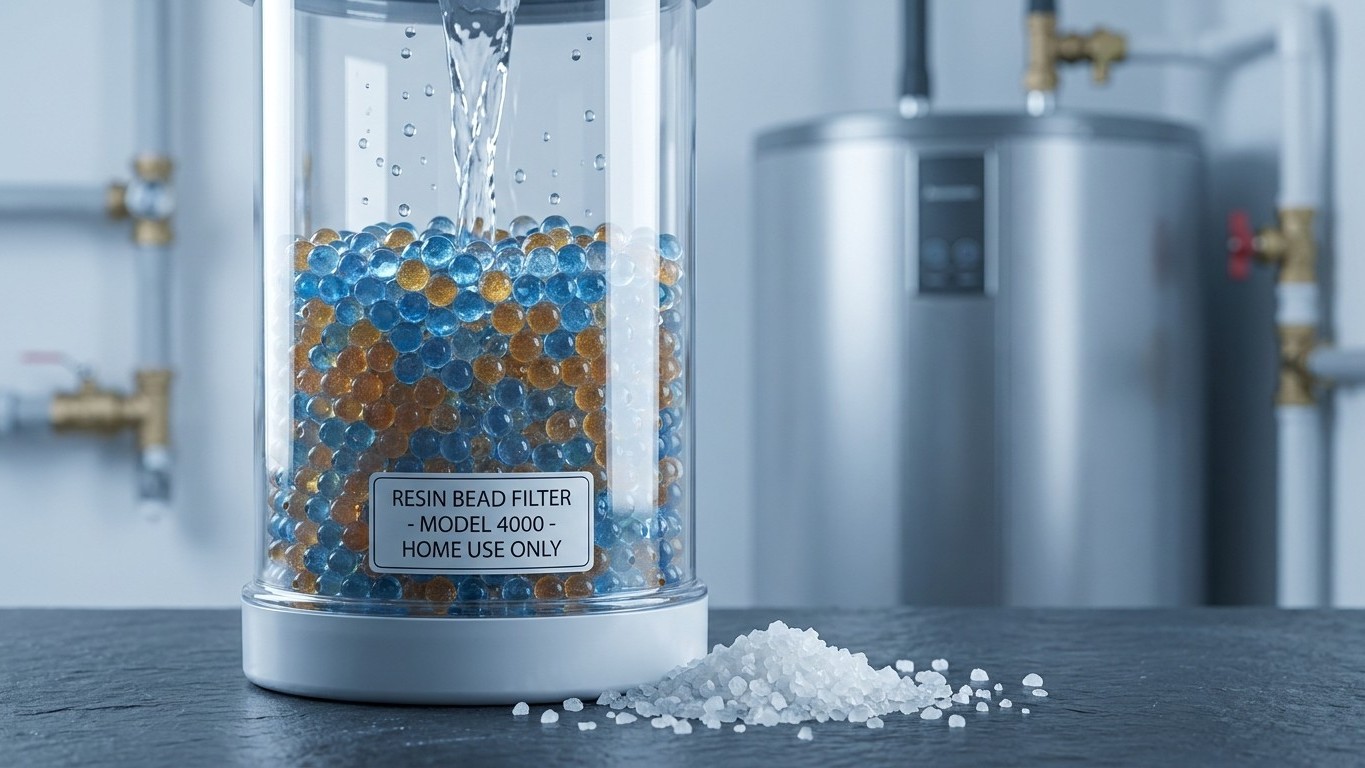

A water softener doesn’t purify water. It swaps out the minerals that make water “hard,” calcium and magnesium, for sodium or potassium, using a tank of resin beads and a periodic salt flush. That trade solves scale on fixtures and extends the life of water heaters and washing machines. It also creates two costs that rarely show up on the sales brochure: a steady draw of salt and water for maintenance, and a change in what’s actually coming out of your tap.
What is actually happening
The thing to understand here is ion exchange. Inside the softener’s tank sits a bed of resin beads coated in sodium ions. As hard water passes through, calcium and magnesium ions in the water are more strongly attracted to the resin than sodium is, so they latch onto the beads and release sodium into the water in their place. That’s the whole mechanism. No filtration, no chemical breakdown, just a swap happening millions of times a second as water moves through the tank.
The resin, the brine, and the swap
Eventually the resin beads are saturated with calcium and magnesium and can’t swap anymore. That’s when the system regenerates: it floods the tank with a concentrated brine solution (salt water), which reverses the exchange, stripping the hardness minerals off the resin and replacing them with fresh sodium again. The leftover brine, now carrying the calcium and magnesium it pulled off, gets flushed down the drain. This is why a softener needs a steady salt supply and why the discharge water during regeneration is noticeably salty.
The two smaller problems
First, every regeneration cycle uses water, on top of what your household already consumes, and it happens automatically. Second, the water coming out of your softened taps carries more sodium than it did before treatment. For most households that’s a non-issue, but anyone managing sodium intake for medical reasons should know softened water isn’t sodium-free. A softener that’s oversized or set to regenerate more often than your actual water hardness requires wastes salt and water for no added benefit, which is why matching the unit to your household’s real hardness level matters more than most installers explain upfront.
What to check, in order
If a softener seems to be underperforming, working through these checks in order will usually tell you where the problem sits before you call anyone.
- Check the salt level in the brine tank. If it’s empty or the salt has dissolved down to a thin layer of water, the resin isn’t regenerating and the unit is just passing hard water through untreated. Refilling it and watching the next cycle is the cheapest diagnostic there is.
- Look for a salt bridge. Sometimes the salt forms a hard crust above the waterline, leaving an empty pocket underneath. The tank looks full but the salt isn’t dissolving into brine at all. Breaking up that crust by hand often fixes a softener that “has plenty of salt” but still isn’t working.
- Test the water hardness directly. A simple hardness test comparing water before and after the softener tells you whether the unit is actually removing minerals or just cycling without effect. This step confirms whether the problem is mechanical or just a settings issue.
- Check the bypass valve. Many softeners have a valve that routes water around the unit entirely, usually left open during maintenance or a filter change. If it’s been left in bypass, every drop in the house is skipping the softener regardless of how well the resin is working.
- Inspect the drain line for a clog. If backwash water can’t drain properly during regeneration, the resin never fully flushes and the cycle stalls partway through, leaving hardness minerals stuck on the beads.
- Review the regeneration schedule. A softener set to regenerate on a timer rather than by actual water use can either run far more often than needed (wasting salt and water) or not often enough for the household’s real usage, leaving hard water untreated between cycles.
What it costs to leave it
A softener stuck in a bad cycle, whether it’s regenerating too often, stuck mid-cycle, or bypassing water it should be treating, behaves a lot like a hidden leak: water moving through the system that never shows up as a benefit to the household. The scale of what’s at stake nationally is worth knowing, even though it says nothing about your own bill. According to the U.S. EPA WaterSense program, “household leaks can waste nearly 1 trillion gallons of water annually nationwide,” and “the average household’s leaks can account for more than 9,300 gallons of water wasted every year.”
Those numbers describe leaks broadly, not softeners specifically, but the mechanism that drives the waste is the same: water moving unnoticed because nobody’s watching the meter. WaterSense also notes that “nine percent of homes have leaks that waste 50 gallons or more per day,” which is roughly what an oversized or malfunctioning softener regenerating too frequently could add to a water bill without anyone noticing for months.
None of these figures tell you what’s happening at your address. They’re national aggregates from a conservation campaign, useful for scale and nothing more. The only number that matters for your situation is what your own meter shows before and after you isolate the softener. This site’s guide to reading your meter for a hidden leak walks through exactly how to do that measurement yourself, and it’s the same method that applies whether the suspect is a softener, a toilet flapper, or a dripping faucet. WaterSense points out that “fixing easily corrected household water leaks can save homeowners about 10 percent on their water bills,” which is a real number worth chasing down, just not one you can borrow from a national average.
When to stop and call a plumber
Everything above sits at the level of a countertop or utility closet: checking a tank, testing water, flipping a valve. That’s where a homeowner can reasonably work. There’s a clear line past that point.
If the softener’s plumbing runs behind a finished wall and you’d need to open drywall to trace a line, that’s a job for a licensed plumber. Anything touching the main water supply line, the pipe feeding the whole house before it splits off to fixtures, carries enough risk of a shutoff error or a flood that it’s not worth the gamble on a DIY fix. Softeners are also frequently installed near a water heater, and if that heater runs on gas, any work that disturbs its connections, venting, or gas line needs a licensed professional, full stop. Combustion appliances aren’t a place to experiment.
And if you’ve already found water damage, staining on a ceiling, warped flooring, a musty smell near the softener’s install location, stop troubleshooting and call someone. A leak that has already wetted structure is no longer a plumbing problem alone; it’s a moisture and mold problem too, and the longer it sits, the more expensive the repair gets. Diagnosing a softener that’s just regenerating too often is a weekend project. Diagnosing a wall cavity that’s been damp for three months is not.
Common questions
Does a water softener waste water even when it’s working correctly?
Yes. Every regeneration cycle uses water to flush the resin, regardless of whether the unit is functioning properly. That’s a built-in cost of the ion exchange process, not a malfunction, though a softener regenerating far more often than your household’s actual hardness requires will waste more than necessary.
Is softened water safe to drink if someone in the house is on a low-sodium diet?
The added sodium from softened water is usually small compared to daily dietary intake, but it’s not zero. Anyone managing sodium for medical reasons should discuss softened tap water with their doctor, and many households in that situation keep a separate unsoftened tap for drinking and cooking.
Why does my softener seem to be using more salt than it used to?
Increased salt use usually points to more frequent regeneration cycles, either because the settings were changed, the household’s water use went up, or the unit’s control valve is misreading actual demand. Checking the regeneration schedule against your household’s real water use is the first place to look.
Can a softener actually cause pipe damage instead of preventing it?
Softened water is more corrosive to certain metal pipes than hard water, since it lacks the mineral scale that can coat and protect pipe interiors over time. This is a known tradeoff, not a defect, and it’s one more reason to match softener output to actual need rather than running maximum softening by default.