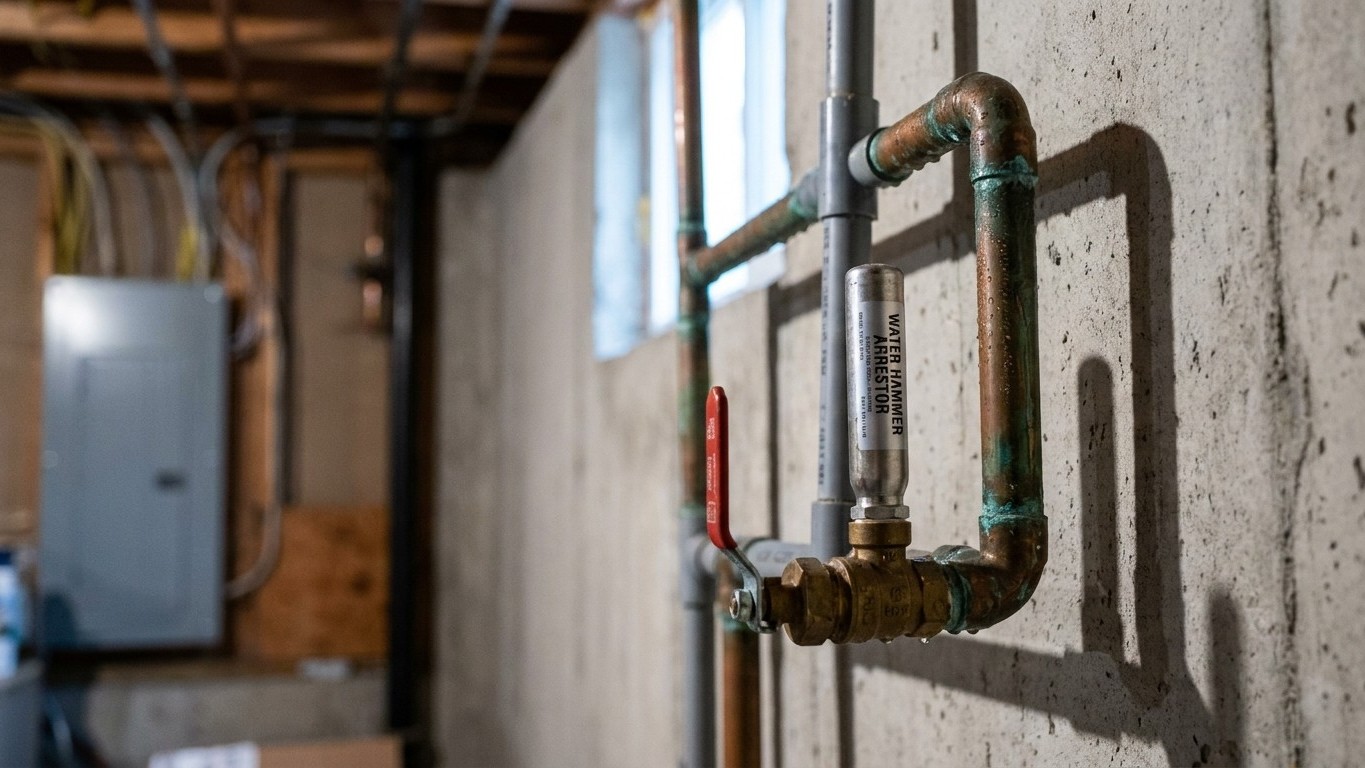

That bang, thud, or knock when a faucet or washing machine valve snaps shut is called water hammer, and it’s caused by a sudden pressure spike as moving water slams to a stop. It’s common, usually harmless to the pipes in the short term, and often fixable with a simple air-chamber or arrestor fix. But repeated hammering can loosen fittings and stress joints over years, so it’s worth tracking down rather than ignoring.
What is actually happening
Water isn’t compressible, but it does have mass, and mass in motion has momentum. When you open a tap, water in the supply line is flowing at a steady speed toward the fixture. Close that valve fast, and the water column doesn’t stop gradually, it stops almost instantly against a dead end. All that kinetic energy has nowhere to go, so it converts into a pressure spike that slams through the pipe. That spike is the bang you hear, and it can travel yards away from the fixture that caused it, which is why the noise sometimes seems to come from the wrong wall entirely.
The speed of the valve closure matters more than the flow rate. A hand-turned faucet closes relatively slowly, giving the water column time to decelerate. Solenoid valves, the kind found in washing machines, dishwashers, and ice makers, snap shut in a fraction of a second because they’re electrically controlled and built for a tight seal. That’s why hammer is so often traced back to appliances rather than the sink you were standing at when you heard it.
Pipe material and layout change how the shockwave behaves once it’s created. Rigid materials transmit the pressure spike efficiently and can amplify the sound as it travels through fittings, elbows, and straps. Longer, straighter runs of pipe give the water column more momentum to shed all at once, which is part of why hammer tends to show up more in houses with long supply runs to a laundry room or a second-floor bathroom.
Older homes were often built with a simple built-in cushion: a vertical length of capped pipe near each fixture, called an air chamber, that trapped a pocket of air. Air compresses, water doesn’t, so that trapped cushion absorbed the shock before it could turn into a bang. Over years, that trapped air can dissolve into the water or get flushed out, and once the cushion is gone, the hammer starts. This is the single most useful thing to understand before you start checking fixtures: the noise usually isn’t a new problem with your plumbing, it’s an old cushion that quietly disappeared.
What to check, in order
Work through these from cheapest and fastest to more involved. Each step tells you something before you spend money on the next one.
- Identify the trigger fixture. Run every faucet, flush every toilet, and cycle the washing machine and dishwasher one at a time, listening for which one produces the bang when it shuts off. If it’s only one appliance, the fix is localized. If it happens with multiple fixtures across the house, the problem is closer to the main supply line or the water heater connection.
- Check for a missing or waterlogged air chamber. Fixtures with an old vertical air chamber nearby (look for a capped pipe stub near the shutoff) may have lost their air cushion over time. Draining the house’s plumbing completely (shut off the main, open the highest and lowest faucets until the lines run dry, then close everything and turn the main back on) lets air refill those chambers naturally in many older systems. If the hammer quiets down afterward, that confirms a lost air cushion was the cause.
- Check the washing machine and dishwasher hoses. These use fast-closing solenoid valves and are the single most common source of hammer in homes with newer plumbing. If a mechanical arrestor was ever installed on these lines, confirm it hasn’t failed or waterlogged the same way an air chamber can.
- Check pipe supports and strapping. Loose pipes that aren’t firmly anchored will rattle and knock against studs or joists when the shockwave passes through, making the noise louder and more percussive than it would be on a well-secured line. Tightening straps won’t eliminate the pressure spike, but it can quiet the noise considerably and rules out a loose-pipe problem before you assume it’s hammer.
- Note whether the noise correlates with unusually forceful flow. If water seems to come out unusually hard at every fixture in the house, that’s worth mentioning to a plumber, since it can make any hammer problem worse. This isn’t something to diagnose with a number yourself, it’s a pattern to describe when you call for help.
What it costs to leave it
Water hammer itself doesn’t usually waste water, but it’s a symptom worth taking seriously because the same aging fittings, worn washers, and stressed joints that cause hammer are often the ones that eventually start to leak. And leaks, unlike hammer, waste water quietly and constantly, which is where the scale gets surprising. According to the U.S. EPA WaterSense program, “household leaks can waste nearly 1 trillion gallons of water annually nationwide,” and “the average household’s leaks can account for more than 9,300 gallons of water wasted every year.” The program also notes that “nine percent of homes have leaks that waste 50 gallons or more per day.”
Those numbers describe the whole country, not your house, so they’re useful for scale and nothing more. But they help explain why a fitting that hammers today is worth checking rather than tolerating for years. A worn valve washer that’s letting a pressure spike through is the same kind of wear that eventually lets water through when it shouldn’t. EPA WaterSense points out that “a leaky faucet that drips at the rate of one drip per second can waste more than 3,000 gallons per year,” and “a showerhead leaking at 10 drips per minute wastes more than 500 gallons per year.” Even a toilet flapper, unrelated to hammer directly but part of the same aging-fixture picture, “can cause your toilet to flush on its own or silently leak thousands of gallons a year” once it’s worn.
The upside is real and measurable: EPA WaterSense states that “fixing easily corrected household water leaks can save homeowners about 10 percent on their water bills.” Your own water meter is the only instrument that tells you what your house is actually losing, not a national average. If you want to check whether hammer-adjacent wear has already turned into an active leak, our guide on finding a hidden water leak walks through reading your meter correctly and spotting the signs before a wall or ceiling shows damage.
When to stop and call a plumber
Most water hammer is a fixture-level fix: an air chamber recharge, a check on an appliance hose, or tightened pipe strapping. But there are clear lines where the job stops being a homeowner task, no matter how confident the diagnosis feels.
If the banging seems to originate from inside a wall rather than at an accessible fixture or shutoff, stop there. Pipes behind finished walls mean any fix requires opening drywall, and a misdiagnosis can turn a noise complaint into a real leak. If the hammer happens on the main supply line itself, before any branch to an individual fixture, that’s also a call for a licensed plumber, since problems at that point affect the pressure and safety of the whole house’s plumbing, not just one tap.
A gas water heater is its own category entirely. Any hammer, hissing, or unusual noise connected to a gas water heater’s connections should go straight to a professional, since the water lines there sit close to gas supply and venting components where a homeowner shouldn’t be improvising fixes. And if you’ve noticed any dampness, staining, warping, or soft spots on a wall, ceiling, or floor near where the hammering happens, treat that as a leak that has already reached structure, not a noise problem. Water that’s already wetted drywall, subfloor, or framing needs a plumber and, in many cases, a moisture assessment, before cosmetic repairs make sense. Hammer is loud and startling but usually cheap to fix; a hidden leak behind a wall is quiet and expensive, and it’s the one you don’t want to guess about.
Common questions
Does water hammer damage pipes over time?
Occasional hammer rarely causes immediate damage, but repeated shockwaves stress joints, solder connections, and fittings over years, which can shorten their working life and contribute to the kind of wear that eventually leads to a leak.
Why did the banging start suddenly after years of quiet plumbing?
The most common reason is that an air chamber that had cushioned the shockwave for years finally lost its trapped air, either through gradual absorption into the water or after a plumbing repair disturbed the line.
Is water hammer worse in winter?
Some homeowners notice it more in colder months, often because water usage patterns shift (more laundry, more hot water draws) and because temperature changes can affect how pipes are seated in their supports, making existing hammer more audible rather than more frequent.
Can one appliance cause hammer that seems to come from a different room?
Yes. A fast-closing valve, most often a washing machine or dishwasher, sends a shockwave through connected supply lines, and the sound can resonate through pipe runs and framing far from where the valve actually closed.