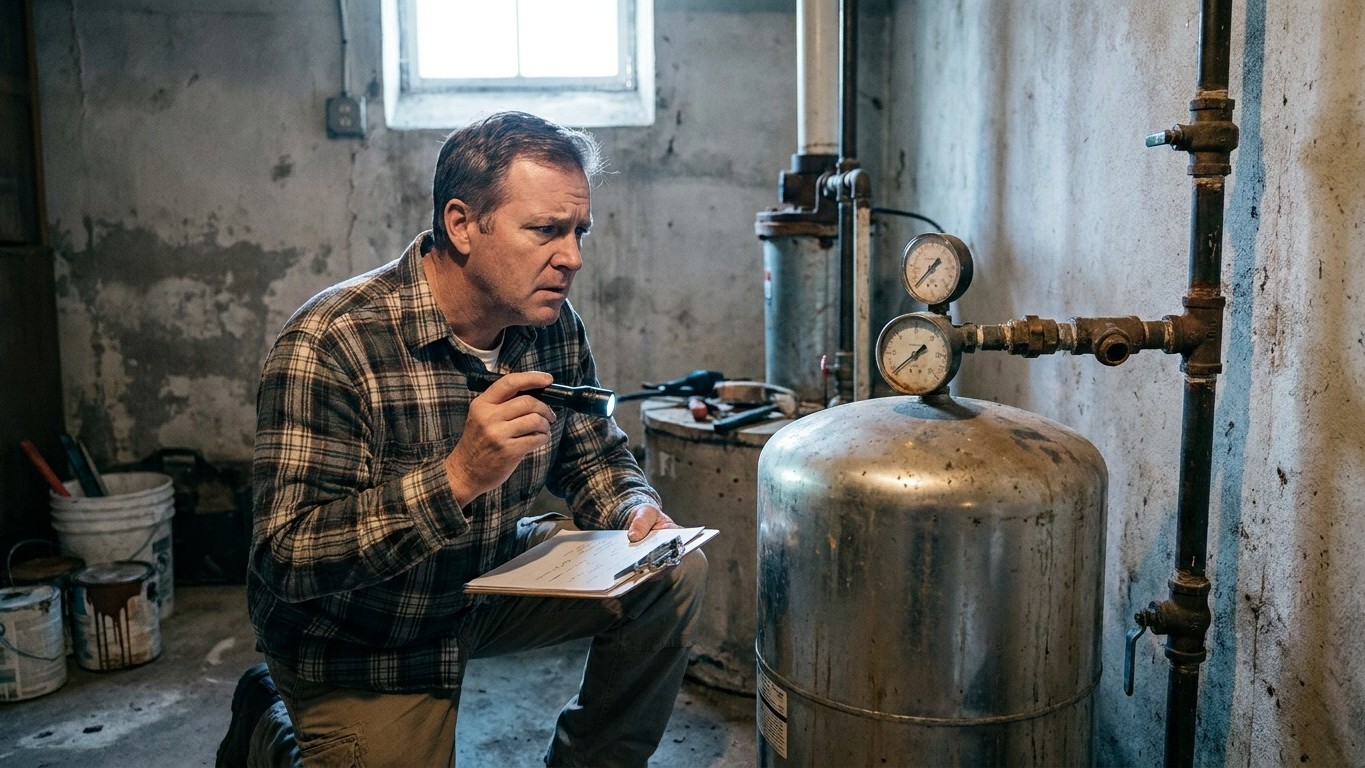

Well water changes the responsibility, not just the source. On a municipal main, a utility treats the water, meters it, and often flags unusual usage. On a private well, none of that exists. You own the pump, the pressure tank, the water quality, and the job of noticing when something’s wrong. There’s no bill spike to warn you, no annual water-quality report showing up in the mail. It’s all on you.
What is actually happening
A well system pulls water from an aquifer through a submersible or jet pump, pushes it into a pressure tank, and holds that tank at a set range, typically cycling the pump on and off as pressure drops and recovers. That cycle is the heartbeat of the whole setup. When it’s steady, the system is healthy. When it starts cycling faster than usual, or the pump runs longer than it used to, something downstream has changed, usually a leak, a failing tank bladder, or a fixture drawing water it shouldn’t be.
Here’s the part municipal customers never have to think about: nobody tests well water for you. Public systems are regulated under the Safe Drinking Water Act, with routine testing and public reporting built in. Private wells fall outside that framework entirely. The EPA and CDC recommend annual testing for bacteria and nitrates, plus periodic checks for regional contaminants like arsenic or radon depending on where you live, but none of it is required. If you don’t test, nobody else will.
The same gap applies to leaks. A municipal customer often finds out about a hidden leak because the water bill jumps. A well owner usually doesn’t get that signal, because there’s no bill tied to gallons used the same way. Instead, the tell is mechanical: the pump cycling more often, running for longer stretches, or making noise when every fixture in the house is off. That’s the well system’s version of a rising bill, and it’s the first thing to learn to notice.
Why the mechanism matters more than a checklist
Every well setup is a little different: tank size, pump type, pressure switch settings, and whether the house has a flow meter at all. Knowing how the pressure cycle is supposed to behave lets you catch problems on your specific system, rather than following steps written for someone else’s plumbing. A homeowner who understands why the pump cycles can tell, within a few days of paying attention, whether a change is normal wear or an early warning sign.
What to check, in order
Start with what costs nothing and points to the most common problems first. Work down the list only as needed.
- Read the pressure gauge on the tank. Most systems cycle within a set range, often marked on the gauge or switch. If the pump is kicking on more frequently than it used to, with shorter run times, that often means the pressure tank’s air bladder has failed or is waterlogged, not that there’s necessarily a leak.
- Listen for the pump with every fixture off. Close every faucet, make sure no appliance is running, and listen or check the pressure switch. If the pump kicks on with nothing drawing water, there’s a leak somewhere in the system between the tank and the fixtures.
- Walk the visible plumbing. Check under sinks, around the base of toilets, behind the washing machine, and at the water heater connections for damp spots, mineral staining, or slow drips. This tells you whether the leak is indoors and visible.
- Dye-test the toilets. A few drops of food coloring in the tank, left for ten minutes without flushing, will show up in the bowl if the flapper is letting water through. Toilets are the single most common source of a silent, ongoing loss.
- Check outdoor spigots and irrigation lines. A well system feeding a hose bib or drip line left cracked or slightly open can run for hours unnoticed, especially in a detached line you don’t pass by daily.
- Test the water itself, at least once a year. This won’t find a leak, but it answers the other question a well owner has to ask that a municipal customer doesn’t: is the water still safe. Bacteria and nitrate levels can shift with seasons, nearby land use, or a cracked well cap.
If the pump still runs continuously after all of that comes back clean, the issue may be further upstream, in the well itself or the line running from the wellhead to the house, and that’s a job for a well contractor rather than a household check.
What it costs to leave it
National figures don’t tell you what your own system is losing, but they show why small leaks are worth chasing down. The U.S. EPA’s WaterSense program notes that “household leaks can waste nearly 1 trillion gallons of water annually nationwide,” and that “the average household’s leaks can account for more than 9,300 gallons of water wasted every year.” On a well system, that waste doesn’t show up as a bill increase. It shows up as a pump running more, wearing out sooner, and drawing more from an aquifer that, in a dry season, may already be under strain.
Some leaks are bigger than others. WaterSense reports that “nine percent of homes have leaks that waste 50 gallons or more per day,” and breaks down how small a leak has to be to add up fast: “a leaky faucet that drips at the rate of one drip per second can waste more than 3,000 gallons per year,” while “a showerhead leaking at 10 drips per minute wastes more than 500 gallons per year.” A toilet is often the worst offender, since “an old or worn flapper can cause your toilet to flush on its own or silently leak thousands of gallons a year” without any visible sign in the bathroom.
These are national aggregates from a conservation campaign, not a measurement of your household. They exist to show scale, not to estimate your own loss. On a well, the only real gauge is the one built into your own system: the pressure tank cycle, the pump’s run time, or a flow meter if the house has one. For a step-by-step way to isolate where a loss is happening in your own plumbing, see our guide on finding a hidden water leak. WaterSense also notes that “fixing easily corrected household water leaks can save homeowners about 10 percent on their water bills”, and on a well, that savings shows up instead as less pump wear and a lighter draw on the aquifer.
When to stop and call a plumber
Most of what’s listed above is safe to check yourself with no tools beyond a flashlight and a few minutes. But well systems have a few points where guessing gets expensive fast, and water damage from a missed leak is quiet right up until it isn’t.
Stop and call a licensed plumber, or a well contractor for anything upstream of the pressure tank, in these situations:
- Any leak or suspected leak behind a wall or under a slab, where you can’t see the source directly.
- Anything involving the main line from the wellhead to the house, including the well casing, submersible pump, or buried supply line.
- Any issue involving a gas water heater, including a leak at or near the unit.
- Any leak that has already left standing water, soft flooring, or visible staining on drywall, framing, or subfloor.
Before touching any of these, know where and how to cut off supply to the house. Our guide on how to shut off the water main walks through that step, and it’s worth doing before a plumber even arrives if water is actively running somewhere it shouldn’t. A well system adds one more line worth knowing: the breaker or switch that powers the pump, since cutting power stops the pump from pushing water into a line that’s already failing, even before the shut-off valve is closed.
Common questions
How often should well water be tested?
At least once a year for bacteria and nitrates, according to CDC and EPA guidance for private wells, with additional testing after any flooding, a noticeable change in taste or color, or known issues in the surrounding area.
Does a well system have a water meter like a municipal connection?
Not always. Some households install a flow meter for their own tracking, but it isn’t standard the way a municipal meter is. Without one, the pressure tank’s cycling pattern is the main built-in signal of a change in demand.
Can a leak affect well water quality, not just quantity?
Yes. A leak in the line between the well and the house can, in some conditions, allow surface water or contaminants to enter the system, which is one more reason a persistent unexplained leak on a well system deserves a faster response than the same leak on a municipal line.
Why does the pump running longer matter if the water bill isn’t changing?
Because on a well, the pump is doing the work a municipal utility’s pipe network does for free. Longer or more frequent run times mean more mechanical wear, higher electricity use, and a heavier draw on the aquifer, even though no water bill reflects any of it.