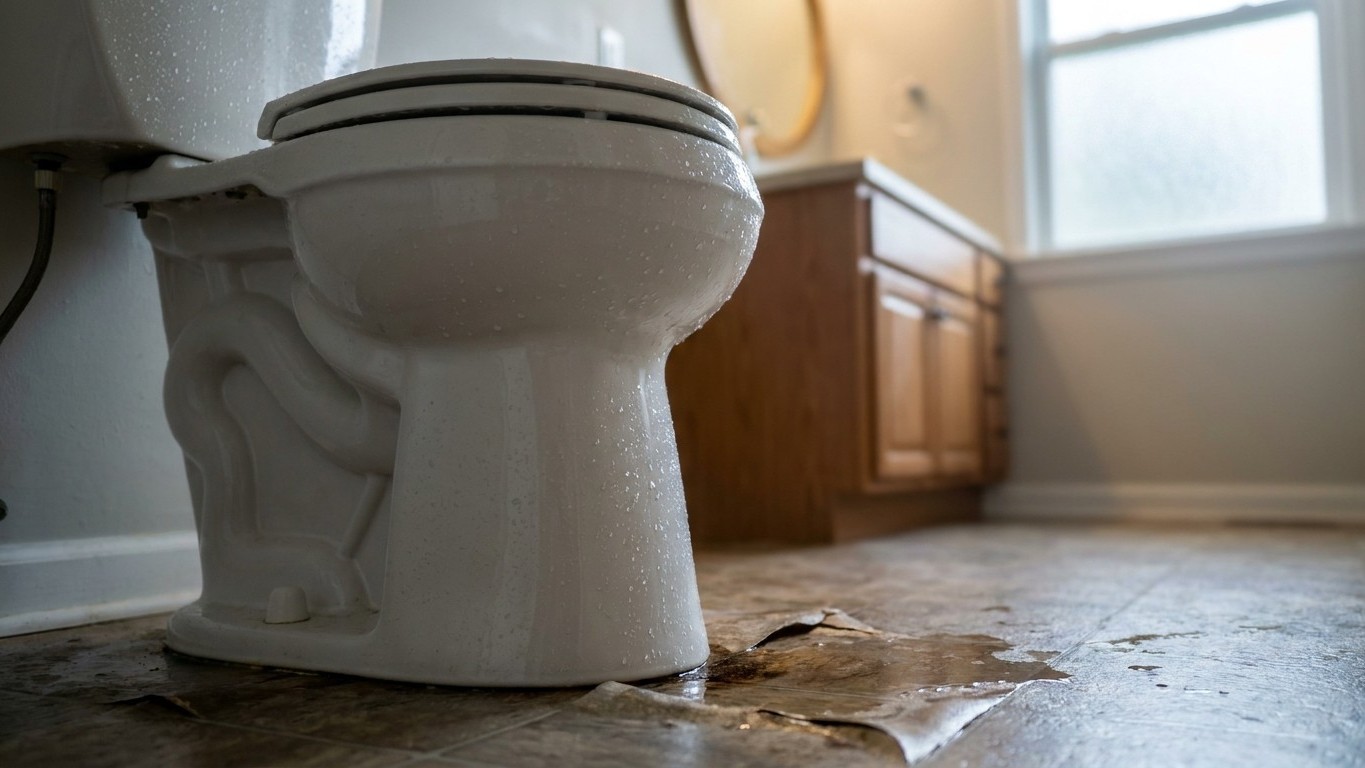

That ring of water around a toilet’s base is usually condensation, not a leak: cold water sitting inside the tank chills the tank’s outer wall below the room’s dew point, and moisture from the air condenses on the surface and drips down. Left alone, it doesn’t just annoy you. It softens subfloor, feeds mold under vinyl or tile, and can rot the wood base of a wall behind the tank before anyone notices.
What is actually happening
Every toilet tank refills with water straight from the supply line, and in most homes that water arrives somewhere between 50°F and 65°F depending on season and region. The bathroom air around it is warmer and holds water vapor, especially after a hot shower with the fan off. When that humid air touches the cold porcelain, it cools instantly and the vapor turns back into liquid water on contact, the same physics that fogs a cold glass of iced tea on a summer porch.
The tank doesn’t have to be damaged for this to happen. It just has to be cold enough, and the room has to be humid enough, for the dew point to be crossed at the tank’s surface. That’s why a sweating toilet tends to show up seasonally: hot, muggy summers in the Southeast and Gulf states produce it constantly, while a dry Mountain West winter with the heat running rarely triggers it at all. Basements and windowless bathrooms with weak ventilation are the worst offenders regardless of climate, because moist air has nowhere to go.
Why the puddle matters more than it looks
A drop or two of condensation evaporates on its own. A steady drip, though, finds the same low spot every time, usually the front corner of the base or wherever caulk has a gap. Over weeks, that water works into the subfloor seam, and vinyl flooring or laminate swells and discolors long before anyone pulls up a floorboard to check. Behind a wall-mounted tank or in a poorly ventilated bathroom, the same moisture can wick into drywall and framing, creating the kind of hidden mold growth that shows up on a home inspection report years later as an unexplained soft spot.
The mechanism also explains why sweating is worse right after the tank refills. Each flush pulls in fresh cold water, chilling the tank wall again just as it was starting to warm to room temperature. A household that flushes often, say with kids or guests, resets that condensation cycle all day long, which is why some bathrooms seem to sweat nonstop in July no matter how many towels get wrapped around the base.
What to check, in order
Before assuming the fix, rule out the cheap explanations first. Each step below tells you something specific, and most take five minutes with no tools beyond a flashlight and a dry hand.
- Feel the tank surface after wiping it dry. If it’s damp again within ten or fifteen minutes with no water added, that’s condensation, not a leak. If it stays dry, look elsewhere for the water source.
- Run the bathroom fan or crack a window for an hour, then recheck. If the sweating drops off noticeably, humidity is the driver, confirming the mechanism above rather than a hardware problem.
- Check the water supply line and shutoff valve for moisture. A wet fitting here, even a slow weep, means a mechanical leak that no amount of ventilation will solve.
- Look at the tank-to-bowl bolts and the base gasket. Rust streaks or a slow trickle from underneath the tank, rather than dripping down its sides, points to a worn seal instead of condensation.
- Lift the tank lid and listen after the fan noise settles. A faint hiss or a flapper that won’t seat fully suggests water is leaking into the bowl internally, which shows up as a running toilet more than a sweating one, but the two problems sometimes overlap.
- Check the floor around the base for softness or discoloration. Press gently with a foot. Any give in the flooring means moisture has already reached the subfloor and the damage has moved past the tank itself.
Working through this order matters because it moves from least destructive to most revealing. A dry tank after wiping tells you to stop worrying about the tank and start worrying about ventilation. A wet supply line tells you this was never condensation at all.
What it costs to leave it
Condensation itself doesn’t run up a water bill, since it’s just room humidity relocating, but the flapper and seal problems that sometimes hide behind a sweating tank absolutely do. The EPA’s WaterSense program notes that “an old or worn flapper can cause your toilet to flush on its own or silently leak thousands of gallons a year,” and a toilet is exactly where that kind of silent, slow leak tends to live, unnoticed because there’s no puddle to see, only a bill that creeps up.
Nationally, the scale is hard to picture in isolation. WaterSense reports that “household leaks can waste nearly 1 trillion gallons of water annually nationwide,” and that “the average household’s leaks can account for more than 9,300 gallons of water wasted every year.” The agency also found that “nine percent of homes have leaks that waste 50 gallons or more per day.” Those numbers describe the country’s aggregate plumbing problem, not any single fixture in any single bathroom, so they’re useful for scale only, not for guessing what your own toilet is doing.
What matters for your household is your own water meter, checked before and after a two-hour period with no water use in the house. That reading is the only number that actually belongs to you, and it’s the fastest way to confirm whether a flapper or supply line is quietly draining money. WaterSense also points out that “fixing easily corrected household water leaks can save homeowners about 10 percent on their water bills,” which is a meaningful incentive to check rather than assume the sweating tank is the whole story. For the exact meter-reading method, see this site’s guide to checking for a hidden water leak.
When to stop and call a plumber
Everything above is reasonable for a homeowner to check alone: wiping a tank, running a fan, feeling for a soft floor. The line moves the moment water is found somewhere you can’t fully see or reach.
If moisture is coming from behind a wall, whether it’s a wall-hung tank, a recessed supply line, or a stain spreading up drywall near the toilet, that’s not a five-minute fix. Water travels sideways inside a wall cavity far from where it entered, and opening it up without knowing the plumbing layout risks turning a small repair into a bigger one.
The same caution applies to anything touching the main water supply, as opposed to the small shutoff valve feeding just the toilet. A slow drip at a fitting near the main line, or any sign of pressure loss throughout the house, points to a problem upstream of what a flapper or wax ring replacement can address.
A gas water heater anywhere near the affected area raises the stakes further. Water pooling near gas appliances, or any smell of gas alongside a plumbing problem, is not a DIY diagnosis under any circumstances; that calls for a licensed plumber and, if there’s any doubt about gas, the utility company first.
Finally, if the subfloor already feels soft, if there’s visible mold on wood framing, or if flooring has buckled, the leak has moved from a plumbing problem into a structural and moisture-remediation one. A licensed plumber can confirm the fixture is sealed properly, but restoring wet framing or subfloor usually needs a contractor who handles water damage, not just pipes. Waiting to see if it dries on its own, in these cases, tends to cost more than calling early.
Common questions
Does a toilet tank liner actually stop sweating?
An insulating liner inside the tank raises the surface temperature of the tank wall so it stays above the room’s dew point, which does reduce condensation in many cases. It works best paired with better bathroom ventilation, since insulation alone can’t fully offset a very humid room.
Is a sweating toilet tank a sign of a bigger plumbing problem?
Usually not by itself. It becomes a bigger problem only if the moisture has nowhere to drain, if it’s been happening long enough to soften flooring, or if it’s mixed up with an actual leak at the supply line or tank seal that a dry-and-recheck test would reveal.
Why does my toilet only sweat in summer?
Warm outdoor air holds more moisture, and air conditioning cools the room without necessarily lowering humidity enough at the tank’s surface. Incoming tank water also tends to be colder relative to the room in summer, widening the gap that drives condensation.
Can condensation from a toilet tank cause mold?
Yes, if it’s chronic and unaddressed. Standing moisture at the base of the toilet, especially where flooring meets the wall, gives mold the steady damp surface it needs, and that risk is exactly why a dry-wipe test and a look at the subfloor are worth doing rather than just wiping up the puddle and moving on.