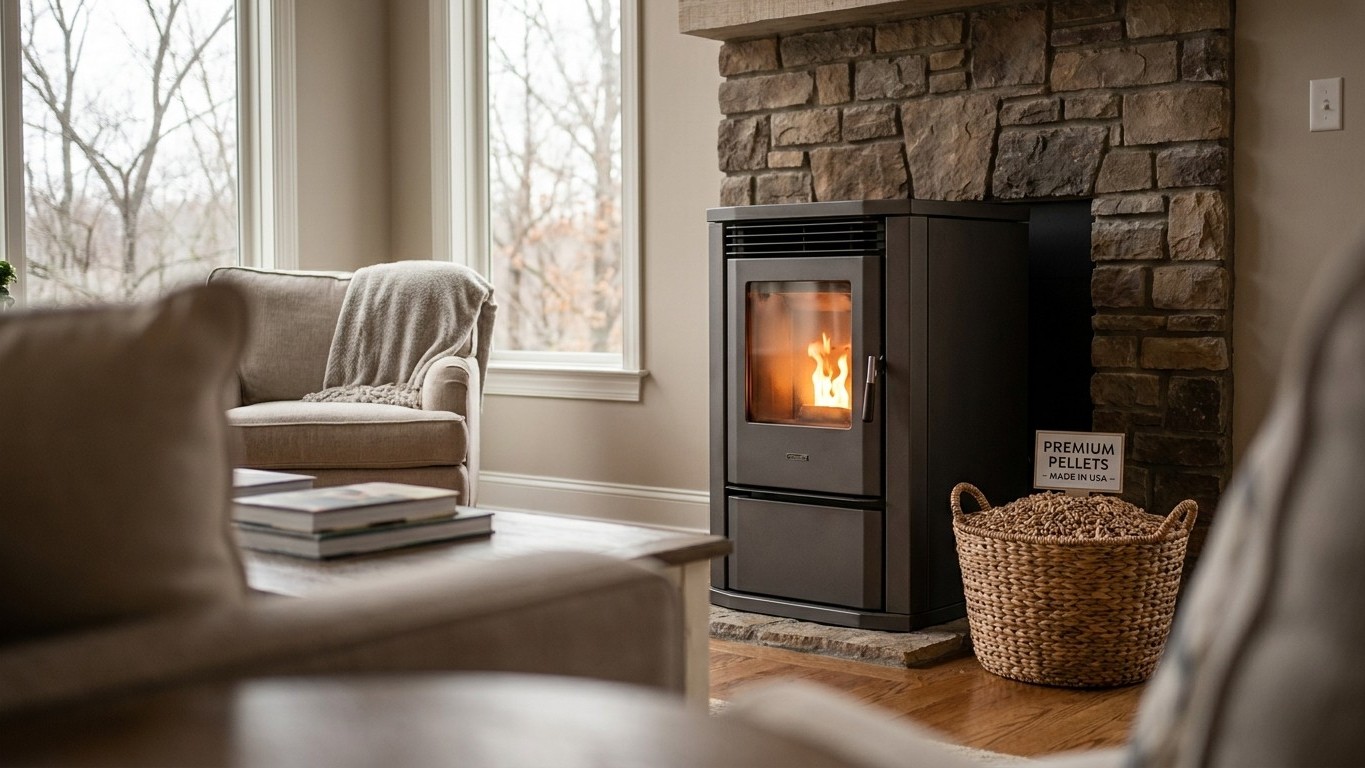

Charlottetown averages about 4,598 heating degree days a year below 18°C, according to Environment and Climate Change Canada’s 1981-2010 normals, a figure that puts Prince Edward Island firmly in serious-heating territory. The heating season stretches roughly 10 months, from September through June. That combination decides everything else on this page: how many tons a stove burns, when to buy, how to store, and what happens when the power goes out.
How hard the winter works here

The number to remember is 4,598. That’s the annual total of heating degree days below 18°C recorded at Charlottetown A, the reference station Environment and Climate Change Canada uses for Prince Edward Island’s climate normals (1981-2010). Heating degree days measure how much, and for how long, a building needs to fight the cold: each degree the daily mean falls below 18°C for a day counts as one degree day. Add them all up and you get a rough proxy for fuel demand across a full year.
4,598 is not a mild number. For comparison inside Canada’s own system, provinces with short, gentle winters post totals in the low thousands; PEI’s total puts it among the more demanding climates in the country. What that means in practice: a pellet stove here is doing real work, not just adding ambiance to a living room that a furnace already keeps warm.
Depth versus length
Two different things get mixed up when people talk about “hard winters,” and PEI’s data separates them cleanly. Depth is how cold it gets at the coldest point : January is the peak month, with 798 degree days on its own, more than a quarter of the entire year’s total packed into 31 days. Length is how long the heating need persists — and that’s the 10-month season, starting in September (the first month whose mean daily temperature, 14.1°C, drops below the 18°C base) and not climbing back above that base until July.
A short, brutal cold snap and a long, moderate season can produce similar totals but demand different things from a stove and from a household’s pellet supply. PEI has both: a genuinely cold January-February stretch (798 and 714 degree days) bracketed by a long shoulder season that starts pulling heat in September and doesn’t fully let go until June. That long tail is why storage and buying timelines here look different from a place with a shorter, sharper winter.
One caution worth repeating: this is one station. Charlottetown sits centrally on the Island, but Prince Edward Island’s own geography is compact enough that most readers can treat this as a reasonable regional proxy, unlike sprawling mainland provinces, no part of PEI is dramatically colder or milder than Charlottetown. Still, if you’re near the North Shore or western tip of the Island, treat the figure as a solid estimate rather than a measurement of your exact backyard.
How many tons a winter takes here
No agency publishes a “tons per winter” figure for Prince Edward Island, and any number presented that way should be treated with suspicion. What you can do instead is work the chain that actually produces consumption, using the degree-day figure above as the engine driving it.
Start with the units. A bag of pellets weighs 40 pounds. A ton is 2,000 pounds, which works out to 50 bags. From there, consumption is simply a function of how much heat your house needs to replace over the season, which is exactly what the 4,598 heating-degree-day figure at Charlottetown is measuring. More degree days, more heat lost, more pellets burned to replace it, all else being equal. But “all else” rarely stays equal from one house to the next, which is why the same climate produces wildly different pellet totals in different homes.
The three variables that move the number
- How well the house holds heat. A tightly insulated, recently built home with modern windows can burn half the pellets of a drafty older farmhouse sitting in the same Charlottetown-area climate, degree day for degree day.
- Whether the stove is the only heat source or a supplement. A household running the pellet stove as primary heat through the full 10-month season burns far more than one using it to take the edge off a heat pump or electric baseboards on the coldest days only.
- The setting it runs at. A stove dialed to a low, steady burn to hold a room at 65°F consumes noticeably less than one cranked to fill a large open-concept space at 72°F.
Those three variables can each swing consumption by a wide margin, and combined they can easily produce a factor-of-two difference between two houses on the same street, in the same PEI winter, burning the same brand of pellets. That’s the honest reason nobody publishes a per-territory tonnage figure: it wouldn’t describe any real house.
The method that actually works is simpler and more reliable than any estimate: count your own bags. Track how many you burn through your first full heating season, from the September start of demand through the tail end in spring, and that number becomes your personal baseline for every winter after. One measured season on your own woodstove or pellet stove beats any published average, because it already accounts for your house, your habits, and your setting. For the full breakdown of that counting method and how to adjust it year to year, see the national page on how many pellets a winter takes.
Buying and storing them in this climate
Timing matters more on the Island than the calendar suggests. Heating demand starts climbing in September, well before most households start thinking about their pellet supply, and it doesn’t fully retreat until July. That long window means the smart buying move is to have your stock in place before September, not after the first hard frost, because a regional cold snap in October or November can empty retailers’ shelves fast, and pellets bought in the scramble almost always cost more than pellets bought in the quiet of summer, when demand is lowest and supply is deepest.
Storage is where PEI’s climate asks for real attention. Pellets are compressed sawdust, held together by the natural lignin in the wood rather than any glue or binder, which means they have no resistance to moisture beyond staying dry. Humidity swells the wood fibers, and once that happens the pellet loses its structure and crumbles into sawdust and dust, a wasted bag that clogs a stove’s auger instead of feeding a clean burn.
Where the risk actually sits
Prince Edward Island’s maritime climate brings damp air off the Gulf of St. Lawrence and the Northumberland Strait for a good part of the year, and that matters most in three specific spots: a garage floor that sweats with seasonal humidity, a basement corner near an exterior wall, or any storage space that isn’t fully sealed against ground moisture. Bags stacked directly on a concrete floor without a pallet or moisture barrier underneath are the classic failure point, the concrete itself can wick dampness upward even when the air above feels dry.
None of that requires exotic equipment to fix, but it does require treating pellet storage as a real task rather than an afterthought, especially given how long they may need to sit before a September-to-June burn season uses them up. For the details on shelf life, moisture barriers, and how to judge pellet quality before you buy, the national storage guide and quality guide cover the mechanics in full. On pricing, the only number worth comparing between suppliers is cost per ton, bag counts and pallet sizes vary enough to make anything else misleading.
What a winter outage means here
A pellet stove runs on electricity as much as it runs on pellets. The auger that feeds fuel into the burn pot, the fan that pushes heat into the room, and the control board that manages both all need a live electrical circuit. Cut the power, and a pellet stove goes cold within minutes, regardless of how full the hopper is, a fundamental difference from a wood stove, which keeps burning through any outage as long as someone keeps feeding it logs.
That distinction carries more weight in a place with PEI’s degree-day profile than it would somewhere mild. In January, with 798 degree days packed into 31 days, an outage during a cold snap is a genuine heating emergency for any household relying on the stove as a primary source, pipes and comfort both at risk within hours, not days. In the shoulder months, September or May, the same outage is closer to an inconvenience: an evening spent under a blanket rather than a household in danger.
What most Island households fall back on matters here too. Statistics Canada’s 2023 primary heating systems data shows heat pumps as the leading primary system in Prince Edward Island, used in 36% of households, with forced-air furnaces at 14%, boilers with hot-water or steam radiators at 16%, and electric baseboard heaters at 10%. Heating stoves aren’t reported separately in that survey, which means the data doesn’t publish a reliable estimate for that category, not that no one on the Island heats that way. The practical takeaway: for the majority of PEI households, the pellet stove is one heat source among several, and an outage that takes down the stove very likely takes down the heat pump and electric baseboards at the same time, since all three need grid power to run.
Sizing a generator or a battery backup for your specific stove isn’t something to guess at from a general figure, the wattage draw is printed right on the appliance’s data label, and that’s the number to match against any backup power plan. The national guide to pellet stoves and power outages walks through how to read that label and what backup options actually cover the load.