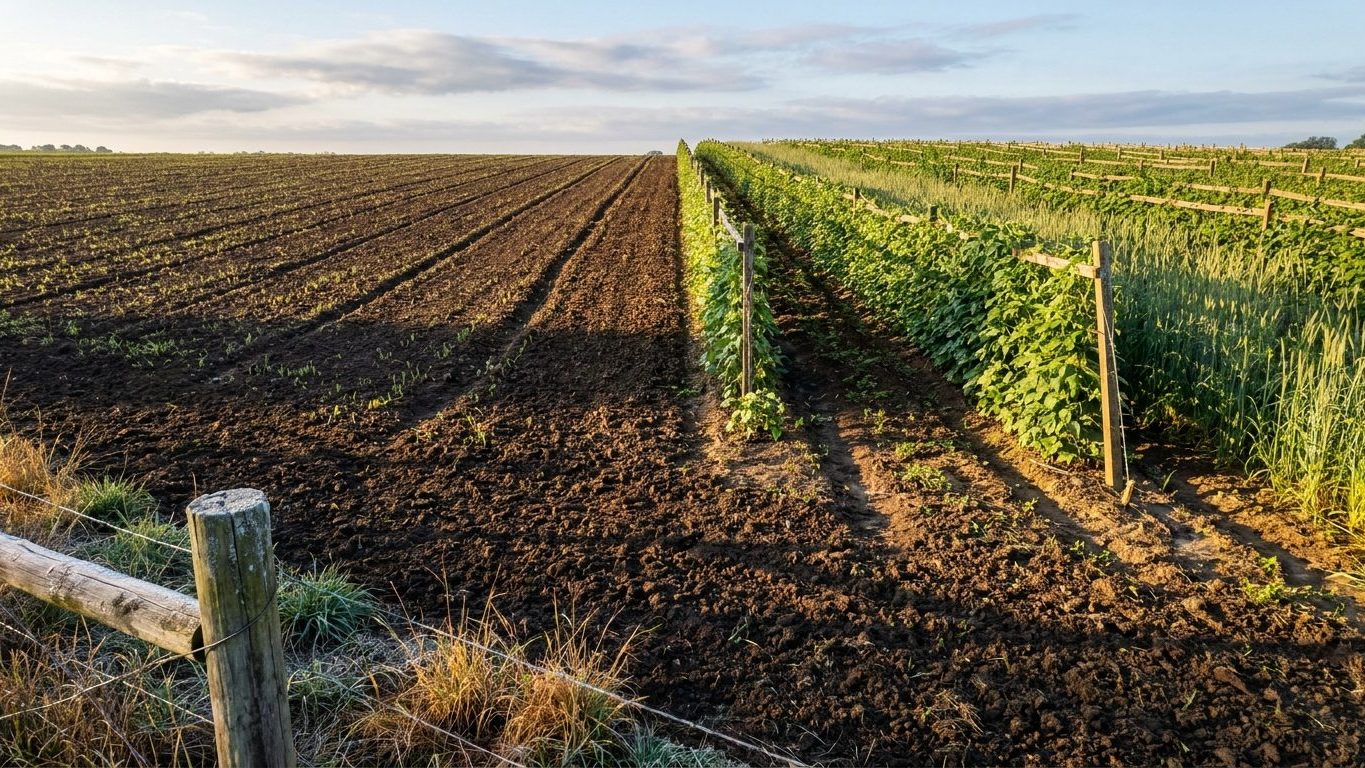

The safe window for fall cover crops in Prince Edward Island runs from late August through mid-September, well ahead of the average first fall frost of October 17. Spring-sown covers like oats or buckwheat go in after the average last frost of May 16. Both dates are averages, not guarantees, and that distinction matters more than it sounds.
The short answer for Prince Edward Island
A mean frost date is the midpoint of a spread, not a line you can plant against safely. Environment and Climate Change Canada’s Charlottetown A station puts the last spring frost at May 16 and the first fall frost at October 17, both averaged over 1981-2010. Read literally, that means frost arrives later than October 17 in roughly half of all years, and later than May 16 in the other half. A gardener who treats either date as a fixed boundary is playing a coin flip they don’t know they’re playing.
For fall-seeded covers, the practical target is to get seed into the ground with enough time for root establishment before growth stalls. Winter rye, hairy vetch, and crimson clover need three to six weeks of active growth before cold shuts them down, so working backward from an October 17 average frost, sowing by mid-September gives the plant its best shot at building the root mass that carries it through winter dormancy. Sow later and you’re gambling on a warm autumn that isn’t promised.
Spring and summer covers work the opposite way. Buckwheat, oats, and field peas are frost-tender or simply slow to establish in cold soil, so they go in after the ground has warmed past the last frost risk, using May 16 as the reference point rather than the deadline. Because that date is a coin-flip average too, gardeners who’ve been burned by a late frost often wait a week or two past it before committing tender seed.
None of this replaces a look at what’s actually happening in the ground. A cover crop calendar built on a 30-year average from one weather station is a starting point, not a schedule. It tells you where the middle of the distribution sits; it says nothing about whether this particular September is running warm or whether a cold snap is stalled over the Northumberland Strait. Treat the dates above as the number you’d write on a calendar in pencil, then confirm with the soil itself before you commit seed.
What will not work here
Prince Edward Island’s growing season is short enough to eliminate some cover crop choices outright, and its winters are cold enough to eliminate others that would work fine one province over. The two failure modes are different, and conflating them is the most common mistake in cover crop planning here.
The season-length failure hits anything that needs a long stretch of warm growth to reach the stage where it does its job. Sunn hemp and cowpea, both popular summer covers in warmer regions, rarely reach useful biomass or nitrogen fixation in the roughly five months between the average last and first frost. By the time they’re hitting their stride, the season is closing. These aren’t marginal choices for PEI; they’re the wrong tool entirely, and no amount of careful timing rescues them.
The winter-cold failure is a separate problem, and it explains why some legumes that overwinter reliably in milder parts of Canada winterkill here instead. The coldest month’s mean daily minimum at the Charlottetown reference station is -12.1°C [10.3°F], and that figure, not the record low, not a single hard freeze, is what decides whether a cover crop’s crown survives the winter. Crimson clover, for instance, is far less cold-hardy than winter rye or hairy vetch, and a stand sown even slightly late, with too little root development before dormancy, is exactly the kind of planting that fails to make it to spring.
There’s a third trap worth naming: assuming a cover crop that thrives in a humid Maritime summer needs the same spacing and airflow management as one grown in a dry interior climate. PEI’s coastal humidity means dense stands of some legumes are more prone to fungal issues than the same seeding rate would produce in a drier province. Thinner seeding, not heavier, is often the safer call here, which runs against instinct for anyone used to gardening in a drier region.
What changes across Prince Edward Island
Prince Edward Island is not one climate zone, and treating it as one is where a lot of cover crop timing goes wrong. The Canadian plant hardiness rating for the Charlottetown reference area is 5b, but that number describes Charlottetown specifically, built from seven climate variables measured at one location. It is not the zone for the whole province, and it is not comparable to a USDA zone despite the similar-looking number.
Coastal areas exposed to the moderating effect of the surrounding water tend to run milder in both directions, later spring warm-ups delayed by cold water, but also later killing frosts in fall, extending the window for fall-seeded covers by days that matter when you’re deciding between mid-September and early October. Inland and low-lying areas, by contrast, tend to pool cold air overnight and can see frost arrive earlier than the provincial average implies, which shortens the safe sowing window for anything that needs weeks of fall growth before dormancy.
This isn’t a case where a single adjustment applies evenly across the Island. Since the reference zone comes from one station and the province spans varied terrain and coastal exposure, there’s no single hardiness number that applies to every county, and no way to give a blanket “add a week” or “subtract a week” rule that holds everywhere. The right move is to consult the interactive map at Natural Resources Canada’s Plant Hardiness site and locate your own municipality rather than assume Charlottetown’s rating applies to your garden.
What this means practically for cover crop timing: a gardener near the coast in a sheltered bay might push a fall seeding into early October with reasonable confidence, while someone farther inland or in a frost-pocket location should treat mid-September as the outer edge, not the middle, of their window. The province-wide averages in the section above are real numbers from a real station, but they describe Charlottetown, not necessarily your particular field or backyard.
Where to check this for your own county
Every date and figure on this page comes from one climate station and one hardiness reference point. That’s useful for understanding the mechanism, but it’s not a substitute for a county-level recommendation, and Prince Edward Island’s own agricultural authorities are better positioned to give you that than a provincial average ever could.
The Government of Prince Edward Island maintains an agriculture resource hub at princeedwardisland.ca/en/topic/agriculture, and that’s the first stop for anything more localized than what’s covered here. What to look for once you’re there: seasonal planting guidance calibrated to the specific counties within the province, and any variety trial results for cover crops that have actually been grown and evaluated under Island conditions rather than imported from a national average.
A county-specific recommendation will almost always beat a provincial one, for the same reason a local weather forecast beats a seasonal outlook. This page works from the mechanism, frost dates, cold minimums, hardiness zones, and explains why the answer shifts the way it does. A county extension resource or provincial agriculture office works from direct observation of what’s been planted and how it performed in that specific soil and microclimate, which is a different and often more reliable kind of evidence.
If the provincial resource doesn’t have a granular enough breakdown for your specific area, the next step is usually a direct call or email to the office listed there. Provincial agriculture staff generally have a good sense of which cover crops have done well on particular soil types nearby, information that doesn’t always make it into a published calendar but that can save a season of trial and error.
Checking this against your own garden
Every date in this article is an average pulled from decades of station data. Your own garden, this particular year, is a sample size of one, and it’s the sample that actually matters when you’re deciding whether to put seed in the ground today or wait another week.
The most reliable low-tech check is a direct read on the soil itself. Grab a handful of soil from about two inches down before sowing a spring or summer cover crop: if it’s cold and clings together in a wet, dense clump, the ground hasn’t caught up to the calendar yet, no matter what the average last frost date says. Soil that crumbles and feels merely cool, not cold, is a much better sign that root growth will actually happen once seed goes in.
Second, watch what’s already growing. If volunteer weeds are germinating vigorously in a bed you haven’t touched, that’s the soil telling you it’s warm enough for seed to break dormancy, often a more current signal than a 30-year average. A bed still weed-free and quiet, by contrast, suggests holding off a little longer even if the calendar date has technically passed.
Third, for fall-seeded covers, track how quickly a test patch reaches its first true leaves rather than just counting days since sowing. A winter rye or vetch planting that’s slow to move past the cotyledon stage in a given September is a sign the season is running cool that year, and it may be worth a slightly denser reseed or acceptance that the stand will enter winter with less root mass than an average year would produce. These three observations don’t require any equipment beyond your own hands and attention, and together they tell you more about your specific patch of ground than any station-derived date ever will.