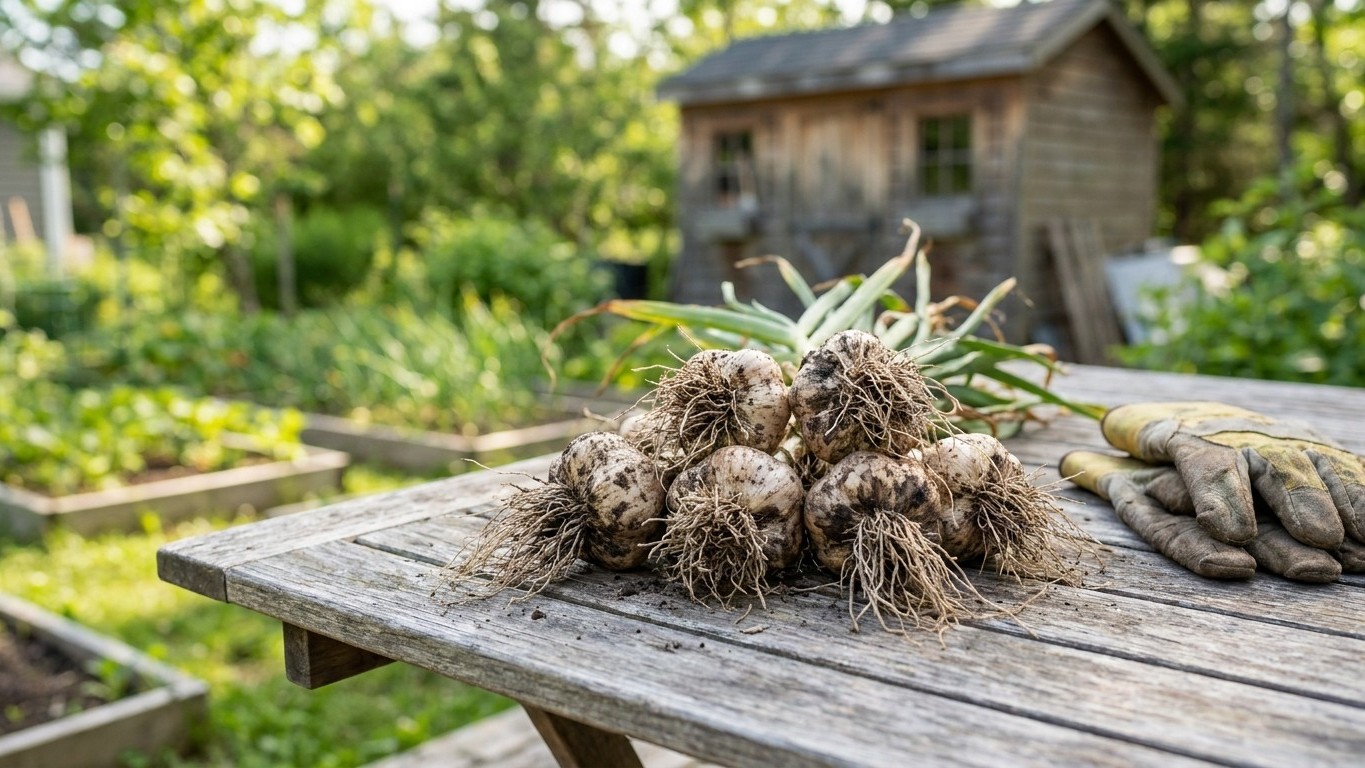

Garlic planted in fall along the Island comes out of the ground the following summer, once the lower leaves have browned and the upper ones are still green. That’s the harvest signal growers watch for here. The trickier part isn’t the digging. It’s what happens in the four to six weeks after: curing in a maritime climate that stays damp well into September, then storing through a winter that swings between deep cold and thaw.
When garlic is ready to lift in Prince Edward Island
Garlic doesn’t run on a fixed date. It runs on leaf color. Each leaf on the plant corresponds to a wrapper layer on the bulb below, and the rule growers use everywhere, including on the Island, is to watch for the bottom five or six leaves turning brown and papery while the top five or six stay green. Pull too early and the bulb is undersized, the wrappers too thin to protect it in storage. Wait too long and the wrappers split, the cloves separate, and the bulb won’t keep past a few weeks.
The safest way to check is to stop guessing from the top of the plant and dig one test bulb instead. Brush off the soil, slice it in half, and look at the clove definition. If the cloves are plump and distinct with wrappers still intact, the rest of the bed is likely ready within a few days.
The season that sets this up
Because this crop goes into the ground the previous fall, the length and character of the growing season between planting and lifting matters more than any single date. On the Island, the average first fall frost lands around October 17, according to Environment and Climate Change Canada’s Canadian Climate Normals for 1981-2010, recorded at the Charlottetown A station. That figure is worth reading carefully before treating it as a planning tool: it’s a mean date, not a guarantee. In one year out of two, frost arrives later than October 17, sometimes weeks later. It’s also a single-station number. Charlottetown sits in a milder pocket of the province, and northern or upland districts routinely run behind it by a couple of weeks. Growers further inland or closer to the north shore should treat that date as a rough midpoint, not a hard line.
What that means for the harvest side of the calendar is simple: a fall that turns cold early compresses the following season’s growth window slightly, while a mild, late fall gives cloves more time to establish roots before winter sets in. Either way, the leaf-color test at lifting time matters more than counting days from any calendar date. For localized guidance on timing in a given county or growing zone, the province’s own agriculture office is the better reference point than a single climate station: princeedwardisland.ca/en/topic/agriculture.
Curing it, and where to hang it here
Curing is the step that turns a freshly dug bulb into something that keeps. Fresh garlic is roughly 65 percent water by weight in the neck and wrapper tissue, and that moisture has to leave slowly, evenly, and without direct sun scorching the bulb, or the wrappers seal in dampness instead of drying it out. Done right, curing takes three to four weeks. Done in a rush, in full sun or a sealed plastic bin, it produces bulbs that look fine on the outside and rot from the neck down within a month.
The practical method: leave the roots and tops attached, brush off loose soil without washing the bulb, and either hang the plants in loose bundles or lay them in a single layer on a screen or slatted rack. Air needs to move freely on every side. That’s the part that trips people up on the Island specifically. Summers here run humid, with onshore air off the Northumberland Strait and the Gulf of St. Lawrence keeping ambient moisture higher than in a drier inland climate. A closed shed with no airflow is exactly the wrong environment.
Spaces that work locally
Good curing spots on Island properties tend to be the same ones people already use for drying anything else: an open-sided barn bay, a detached garage with the door cracked, a covered porch out of direct sun, or a shed with a box fan running on low. The goal is shade, warmth, and constant air exchange, not heat. A space that traps humidity, like a sealed basement or an unventilated greenhouse, will slow curing down and invite mold on the outer wrappers before the inside ever finishes drying.
Once the wrappers are papery, the roots are stiff and dry, and the necks have tightened down, trim the roots close and cut the tops back to an inch or two above the bulb, or braid them if the variety and neck type allow it. That’s the point where garlic is ready to move into winter storage.
Storing it through a Prince Edward Island winter
Cured garlic wants three things in storage: cool temperatures, low humidity, and darkness. What it does not want is a refrigerator. Cold, damp conditions below the mid-40s Fahrenheit push the bulb toward early sprouting, since garlic reads sustained cold as the end of its dormancy period and starts pushing green shoots months before it should. A pantry shelf, an unheated closed porch, or a cool back room away from a furnace or woodstove usually works better than anything electrically cooled.
The Island’s winter climate cuts both ways here. Outdoor air runs genuinely cold for long stretches, which is useful if a grower has an unheated but frost-free space like an attached garage or a mudroom that never quite reaches freezing. But indoor humidity in an occupied house, especially with a woodstove or forced-air heat running most days, can swing drier than garlic prefers, drying bulbs out faster than expected by midwinter. An uninsulated space that’s too close to outdoor temperatures risks the opposite problem: actual freezing, which turns the interior of the bulb soft and unusable once thawed.
Checking on stored bulbs
Garlic stored well doesn’t need daily attention, but a monthly check catches problems before they spread. Any bulb that’s gone soft at the neck, developed a sour smell, or started sprouting should come out of the batch immediately, since one compromised bulb sitting against others in a bin or mesh bag can pass rot along faster than it would sitting alone. Mesh bags, open baskets, or old onion sacks work better than sealed containers for this reason. Air needs to keep moving around stored bulbs the same way it needed to during curing.
What goes wrong here
Most storage failures on the Island trace back to one of two points in the process rather than bad luck with the bulbs themselves. The first is curing in a space with poor airflow during a humid stretch, which produces mold on the outer wrappers that then works inward. The fix isn’t a different variety or a different harvest date. It’s moving the crop to a spot with real cross-ventilation and giving it the full three to four weeks before packing it away.
The second is storage temperature that’s either too cold and damp (triggering early sprouting) or too warm and enclosed (accelerating moisture loss and softening). Neither shows up right away. A bulb that looked perfect at Thanksgiving can be visibly shrunken or sprouting by February if the storage spot wasn’t right from the start.
Pest pressure is a smaller factor for stored bulbs than curing conditions, but it’s not zero at the planting stage the previous fall. University of Maine Cooperative Extension, covering the neighboring region, documents seedcorn maggot as a pest that attacks seeds and planted material in cool, damp soil, the same conditions garlic cloves sit in through a fall planting before winter dormancy sets in. It’s worth knowing the name if cloves fail to establish roots properly in a wet fall, since the damage happens underground and out of sight until spring.
Common questions
How long does cured garlic actually last in storage on the Island?
Well-cured, properly stored garlic in a cool, dry, dark spot typically holds for several months into winter before quality starts to drop. The exact endpoint depends more on how well the curing and storage conditions were managed than on the calendar, which is why checking bulbs periodically matters more than marking a fixed expiration date.
Can garlic be harvested before the leaves start browning?
It can be pulled early, but the bulb will be smaller and the wrappers won’t have thickened enough to protect it in storage. Garlic lifted too soon tends to shrivel and lose moisture fast rather than cure into a keeper.
Is the October 17 frost date useful for deciding when to harvest?
Not directly. That date describes the average first fall frost from Environment and Climate Change Canada’s climate normals for the Charlottetown A station, which matters more for planning fall planting than summer harvest. It’s also a mean date, meaning frost falls later than that in half of all years, so it should never be treated as a fixed cutoff for any garden task.
What’s the biggest mistake people make curing garlic on the Island specifically?
Underestimating the region’s humidity. A curing space that would work fine in a drier climate, like a closed shed with no airflow, often isn’t enough here. The fix is straightforward: more open air movement, whether that’s a cracked door, a screened window, or a fan, for the full three to four weeks the bulbs need to dry down properly.