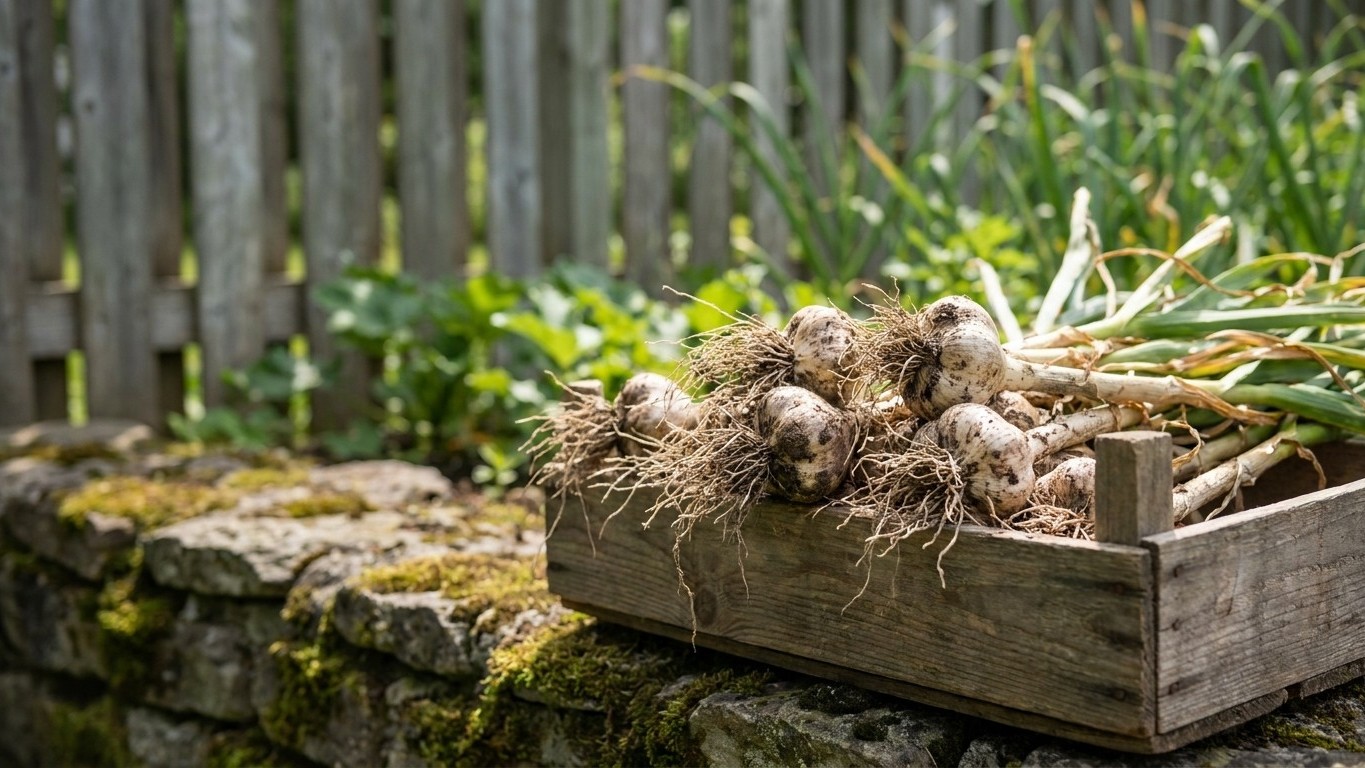

Hardneck and softneck garlic both handle Quebec winters, and every variety worth planting here goes into the ground in mid-September, about three weeks before the region’s mean first fall frost of October 5, tracked by Environment and Climate Change Canada at the Montreal/St-Hubert A station. That frost date is an average, not a guarantee: treat it as the midpoint of a window, not the day to plan around. Mark mid-September on the calendar now and plant then, whatever the forecast shows closer to fall.
The short answer for Quebec

Every cultivar on this list, hardneck or softneck, is set out in mid-September in Quebec. That timing is anchored to Environment and Climate Change Canada’s 1981-2010 Canadian Climate Normals for the Montreal/St-Hubert A station, which put the mean first fall frost at October 5. Three weeks or so of root growth before that date gives cloves time to anchor themselves before the ground locks up for winter, without pushing enough top growth to be hurt by cold.
Why the date sits in mid-September
That October 5 figure is a long-term average, and in roughly half of the years on record the first frost lands later than that, sometimes by a couple of weeks. It is not a safe date to plant toward. Garlic goes in on the calendar in mid-September regardless of what the extended forecast shows, because a clove that misses its rooting window loses far more than one planted a little early ever risks.
Cold itself is not the limiting factor here. Garlic needs six to eight weeks of temperatures below 40°F after planting to split into cloves, according to the University of Georgia Extension (publication C854). The Montreal area spends an average of 30.4 weeks a year below that mark, which comfortably clears what the crop needs several times over. Whatever variety you choose from the table below, winter will do its job. The date you plant it, and how deep, are what actually decide the outcome.
| Variety | Neck type | Set-out window |
|---|---|---|
| Early Red Italian | Softneck | Mid-September |
| Inchelium Red | Softneck | Mid-September |
| Italian Late | Softneck | Mid-September |
| Lorz Italian | Softneck | Mid-September |
| Bavarian Purple | Hardneck | Mid-September |
| Blue Music | Hardneck | Mid-September |
| Chesnok Red | Hardneck | Mid-September |
| Duganski | Hardneck | Mid-September |
| Fall Festival | Hardneck | Mid-September |
| Georgian Crystal | Hardneck | Mid-September |
| Georgian Fire | Hardneck | Mid-September |
| German Red | Hardneck | Mid-September |
| German White | Hardneck | Mid-September |
| Ivan | Hardneck | Mid-September |
Softneck types such as Early Red Italian, Inchelium Red, Italian Late and Lorz Italian sit on the same mid-September schedule as the ten hardneck cultivars on the list. Hardnecks including German Red, German White, Chesnok Red and Duganski are the traditional choice in a cold winter province because their stiff central stem and looser wrapper tend to tolerate a hard freeze in open ground better than a softneck’s tightly wrapped bulb does. Softneck varieties still belong on a Quebec planting list. They just ask for a heavier mulch layer where snow cover runs thin.
Working it out for your own garden
The mid-September date above is built from one reference point: Environment and Climate Change Canada’s average first fall frost of October 5 for the Montreal/St-Hubert A station. To set a planting date for your own garden, start with your own area’s mean first fall frost, then count back roughly three weeks, the same span used here, so the cloves get comparable time to root before the soil freezes hard.
Redoing the arithmetic locally
Three weeks is not a fixed rule. It is what fits the gap between mid-September and October 5 at this one station. If your own area’s frost normal runs later than Montreal’s, you can push planting a little later and still land inside that same rooting window. If it runs earlier, move planting earlier to match. The goal stays the same wherever you garden: cloves in the ground long enough to grow roots, but not so early that they push much leaf before the cold sets in.
Elevation, a large lake nearby, or a coastline can each shift a district’s frost normal by up to two weeks in either direction from a low-lying inland station like Montreal’s. A higher garden usually sees its first frost arrive earlier than the flatland average. A garden near a large body of water usually sees it arrive later, because the water releases stored summer heat into the fall air. Weigh both effects before subtracting three weeks from your own district’s frost date, rather than borrowing the Montreal number outright.
The planting calendar for Quebec garlic walks through that back-counting exercise in more detail, including how to read your own regional frost normal instead of Montreal’s. If you have not already worked through bed preparation and clove selection, the general guide to growing garlic in Quebec covers that ground first.
None of this changes the winter chilling side of the equation. Once cloves are in the ground, the province’s winter cold is more than sufficient wherever garlic is grown here, so the vernalization period settles itself without any attention from the grower. What planting date and depth control is whether the clove has rooted enough, before that cold arrives, to make use of it.
What changes across Quebec
The October 5 mean frost date used above comes from one station, Montreal/St-Hubert A, sitting in the Montérégie lowlands south of the city. That is among the mildest, latest-frost farmland in the province, and it does not describe anywhere with more elevation or more distance from the moderating St. Lawrence.
Higher and more inland ground
The Eastern Townships and the Laurentian foothills sit higher than the Montreal plain, and higher ground cools faster after sunset. Expect frost to arrive earlier there than the Montreal normal, which pulls the whole mid-September planting window earlier with it. Saguenay-Lac-Saint-Jean and Abitibi-Témiscamingue run on a more continental pattern further from the St. Lawrence, with a shorter frost-free season than the river valley overall.
Along the St. Lawrence estuary
From the Bas-Saint-Laurent through the Gaspé and the Côte-Nord, the open water works the other way. It releases summer heat slowly through the fall, which tends to delay the first frost near the shoreline compared with inland ground at the same latitude. A garden a few kilometres back from the water can still see an earlier frost than one right along it, even within the same district.
None of this changes the planting window’s logic, only its exact date. Garlic still goes in roughly three weeks ahead of whatever the local mean first frost turns out to be, wherever in the province that garden sits.
The mistakes this climate punishes
Planting on the forecast instead of the calendar
Waiting for a frost warning before planting is the single costliest mistake in this climate. Because October 5 is a mean and not a guaranteed date, a mild fall can push the real frost two or three weeks past it, and a grower waiting for cold weather as a planting cue ends up going in far too late for cloves to root before the ground freezes hard. Plant in mid-September on the calendar, and let the actual frost date be irrelevant to the decision.
Planting shallow or skipping mulch
Ground that freezes hard and then thaws in a midwinter warm spell heaves shallow-planted cloves right out of the soil, roots and all, and a bulb sitting on the surface through the rest of winter is a dead bulb by spring. A generous mulch layer put down at planting time, not added later once the ground looks bare, is what keeps that freeze-thaw cycle from reaching the clove in the first place.
Choosing an unprotected softneck for an exposed site
Softneck cultivars such as Italian Late or Early Red Italian can still be grown here, but their tightly wrapped bulb and softer neck are generally less tolerant of a hard, open freeze than a hardneck’s stiffer stem. On a site with thin snow cover and little windbreak, a hardneck such as Georgian Fire or Fall Festival is the safer bet, or plan on mulching the softneck rows more heavily than the hardneck ones.
Planting saved stock without checking its disease history
White rot (Sclerotium cepivorum) and Fusarium basal rot (Fusarium oxysporum f. sp. cepae) both find conditions to work with in this climate. Using the UC IPM Pest Management Guidelines for onion and garlic (UC ANR Publication 3453), Quebec’s growing-season air temperature falls inside white rot’s published 50-75°F range in four months, September, May, June and July, and inside Fusarium basal rot’s published 59-90°F range in three months, September, June and July.
- Those thresholds were published as soil temperatures, and the comparison above uses air temperature instead, so read it as a rough indicator, not a diagnosis.
- A monthly average hides a lot of daily swing, a month that averages inside a pathogen’s range still has plenty of days outside it.
- One weather station never describes an entire province, and a lower count of months does not mean either disease is impossible here.
Both pathogens travel in infected planting stock, and cold Quebec air will not stop garlic that was already carrying either one before it went into the ground. Buying certified, disease-free seed garlic is the actual defense, not the calendar.
Checking this against your county
Quebec’s agriculture ministry, the Ministère de l’Agriculture, des Pêcheries et de l’Alimentation (MAPAQ), is the place to check local advisories and regional frost information. MAPAQ’s regional offices track conditions specific to their own district, and their regional pages will confirm whether your local frost pattern runs earlier or later than the Montreal/St-Hubert A normal.
Treat everything above as a starting point for planning, then confirm the fine detail against your own district’s actual conditions before you commit a full bed of Blue Music or Ivan to a mid-September planting date.
Common questions
Do I have to Plant Garlic before the first frost in Quebec?
Yes, and with room to spare. Garlic goes in about three weeks ahead of the mean first frost, not the week before it, so the cloves have time to root while the soil is still workable.
What happens if I plant in early October instead of mid-September?
The cloves may still survive if that year’s frost happens to land late, since October 5 is only a long-term average. You are gambling on a later-than-normal fall, though, and a planting that misses the mid-September window generally roots poorly and produces a smaller bulb the following summer.
Is hardneck garlic really required for a Quebec winter, or will softneck survive too?
Softneck varieties such as Inchelium Red and Lorz Italian are grown successfully in Quebec, so hardneck is not a strict requirement. Hardnecks tend to need less winter protection on an exposed site, while softnecks generally reward a heavier mulch layer with a longer storage life after harvest.
Can I plant garlic from the grocery store instead of buying seed stock?
It is not worth the risk. Grocery garlic is rarely labeled by variety, is often treated to slow sprouting, and carries an unknown disease history, including the white rot and Fusarium basal rot risks covered above. Certified seed garlic from a known source costs more but removes that gamble.