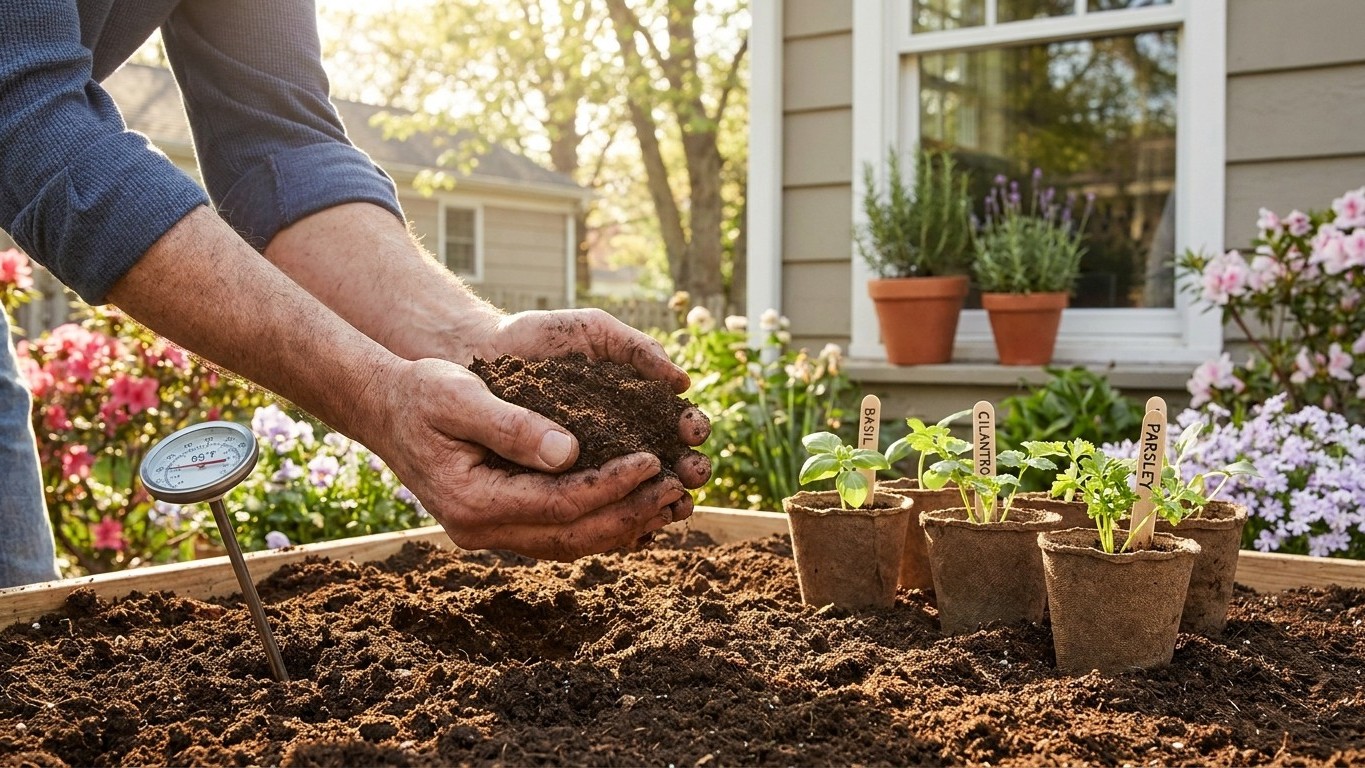

Herbs go into Prince Edward Island soil once the ground itself has warmed, generally mid-to-late May, roughly two weeks past the average last frost. But the province’s short, cool season means the real decision isn’t the calendar date, it’s which herb types can handle a Canadian hardiness zone 5b winter as permanent plants, and which ones need a pot and a trip indoors before the cold sets in.
When the soil is warm enough in Prince Edward Island

The Charlottetown A station puts the average last spring frost at May 16, drawn from Environment and Climate Change Canada’s Canadian Climate Normals for 1981-2010. That single date gets treated by a lot of gardeners as a green light. It isn’t. It’s a mean, which means in roughly half of all years frost arrives after May 16, sometimes well after. Treat it as the midpoint of a window, not a guarantee, and plan sowing dates with that gap in mind.
Frost date matters less than what it stands in for, which is soil temperature. Herb seeds and transplants don’t respond to air readings on a thermometer; they respond to the ground around their roots. Soil takes longer to warm than air does, especially on an island surrounded by cold ocean water well into spring. So the frost date is a proxy, and a rough one. The actual warm-enough point for most herb sowing tends to land after that mid-May mark, once the soil itself has caught up.
There’s also a geography problem baked into that single number. Charlottetown A is one station on one part of the island. Prince Edward Island is small, but it isn’t one climate: coastal spots warm differently than inland fields, and low-lying areas hold frost pockets that a station reading won’t show. Anyone gardening outside the Charlottetown area should expect their own soil to lag behind or occasionally run ahead of what the official normals suggest.
Cold-tolerant types versus warmth-loving types
Not every herb needs the same soil temperature to get going. Some types, the ones with a reputation for tolerating a light frost, can go in the ground while the soil is still cool and the last-frost date is barely behind you. Others, especially the tender annual types that come from warmer native ranges, sulk or rot in cold, wet soil and do better waiting until the ground has properly warmed, sometimes into early June on this island. That difference in timing is the single most useful piece of planning information a PEI gardener can use, more useful than the frost date on its own.
Several herbs common in home gardens carry long-standing reputations for traditional or medicinal uses. This page doesn’t evaluate any of those claims one way or another; it sticks to growing conditions. And for the sake of safety, this isn’t a foraging guide either: a handful of dangerous look-alike plants resemble common garden herbs closely enough that identification by written description alone is a real risk. Buy known nursery stock or seed from a reputable source, and skip the wild patch.
How long the season lasts here
With an average last spring frost of May 16 and an average first fall frost of October 17, both from the Charlottetown A station’s 1981-2010 normals, the frost-free window on Prince Edward Island runs about 154 days. That’s the arithmetic straight from the two dates given, and it’s worth sitting with, because it’s shorter than what gardeners in much of the northeastern United States are working with.
A season that length does real work in shaping decisions. It’s long enough to get a full run out of most herb types planted after the frost risk has passed, with time to establish, grow, and be harvested repeatedly before fall cold shuts things down. It is not, however, generous enough to assume a second full sowing of slower-growing types will mature before the October frost arrives. For quick-cycling herbs, especially ones typically grown from seed and harvested young, a second sowing in mid-summer can still finish before the window closes. For herbs that take longer to establish or that are usually grown as transplants, one planting per year is often the realistic plan here, not two.
That distinction changes how much effort goes into transplanting versus direct seeding. In a longer season, a failed or slow transplant can be replaced and still produce something worthwhile. In PEI’s compressed window, a transplant that struggles in its first two weeks has eaten into a season that doesn’t have much slack to give back. Checking root health and hardening off transplants properly before they go in the ground matters more here than it would in a region with an extra six or eight weeks of frost-free growing to spare.
Anyone planning to stretch the calendar with a second round of fast herbs, or stagger plantings for a steadier harvest, should work from the site’s succession sowing guide, which lays out timing logic that applies directly to a short-season window like this one.
Heat and water in Prince Edward Island

This is the section where a lot of general herb-growing advice stops applying to Prince Edward Island, because most of it is written with hot, dry summers in mind. That’s not this climate. The island sits surrounded by ocean water that keeps summer temperatures moderate, and the pattern of a stretch of days above 90°F that shapes gardening advice in warmer US states simply isn’t the defining feature here. The bigger factor for herbs grown on PEI isn’t summer heat at all. It’s winter.
The coldest month here averages a daily minimum of just 10.3°F, according to Environment and Climate Change Canada’s 1981-2010 normals for the Charlottetown reference station. Paired with a Canadian hardiness zone rating of 5b, that number is the one that actually decides the shape of a PEI herb garden. It’s worth flagging that this Canadian zone system is not the same scale as the USDA zones cited elsewhere on this site; NRCan builds its zones from seven climate variables rather than one, and the two systems don’t convert cleanly. A Canadian 5b rating tells you specifically how this reference location’s climate behaves, not where it sits on a US map.
What that cold minimum means in practice: herbs with genuinely woody, cold-hardy root systems can survive a PEI winter outdoors and come back as permanent plantings year after year. Herbs from warmer native climates, including several of the most commonly grown culinary types, have no realistic chance of surviving that winter minimum in open ground. For those, the island’s growers generally treat them as annuals raised fresh each spring, or as container plants brought indoors before the cold arrives.
On the summer side, a cool, often damp season brings its own set of problems that a hot-climate guide wouldn’t mention. Without the intense heat and days above 90°F, herbs on the island are less likely to suffer heat stress or bolt early, but the trade-off is a slower ripening pace for anything that wants real warmth, plus a higher risk of fungal issues on herbs planted too densely. Good airflow between plants and morning watering rather than evening watering both help offset the extra humidity that a cooler, wetter summer tends to hold onto overnight.
Which herbs suit Prince Edward Island
Every fact above points toward the same organizing question for a PEI herb bed: is this herb type built to survive a 5b winter outdoors, or does it need to be treated as an annual or a container plant that comes indoors? That single split does more to organize a workable herb garden here than any other single factor, including the short season or the cool summer.
From there, the island’s specific conditions narrow things further:
- A short, 154-day frost-free window favors herb types known for reaching usable size quickly, since slower types cut it close against the October frost.
- A cool, damp summer rewards types with a reputation for disease resistance and good tolerance of humid air, since mildew and rot pressure tend to run higher here than in a drier climate.
- Herbs grown as permanent, in-ground plantings need genuine cold hardiness for a zone 5b winter and a 10.3°F coldest-month minimum, not just general frost tolerance.
- Herbs that can’t meet that winter threshold do better in containers, where they can be moved into a garage, porch, or indoors before the ground freezes hard.
| Consideration | Hardy perennial-type herbs | Tender annual-type herbs |
|---|---|---|
| Winter survival outdoors (zone 5b, 10.3°F coldest-month min) | Generally survives in the ground | Does not survive; needs container or annual replanting |
| Best fit for the 154-day season | Established once, produces for years | Needs full season each year to reach usable size |
| Response to a cool, damp summer | Usually tolerant if airflow is good | More prone to slow growth and fungal issues |
What this page won’t do is name a specific variety within any of those types. The cultivars that actually perform well on Prince Edward Island are the ones trialled locally, under this specific combination of a short season, a cool summer, and a genuinely cold winter, and that information belongs to the people testing it on the ground, not to a general guide. Prince Edward Island’s own provincial agriculture service is the source built to answer that question with current, locally tested recommendations, and it’s the right next stop for anyone ready to move from herb type to an actual seed packet or nursery tag.