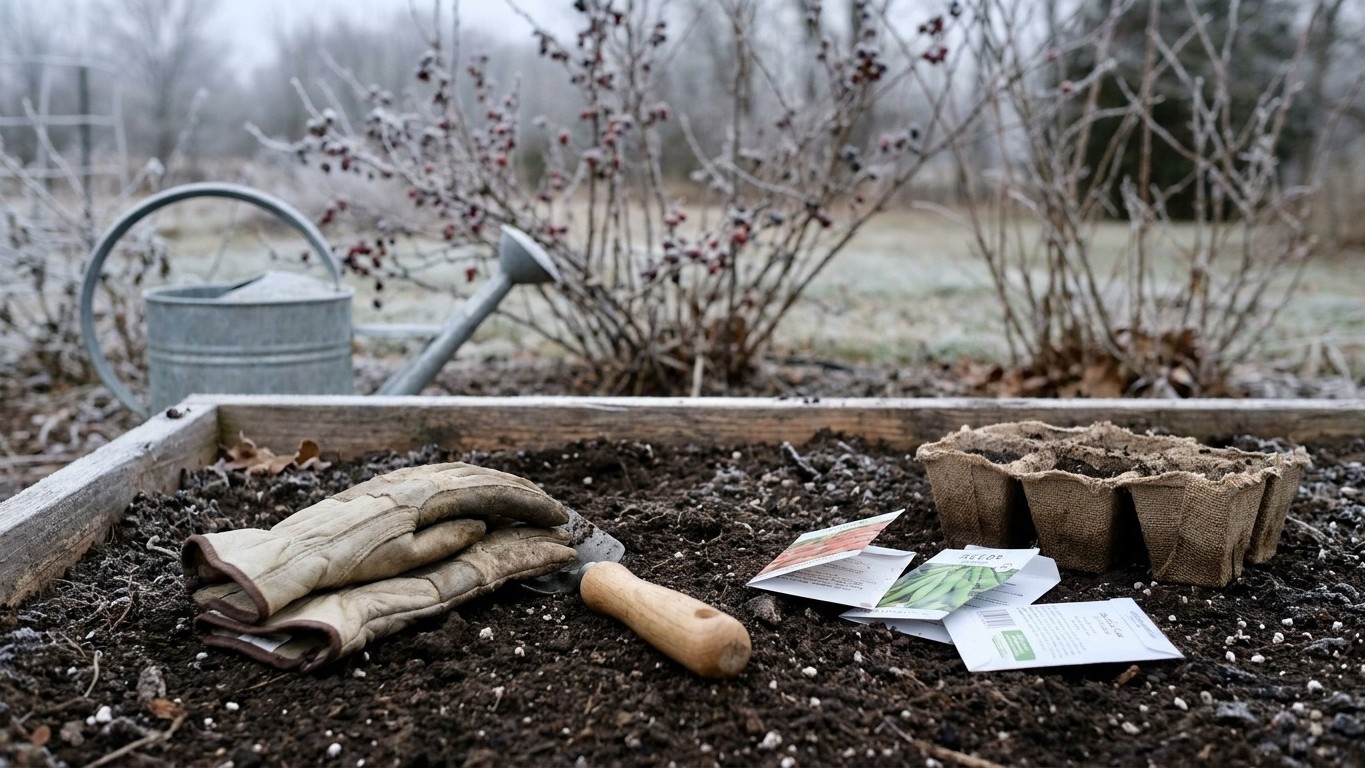

February in Prince Edward Island is the deep freeze, and the honest answer is that nothing goes into open ground this month. The soil is locked solid, snow cover is doing the only useful work outdoors, and the real gardening happens indoors: forcing crops, starting long-season seedlings under lights, and getting dormant pruning and planning done before the thaw makes everything urgent at once.
What goes in the ground in February

The decision here isn’t the calendar, it’s soil temperature, and in February in PEI that temperature is at or near freezing to several inches down. Environment and Climate Change Canada’s Charlottetown A station puts the average last spring frost at May 16, which means February sits roughly three months ahead of the point where the ground even starts to soften. There is no direct-sow or transplant window open right now, and pretending otherwise sets a garden up to fail before it starts.
That doesn’t mean the garden is idle. A few things are genuinely doable this month, and they’re worth doing well rather than skipped:
- Forcing rhubarb crowns indoors in a dark, cool space (a basement or unheated porch works) for an early harvest weeks ahead of anything outdoors.
- Forcing chicory for Belgian endive: lifted roots, trimmed and packed in soil or sand in total darkness, produce tight pale heads in three to four weeks.
- Bare-root stock for fruit trees, cane fruit and roses can be ordered and, if it arrives before the ground thaws, heeled into a box of damp sand or sawdust in a cold but frost-free space until planting is possible.
- Cold frames already holding hardy greens from fall can be checked and vented on sunny days, but nothing new goes into them this month in this climate.
Garlic and shallots, which some regions still plant in late winter, are not a February job on the Island. PEI garlic goes into the ground in fall, and by February that crop is already dormant under snow, not being newly planted.
What to start under cover
The arithmetic for indoor seed-starting runs backward from that May 16 average last frost, and it’s worth doing the math rather than trusting a fixed date, because that figure is a mean: in roughly half of all years, frost arrives later than May 16, not earlier. Treat it as the middle of a window, not a finish line.
Onions, leeks, celery and celeriac are the slow starters that need 10 to 14 weeks of indoor growth before they go outside, and they can tolerate being set out close to the average last frost date since they shrug off a light freeze. Counting back 10 to 14 weeks from mid-May lands squarely in February, which makes this the month to get them under lights. Onions in particular are sensitive to timing because they bulb in response to day length starting around the summer solstice; start them too late and they’ll form small bulbs regardless of how big the plant is by then.
Tomatoes, peppers and other tender crops are a different story. They need 6 to 10 weeks indoors but can’t go outside until the danger of frost has genuinely passed, which on the Island often means waiting well past the May 16 average into late May or June. Starting them in February is the classic overshoot: by the time it’s safe to plant out, they’re rootbound, leggy and stressed, and they rarely catch up to a batch started three or four weeks later. February belongs to the alliums and celery family; save the nightshades for next month.
What is ready to pick
Little to nothing is coming out of open ground in PEI in February, and any gardener who tells you otherwise is either in an unusually sheltered microclimate or talking about something under cover. That’s the plain truth of a Canadian hardiness zone 5b winter (a rating built from seven climate variables specific to the reference city, not a stand-in for a USDA zone, and not uniform across the whole province).
What still feeds the household this month comes from three places. First, anything overwintered under a heavy snow blanket: kale, and sometimes leeks in a well-drained bed with extra mulch, can survive under insulating snow cover and be dug out on a mild day, though quality drops the longer they sit frozen and thawed repeatedly. Second, cold frames holding hardy greens like spinach or mâche can still yield a light picking when the frame is vented and the plants haven’t been smothered by snow load. Third, and most reliable, is what’s growing indoors on purpose: sprouts and microgreens started on a windowsill or under a grow light take just one to two weeks from seed to harvest and don’t care what the thermometer outside is doing.
This is also the month to walk the root cellar or cold storage shelf with a critical eye. Check stored squash for soft spots near the stem, potatoes for sprouting eyes or green shoulders, and onions for any that have gone soft at the neck. Pulling the failing ones now protects everything stored around them from spreading rot.
The jobs that matter this month

A quiet-looking garden in February is still carrying a full workload, and most of it has a real deadline attached.
Pruning and stock work
Dormant pruning of apple and pear trees, and of raspberry and currant canes, is best done while the plants are fully asleep and before sap starts moving. Pick a day that isn’t in the middle of a hard cold snap, since cutting into wood at extreme low temperatures can cause dieback around the cut. This is also the window to buy or order bare-root fruit trees and berry canes before nurseries sell through their best varieties, a real risk given how far ahead serious growers plan.
Soil, tools and planning
Compost piles that aren’t frozen solid should still get an occasional turn to keep the aerobic breakdown going; frozen piles can simply wait. Garden tools benefit from a proper cleaning and sharpening now, while there’s time and no urgency pulling attention elsewhere. Raised bed frames, trellises and fencing that took damage over the fall are easier to repair in a workshop than in a muddy spring bed. And this is the month to sketch next season’s crop rotation on paper, so the plan is ready the moment the soil is workable rather than being improvised in a rush.
What not to do in February
The biggest mistake this month is starting tender crops too early because a sunny stretch made it feel like spring. Tomatoes, peppers, cucumbers and squash started in February will be weeks too old and stressed by the time PEI’s soil and air are actually warm enough for them outdoors, generally well after that May 16 average frost date. Hold them for next month instead.
A mid-February thaw is another trap. A few days of melt can tempt a gardener to pull mulch off perennial beds or vent a cold frame wide open, but Island winters routinely swing back into hard freezes after a warm spell, and exposed crowns or newly vented frames take the hit. Leave protective mulch in place until the thaw looks sustained, not just pleasant.
Skip nitrogen fertilizer entirely this month. Dormant plants aren’t taking up nutrients, and on ground that’s still frozen or saturated with snowmelt, applied nitrogen has nowhere to go but into runoff, which is a real concern on an island where agricultural land drains quickly into surrounding waterways. Save fertility work for when plants are actively growing and can actually use it.
Checking this against your own county
These are province-wide patterns built around the Charlottetown A climate station, and Prince Edward Island isn’t one uniform climate. Coastal areas exposed to the Gulf of St. Lawrence, sheltered inland pockets, and spots that hold snow cover longer can each shift these windows by a couple of weeks in either direction. Snow depth alone changes how well a cold frame or mulched bed performs from one part of the Island to another.
For local specifics, the Prince Edward Island agriculture resources page is the place to check before committing a season’s seed order to any single date.
Common questions
Can I plant anything directly outdoors in PEI in February?
No. The ground is frozen and the average last spring frost doesn’t arrive until May 16, so open-ground planting isn’t realistic this month regardless of a mild-feeling day.
What’s the first thing I should start indoors?
Onions, leeks, celery and celeriac, since they need 10 to 14 weeks of indoor growth and can go outside close to the last frost date without much risk from a light freeze.
Is it too early to start tomato seeds in February?
Yes, for PEI’s timeline. Tomatoes only need 6 to 10 weeks indoors, and starting now means leggy, rootbound plants by the time it’s safe to move them outside.
What hardiness zone is Prince Edward Island in?
The reference city sits in Canadian zone 5b, a rating from Natural Resources Canada built on seven climate variables. It does not convert to a USDA zone and shouldn’t be compared directly to US zone numbers used elsewhere.
Gardeners who plant by the Moon can check the February 2027 moon planting calendar, a tradition rather than a proven method.