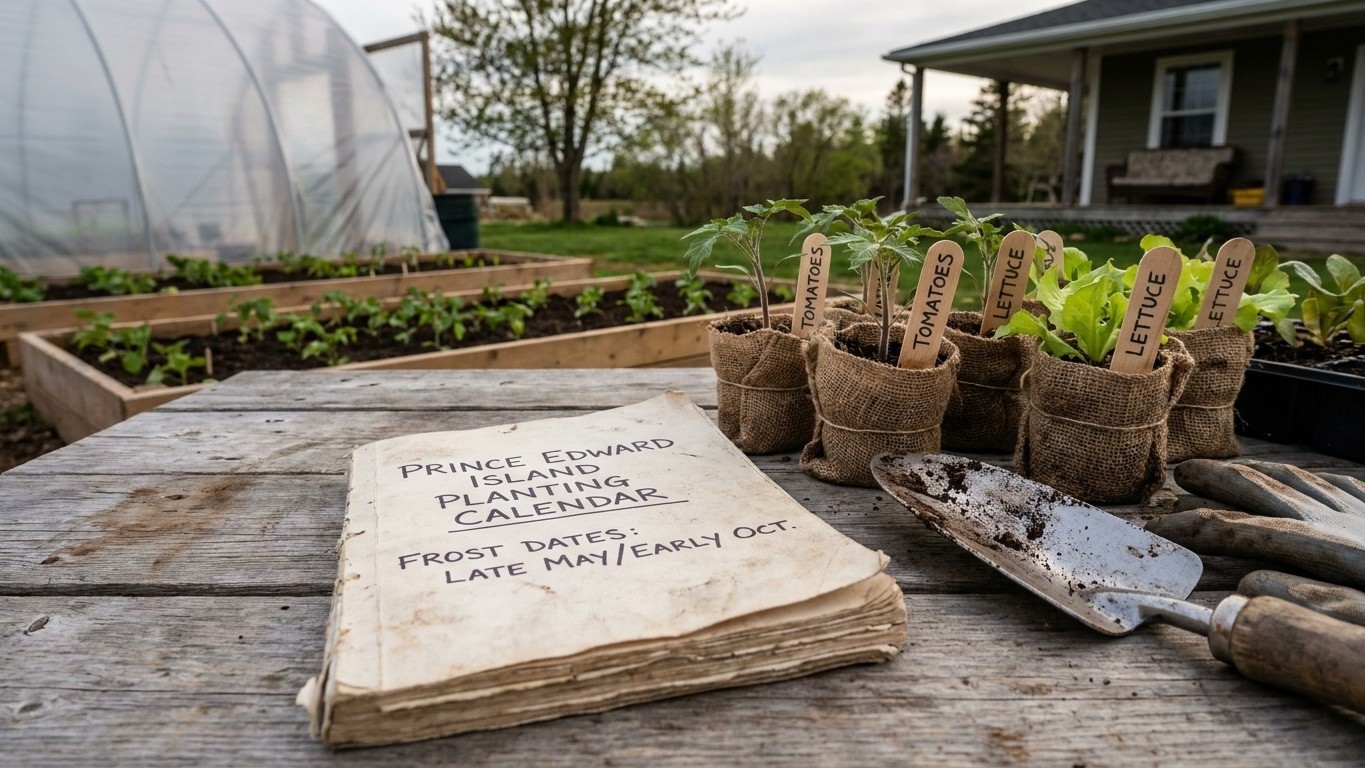

Prince Edward Island’s growing season runs from an average last spring frost of May 16 to an average first fall frost of October 17, according to Environment and Climate Change Canada’s 1981-2010 Canadian Climate Normals for the Charlottetown A station. That leaves roughly five months of frost-free time in a typical year, though frost arrives later than May 16 in half the years on record. Treat that date as a midpoint, not a green light, and hold tender transplants back until the last week of May at the earliest.
The frost window in Prince Edward Island

Charlottetown A is the province’s reference weather station, and its 1981-2010 normals from Environment and Climate Change Canada set the last spring frost at May 16 and the first fall frost at October 17. Those two dates bracket a frost-free season of about 154 days on average, counting from mid-May through mid-October. That is a generous window by Atlantic Canada standards, but the word “average” is doing a lot of work in that sentence.
Why the mean date is not a safe date
A mean frost date is the midpoint of a distribution, not a guarantee. In roughly half of the years in the 1981-2010 record, the last spring frost at Charlottetown fell after May 16, sometimes by a week or more. The same logic runs the other way in fall: October 17 is the average first frost, and plenty of years push past it while others fall short. Gardeners who plant to the mean date and not around it are gambling with even odds every spring.
Elevation and distance from the coast shift these numbers further. Charlottetown sits close to the water, where the surrounding Northumberland Strait and Gulf of St. Lawrence moderate temperature swings. Inland and higher ground, particularly toward the interior of Queens and Kings counties, cools faster on clear nights and warms more slowly in spring. Those districts run weeks behind Charlottetown’s normals, not days, so a calendar built on the coastal station will read too optimistic for anyone gardening away from the shoreline. Growers working a colder microclimate, whether on the Island or across the water in Quebec, do better to add a buffer on both ends of the season rather than trust a single reference date. Starting with What to Plant in Prince Edward Island in January for the earliest indoor planning, then checking What to Plant in Prince Edward Island in February, moving on through the season to see What to Plant in Prince Edward Island in May once the frost risk finally clears, and continuing with What to Plant in Prince Edward Island in March, then to What to Plant in Prince Edward Island in November for closing out the season,garden/planting-calendar/march/”>What to Plant in Prince Edward Island in March, and later consulting What to Plant in Prince Edward Island in June once the frost risk has truly passed, and later consulting What to Plant in Prince Edward Island in July once the frost-free window is fully open, followed by What to Plant in Prince Edward Island in April at the start of the season alongside What to Plant in Prince Edward Island in August, September, and What to Plant in Prince Edward Island in DecemberWhat to Plant in Prince Edward Island in September and What to Plant in Prince Edward Island in October is a good way to plan around both ends of the season.
Cool-season crops
Cool-season vegetables tolerate a light frost and actually prefer to germinate and grow on while the soil is still cold, so they go in the ground before May 16, not after it. Peas are usually the first seed in the ground, since their germination is more limited by wet, cold soil than by frost itself. Spinach and lettuce follow a similar logic: both germinate poorly in warm soil and bolt fast once summer heat sets in, so an early start is an advantage rather than a risk.
What goes in early and why
- Peas: sown as soon as the soil can be worked, weeks ahead of the last frost, since young pea plants shrug off a light freeze.
- Spinach: direct-sown early, since it germinates best in cool soil and bolts once daytime temperatures climb.
- Lettuce: started early from seed or transplant, with a second sowing possible a few weeks later for a longer harvest.
- Brassicas (cabbage, broccoli, kale): started indoors or under cover several weeks before the last frost, then set out while nights are still cool, since seedlings handle a light frost far better than the heat stress of a late start.
- Root crops (carrots, beets, radishes): direct-sown early, since they need weeks of cool soil to size up before summer heat toughens the roots.
None of this timing runs off the calendar month. It runs off soil condition and the last frost date as a reference point, which is why a grower on the Island’s north shore, working a garden that lags Charlottetown’s normals by a couple of weeks, should watch the ground rather than the wall calendar before sowing any of the above.
Warm-season crops

Tomatoes, peppers, squash, beans and corn are killed outright by frost, and worse, they stall in cold soil even before a frost touches them. Soil temperature governs germination and root growth for this whole group, and it lags air temperature by weeks in spring. That is why growers wait past the mean last frost date, not on it, before setting out warm-season transplants. On Prince Edward Island, with a mean last frost of May 16 from Environment and Climate Change Canada’s Charlottetown normals, that generally means holding transplants until late May, giving the soil extra time to warm and hedging against the very real chance that frost lands after the mean date.
Counting back from transplant to seed-starting
Tomato and pepper transplants are typically started indoors six to eight weeks before they go in the ground, which for a late-May set-out lands seed-starting in the early-to-mid April window. That is general nursery practice rather than a local figure, so treat it as a starting point and adjust based on how leggy your seedlings get under your own lights or windowsill.
Every tomato’s days-to-maturity figure on the seed packet is counted from the transplant date, not from seed, and it assumes average conditions rather than a cool coastal summer. The table below works the arithmetic for a late-May set-out against Charlottetown’s mean first fall frost of October 17.
| Variety | Days to maturity (from transplant) | Habit | Expected first ripe | Margin before mean fall frost |
|---|---|---|---|---|
| Sakura | 55 | Indeterminate | Late July | About 85 days |
| Edox | 55 | Indeterminate | Late July | About 85 days |
| Valentine | 55 | Indeterminate | Late July | About 85 days |
| Glacier | 55 | Determinate | Late July | About 85 days |
| Sun Gold | 57 | Indeterminate | Late July | About 83 days |
| Supersweet 100 | 60 | Indeterminate | Late July | About 80 days |
| Juliet | 60 | Indeterminate | Late July | About 80 days |
| Amalfi | 68 | Determinate | Early August | About 72 days |
| Cherokee Purple | 72 | Indeterminate | Early August | About 68 days |
| Big Beef Plus | 72 | Indeterminate | Early August | About 68 days |
| Tiren | 75 | Indeterminate | Mid August | About 65 days |
| Granadero | 75 | Indeterminate | Mid August | About 65 days |
| San Marzano II | 78 | Indeterminate | Mid August | About 62 days |
| Celebrity Plus | 78 | Determinate | Mid August | About 62 days |
The arithmetic is simple to redo yourself for any variety: take the catalogue days-to-maturity, add it to a late-May set-out date, and check the result against the mean October 17 fall frost. A cherry tomato like Sakura or Sun Gold clears frost with two and a half months to spare, while a long-season paste tomato such as San Marzano II leaves barely two months of margin, which is why a cool or wet August on the Island can leave the latest-maturing plants short of a full harvest.
The fall planting window
Fall planting works backward from the first frost rather than forward from spring. Start with Charlottetown’s mean first fall frost of October 17 from Environment and Climate Change Canada, subtract the crop’s days to maturity, and then add a buffer, because growth slows as daylight shortens through September regardless of what the calendar says the temperature should be.
What actually improves after a light frost
Not every crop needs to escape the frost. Kale, Brussels sprouts, parsnips and carrots left in the ground through a light freeze convert stored starches to sugars, and many gardeners find the flavor noticeably better after that first cold snap than it was in September. These are worth timing to meet, not avoid, the season’s first light frost. Tender crops obviously get no such treatment: a fall planting of beans or squash has to finish and be harvested well ahead of October 17, with no benefit to lingering past it.
Quick-maturing crops make the best fall candidates on a shortened Island season. Spinach, lettuce, and radishes can all be direct-sown in mid to late summer for a harvest that lands well inside the frost window, since their maturity windows run to a matter of weeks rather than months. A second planting of peas can work the same way, though it needs to go in early enough that pod-fill finishes before the cooling really sets in. The margin that matters here is the one between a crop’s stated days to maturity and the calendar days actually remaining before October 17, and that margin should be generous, since fall growth is consistently slower than the same crop would manage in the longer days of June.
Reading a planting calendar properly
A provincial planting calendar, this one included, is built from one weather station’s data and applied to an entire province, which means it is a starting point rather than an instruction to follow blindly. Charlottetown’s coastal position keeps its normals milder than inland or upland ground, and the same mismatch shows up everywhere: a calendar built for Chicago reads differently than one built for downstate Illinois, and the same principle applies at Island scale between the coast and the interior.
What actually shifts the date in your yard
Elevation is the biggest factor beyond the coast itself. Cold air is heavier than warm air and drains downhill overnight, so a garden in a low spot or a valley bottom frosts sooner and harder than one on a slope a few hundred feet away. Large bodies of water, including the Northumberland Strait along PEI’s south shore, hold heat into fall and release it slowly, delaying the first frost near the coast relative to inland fields. Urban and built-up areas run warmer too, since pavement and buildings retain daytime heat overnight.
The only real fix is to watch your own ground. Keep a simple log of your garden’s actual last spring frost and first fall frost for a few years, and that record will tell you more than any provincial normal ever will. A late cold snap after a warm stretch in May is the classic trap: warm days pull gardeners into planting early, and a clear, calm night a week later erases the head start.
Local help
The Prince Edward Island agriculture office, part of the provincial extension service, is the right place to check county-level frost expectations and to get a soil test done before you commit a season’s budget to seed and transplants. A soil test result is worth more than any planting date, since it tells you what your particular ground needs rather than what the province averages out to. For more on adapting a general schedule to Island conditions, the broader set of Prince Edward Island guides on this site goes further into crop-by-crop specifics.
Common questions
Is May 16 safe to plant tomatoes outside on PEI?
No. May 16 is Environment and Climate Change Canada’s mean last frost date for Charlottetown, which means frost falls later than that in roughly half of all years. Tomatoes and other warm-season transplants are safer held back to late May, and soil temperature matters as much as the frost date itself.
Does the frost date change much across the Island?
Yes. Charlottetown’s coastal position gives it milder normals than inland or higher ground, and areas away from the moderating effect of the Strait can run weeks behind the Charlottetown figures used on this page. Check with the provincial agriculture office for anything closer to your specific county.
What can I still plant in July on PEI?
Quick crops like lettuce, spinach, and radishes can still be sown in July for a fall harvest, since their maturity runs to weeks rather than months. Anything with a long days-to-maturity figure, like a paste tomato or a full-season squash, is too late to start from seed by midsummer.
Why did my seedlings stall after I transplanted them on time?
Cold soil is the usual culprit. Air temperature can feel warm on a sunny May day while the ground several inches down is still cold from winter, and warm-season roots barely grow until soil temperature catches up, regardless of the calendar date.
Should I trust a planting calendar from a different province?
Only as a rough comparison. A calendar built for a different climate, whether it is Quebec’s colder interior or a warmer inland US state, uses different frost data entirely, so treat any outside calendar as context rather than a schedule to copy.
Related guides
- New Brunswick Planting Calendar: When to Sow and Plant, Frost Dates Included
- Nova Scotia Planting Calendar: When to Sow and Plant, Frost Dates Included
- Quebec Planting Calendar: When to Sow and Plant, Frost Dates Included