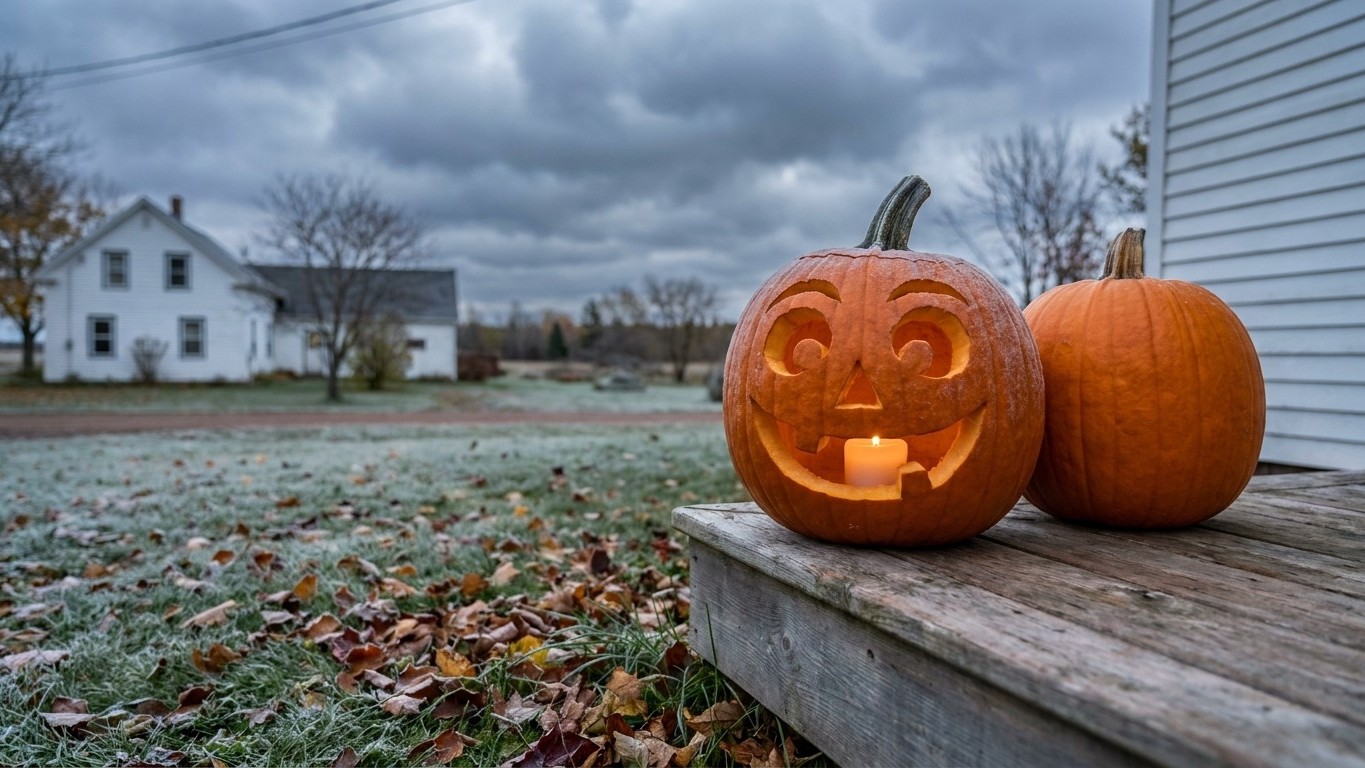

Charlottetown’s mean first fall frost lands around October 17, roughly two weeks before Halloween arrives. That single fact changes how Prince Edward Island carvers should think about timing. A pumpkin left whole and sheltered can wait out that cold snap just fine, but a carved one, exposed and cut open, is far more vulnerable to whatever the weather does next. Here’s how to read that frost date and turn it into an actual carving window.
The short answer

On average, Charlottetown sees its first fall frost around October 17, based on Environment and Climate Change Canada’s climate normals for the CHARLOTTETOWN A station. That’s about two weeks ahead of Halloween. But a mean date is exactly that, a midpoint, not a promise. In roughly half of all years on record, frost actually arrives later than October 17, sometimes pushing right up against Halloween itself, sometimes well past it. So the frost date alone doesn’t tell you the safe day to carve. What it tells you is that Islanders shouldn’t assume they’ve got a long, mild stretch of open-air pumpkin display ahead of them.
The practical takeaway is to treat the whole pumpkin and the carved pumpkin as two different problems. A whole, uncut pumpkin can sit through a light frost with minimal damage as long as it’s not left outside overnight once temperatures start dropping into the 30s. A carved pumpkin, with its flesh exposed to air and moisture, breaks down faster once the weather turns, and no published research from university extension programs offers a set number of days a carved jack-o’-lantern will last. That’s not an oversight. It simply hasn’t been studied and tracked the way whole-pumpkin storage has.
Given that, the window that makes sense for Prince Edward Island is to carve within the final three to five days before Halloween. That keeps the cut pumpkin’s exposure to the outdoors short, reduces the odds it sits through an early frost event, and still gives you a finished jack-o’-lantern in plenty of time for the actual night. If a frost warning shows up for your area in the days leading up to Halloween, bringing the carved pumpkin indoors overnight, or at least into a covered porch or garage, buys it a little more time without changing anything about how it looks on display.
None of this means you can’t buy or pick your pumpkin weeks ahead of time. It just means the buying and the carving don’t have to happen on the same day, and for this climate, they probably shouldn’t.
Frost or heat: which one gets it here
The cold end of the range
University of Illinois Extension recommends storing a whole pumpkin somewhere between 45 and 50 degrees Fahrenheit. Prince Edward Island’s late-October climate sits right at the edge of that range and then drops below it fast. The mean first fall frost around October 17 signals that overnight lows are already dipping toward or below freezing well before Halloween arrives in an average year. The province’s coldest month brings a mean daily minimum of just 10.3 degrees Fahrenheit, and while that figure describes winter rather than late October specifically, it underscores how quickly this region tips from mild to genuinely cold once autumn turns. For a pumpkin sitting outside, the risk here is unmistakably about freezing, not overheating. A hard freeze can turn the flesh soft and eventually mushy, especially once the skin has been cut into for carving.
The warm end of the range
In parts of the country with mild, humid fall weather, the concern runs the opposite direction: temperatures stay above that 45 to 50 degree band well into November, and pumpkins can soften, mold, or attract pests simply from sitting somewhere too warm. That’s not the story on Prince Edward Island. By the time Halloween approaches, the Island’s outdoor temperatures are already trending at or below the ideal storage band, not above it. There’s no meaningful stretch of the season here where excess heat is the threat. The entire concern for Island carvers is managing cold, and specifically managing the gap between “cool and stable” and “frozen and damaged.”
Where to keep it until you carve
Finding a spot on Prince Edward Island that holds close to 45 to 50 degrees Fahrenheit and stays dark takes a little thought, since most homes swing warmer indoors and colder outdoors than that target. Here’s a practical order of preference:
- An unheated porch or mudroom. These spaces often track close to the outdoor temperature without the extremes, especially if they’re shielded from direct sun and wind.
- A cool basement or cellar. Many Island homes have below-grade spaces that stay in the mid-40s to low 50s through October, making this one of the most reliable options once temperatures outside start swinging.
- An attached garage. Unheated but insulated from the harshest overnight lows, a garage works well as long as the pumpkin isn’t sitting directly on cold concrete for weeks at a time; a piece of cardboard or wood underneath helps.
- A shaded shed or outbuilding. Fine for shorter stretches, but check it during any stretch of hard frost, since unheated outbuildings can dip below freezing overnight even when the daytime air feels mild.
- Away from ripening fruit. Wherever you land, keep the pumpkin apart from apples, potatoes, or tomatoes. Ripening produce releases a gas that speeds up aging in the pumpkin sitting nearby, which matters even before you’ve made a single cut.
Whichever spot you choose, check the pumpkin’s stem before you commit to storing it long-term. Look for one to two inches of stem still attached. That stem isn’t there for carrying the pumpkin, and it should never be used as a handle. It functions as a seal over the top of the fruit, and once it breaks off, that exposed section becomes an easy entry point for decay long before Halloween ever arrives.
Checking this against your own county
Charlottetown’s frost data is a solid reference point for most of Prince Edward Island, but the Island isn’t one uniform microclimate. Inland and northern areas can run behind the Charlottetown timeline, sometimes seeing frost days earlier than the provincial average suggests. If you want figures specific to where you actually live, the Prince Edward Island Department of Agriculture is the right place to check, and it’s reachable through the province’s official agriculture topic page. It’s a better source for local frost timing than general folklore about “the first cold snap,” since it draws on the same kind of climate monitoring behind the Charlottetown normals cited here.
Common questions
How long does a carved pumpkin actually last on Prince Edward Island?
There’s no published extension research on this, and no reliable number to give. What is documented is whole-pumpkin storage, which runs three to six months in a cool, dark spot between 45 and 50 degrees Fahrenheit. The safest approach is to keep the pumpkin whole for as long as possible and carve it close to Halloween itself.
Should I bring my jack-o’-lantern inside if frost is forecast?
Moving it into a garage, porch, or covered entryway overnight is a reasonable precaution once a cut pumpkin has been sitting outdoors and frost is expected, since the exposed flesh is more sensitive to freezing than an intact pumpkin.
Does the pumpkin’s shape or size matter for storage?
No. University of Illinois Extension notes that shape doesn’t matter for a good pumpkin. What matters is weight (it should feel heavy for its size), a firm, blemish-free skin, and an intact stem of one to two inches.
Is Prince Edward Island’s frost risk the same as its hardiness zone would suggest?
Not directly. A hardiness zone reflects winter minimum temperatures over the whole season, while the first fall frost date is a separate measurement of when autumn cold first arrives. Charlottetown’s mean first frost around October 17 is the figure that actually matters for pumpkin timing, not the zone number itself.