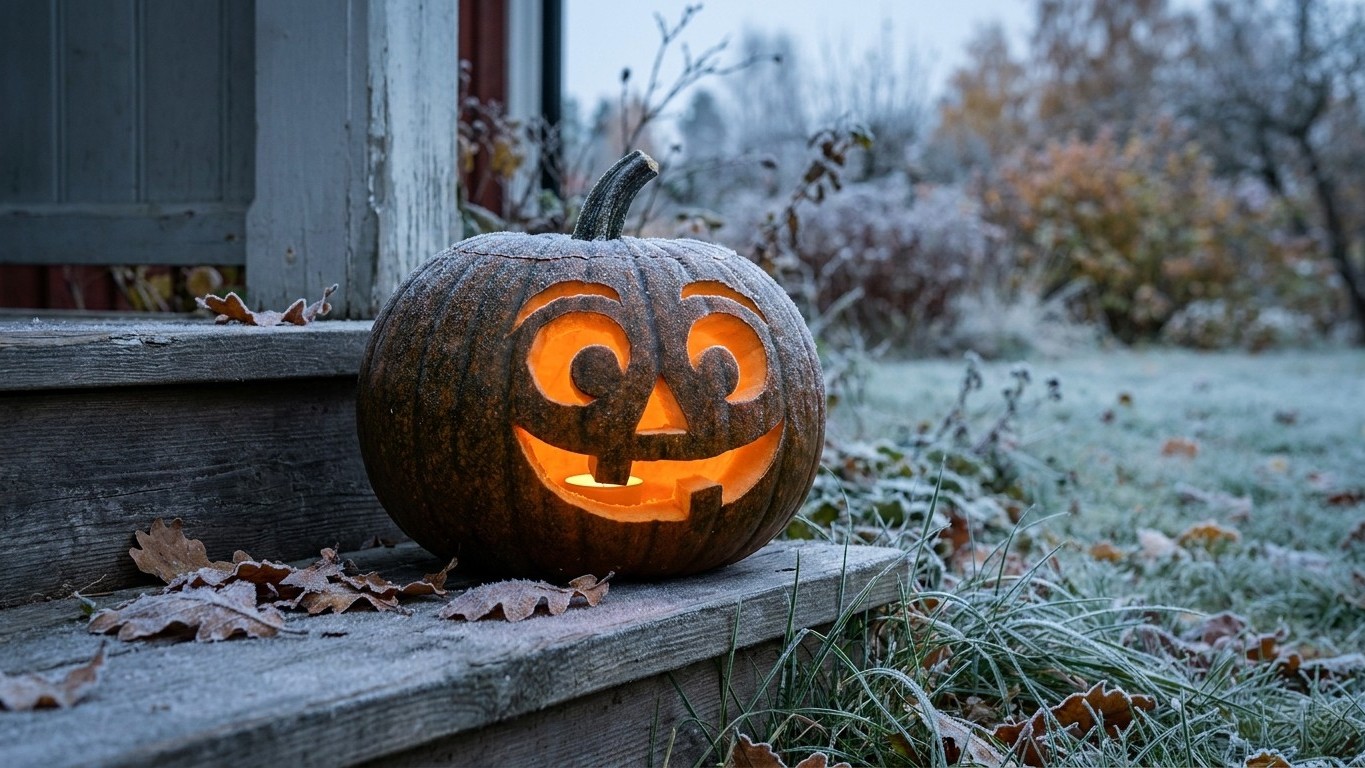

New Brunswick’s growing season wraps up early enough that pumpkins are usually long off the vine before Halloween ever shows up on the calendar. The real question for anyone here isn’t when the fruit ripens, it’s how long you can keep it looking sharp once the knife comes out. This province’s frost timing makes that math tighter than it is for gardeners farther south.
The short answer

New Brunswick’s mean first fall frost lands around October 2, according to Environment and Climate Change Canada’s climate normals for the Moncton station. That figure comes from three decades of data (1981-2010), and it’s worth treating as a midpoint rather than a promise: in roughly half those years frost held off later than that, and in the other half it showed up sooner. Still, when a mean frost date sits about a month ahead of Halloween, it tells you something concrete about this province: cold arrives well before the holiday here, not on it and not after it.
That gap matters for anyone timing a jack-o’-lantern. A whole, uncarved pumpkin sitting outside through early October is likely to see at least one light frost long before Halloween gets close. That’s generally not a crisis for fruit that hasn’t been cut into yet, since the shell is tough and pumpkins are bred to sit in a field well into fall. What changes the math is carving. Once the skin is opened, the flesh underneath is exposed to whatever the air is doing, and a freeze that a whole pumpkin shrugs off can turn a carved one soft almost overnight.
So the practical window in New Brunswick looks like this: pick or buy the pumpkin whenever it looks right at the patch, keep it whole through the weeks in between, and save the knife for the final stretch before Halloween itself, roughly the last few days rather than weeks ahead. With the average frost already about 29 days ahead of Halloween, that gap between “frost happens” and “Halloween happens” is exactly why keeping the fruit whole for as long as possible matters more here than in a milder province. No extension service publishes an exact number of days a carved pumpkin holds up once it’s been cut, so the honest guidance is simple: choose a sound pumpkin, store it whole, and carve close to the day you actually need it lit up on the porch.
Frost or heat: which one gets it here
The cold end
New Brunswick’s coldest month averages a daily minimum of 6.9°F, based on the same Moncton climate normals. That’s far below the 45-50°F range recommended for storing a whole pumpkin. Late October isn’t the coldest stretch of the year yet, but with the mean first frost already arriving around October 2, nights by the back half of the month are reliably dipping under that 45-50°F storage band, and sometimes well below freezing. That’s the risk that applies here: freezing, not overheating. A porch, an unheated garage, or a garden shed in New Brunswick in late October can easily drop into the 20s on a rough night, and a hard freeze like that (which is a different animal than a first light frost) can damage a pumpkin, especially one that’s already been carved and opened up to the air.
The warm end
In warmer parts of the country, the opposite problem shows up: pumpkins can effectively overheat in an autumn that’s still running mild, which speeds up rot from the inside before Halloween even gets there. New Brunswick essentially never deals with that. Frost has already set in on average by the start of October, so by the time Halloween rolls around, warmth simply isn’t the threat. The climate here is built around the cold end of the scale, and any storage plan should be built the same way.
Where to keep it until you carve
The goal is a spot that holds close to that 45-50°F range and stays dark, which in a New Brunswick home usually rules out anywhere near a heat source or a drafty exterior wall. A few places tend to come closest:
- An enclosed but unheated porch or mudroom. These stay above freezing on most nights while staying well below room temperature, which is close to the storage band a whole pumpkin needs.
- A basement or cellar. Many older New Brunswick homes have below-grade spaces that hold a steady cool temperature and stay dark year-round, which makes them one of the better options in the province.
- A detached, unheated garage or shed. Fine as long as it isn’t so exposed that it swings into the teens on a hard-freeze night; check it against how cold your particular structure actually runs.
- Away from ripening fruit and vegetables. Apples, potatoes, and tomatoes give off a gas as they ripen that ages a pumpkin faster, so store it apart from the harvest bin, not in it.
- Away from wood stoves, furnace vents, and direct sun. Any of these push the pumpkin’s environment above that 45-50°F range and shorten how long it holds up before carving.
Checking this against your own county
These figures come from the Moncton station, and New Brunswick isn’t one climate. Upland areas, the northern counties, and spots farther from the coast typically see frost weeks earlier than this average, while some sheltered coastal pockets run a little later. Before you lock in a carving date, it’s worth checking conditions closer to home. The provincial agriculture department’s own site currently blocks automated verification, so the more reliable federal resource is Agriculture and Agri-Food Canada, which can point you toward regional data and local growing conditions specific to your part of the province.
Common questions
Does a light frost ruin a whole pumpkin?
Not typically. The shell on an uncarved pumpkin is tough enough to handle a light frost without much trouble. The real damage tends to show up with a hard freeze, or once the pumpkin has already been carved and the flesh is exposed.
How long does a whole pumpkin actually keep?
A whole pumpkin stored in a cool, dark spot between 45-50°F can keep for three to six months, according to University of Illinois Extension. That’s a very different number from a carved pumpkin, which no extension service has published a shelf-life figure for.
Can I carve early and just refrigerate it?
There’s no published research from University of Illinois Extension or Utah State University Extension on preserving a carved pumpkin, so there’s no verified protocol to point to here. The safest approach is still to keep it whole as long as you can and carve close to the day you plan to display it.
What does the stem tell me at the pumpkin patch?
Look for one to two inches of stem left on the fruit. Once that stem breaks off, the spot where it was attached is exposed and the pumpkin is more likely to spoil early. It should also be heavy for its size and free of soft spots or blemishes; the exact shape doesn’t matter. And it’s never meant to be carried by that stem, since breaking it off is precisely the failure this guidance is warning against.