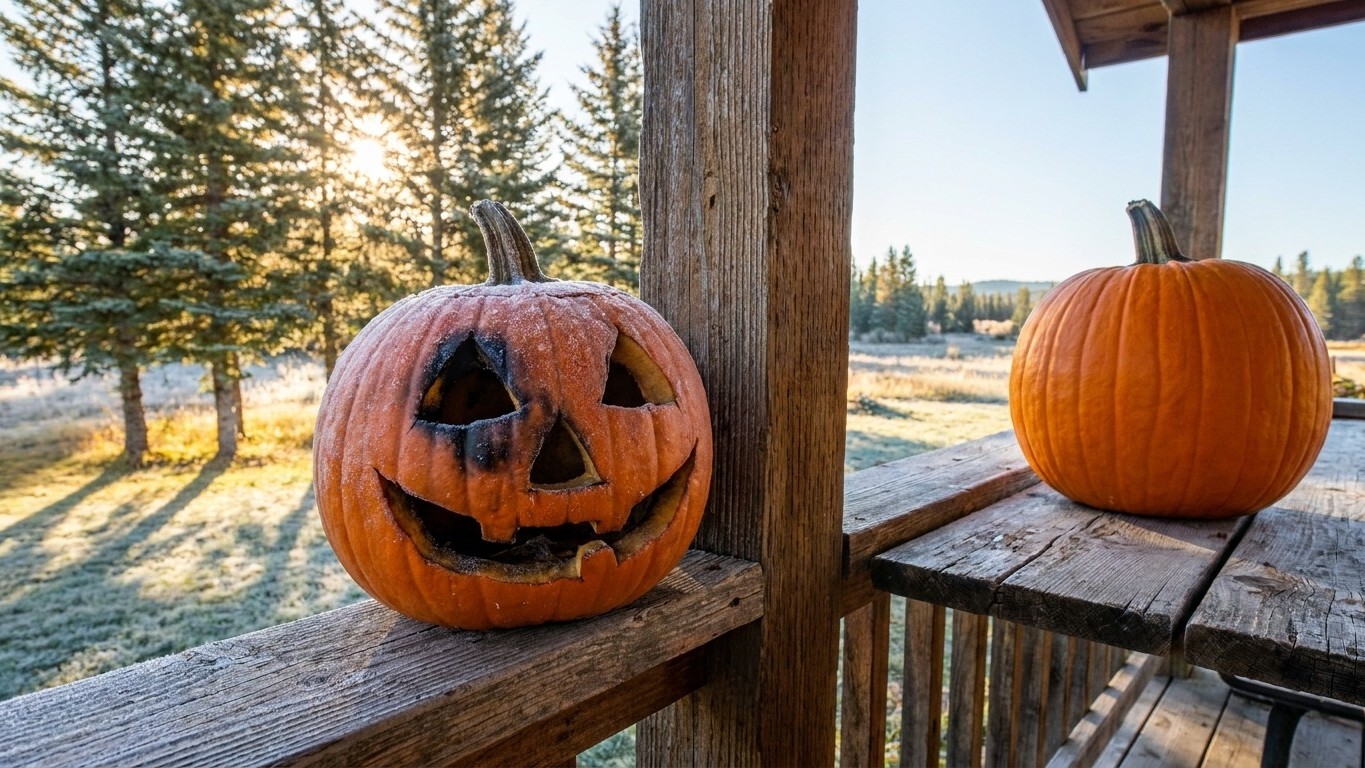

Squash bugs and cucumber beetles are the usual insect suspects on a pumpkin patch, and each has its own page on this site. On Prince Edward Island, though, the bigger thing eating into the harvest is the calendar. Frost arrives before a late pumpkin finishes, and the fruit is lost. The pumpkin clock is short enough here that the date a flower opens matters more than almost any spray or trap.
The short answer
At the Charlottetown A station, the first fall frost arrives on average October 17, according to Environment and Climate Change Canada’s climate normals. Count back 45 to 55 days, the time a pumpkin needs to mature after the flower opens, and you get a window from about August 23 to September 2. That is the latest a flower can open here and still give a ripe pumpkin. It assumes frost shows up on schedule, and frost rarely keeps to a schedule.
The arithmetic is simple. Forty-five days before October 17 is September 2. Fifty-five days before is August 23. The spread comes from Utah State University Extension, which gives 45 to 55 days for pumpkins to mature after flowering. Where a particular variety sits in that range is something to check on its seed packet, because this page attaches no variety figures to it.
Treat October 17 as the middle of a window, not a safe date. It is a mean. In about one year out of two the first frost lands later than that, which also means that in the other years it lands earlier. A flower that opens on September 2 and needs the full 45 days is a coin flip in this arrangement, and a flower that needs 55 days and opens on August 23 is no better. Flowers that open well ahead of the window carry the margin. Flowers that open inside it are borrowing luck.
One more limit. The October 17 figure comes from a single station, and a province is not one climate. Northern and upland districts of the island run weeks behind Charlottetown, so a garden there should shift the whole window earlier by a margin the published normals do not quantify. The Canadian normals also use an older averaging period than the US figures on this site, so comparing the two directly is loose at best. The station data is available from Environment and Climate Change Canada’s climate normals service.
The clock starts at flowering, not at seeding or transplanting. A seed in the ground in early June has not started the 45 to 55 days. The count begins the day a flower opens, and gardeners who count from the seed packet date end up with a calculation that is wrong by weeks. For how that plays out against a cold autumn, see Will Pumpkins Ripen Before Frost in Prince Edward Island?. The wider picture of the crop is in Growing Pumpkins in Prince Edward Island.
When to sow here
Sowing is governed by soil, not by the calendar. Pumpkin seed goes in when the soil reaches 65 F, and on the island that is a good while after the last spring frost. Working it out in order:
- Start with the last spring frost. At Charlottetown A it averages May 16. Like the fall date, that is a mean, so in about one year out of two the last frost comes later. It is the midpoint of a window, not a promise.
- Add the soil lag. Soil trails the air by weeks, and 65 F soil is not the last frost date. Add a few weeks to May 16 and you reach the turn of May into June at the earliest, and in a cool spring well into June. A soil thermometer settles it better than any date.
- Subtract two weeks if you use row covers. Covers warm the soil underneath, and they buy about two weeks. If bare soil would hit 65 F in the first days of June, covered soil gets there in the third week of May. The covers have to stay on through any late frost, since the plants under them are no hardier than the ones outside.
- Check the result against the flowering deadline. Flowers must open between roughly August 23 and September 2 at the very latest, and earlier is better. The time from seeding to first flower is not published in the sources behind this page, so the safe move is to treat the soil date as the earliest possible start and not to delay beyond it. Each week of delay eats directly into the margin. The detail is in When to Sow Pumpkins in Prince Edward Island.
- Plan the harvest to match. Pumpkins are harvested with the stem attached, before frost. A pumpkin cut off its stem has lost something that does not grow back.
Notice what is missing from this list: a single sowing date. A shortcut such as “plant on the last frost date” is the error that costs the most weeks, because it confuses what the air is doing with what the soil is doing. Seed sown into cold ground tends to sit there, and the days it sits are days the season does not give back.
What goes wrong here
A short season fails in specific ways. These three account for most lost pumpkins on the island, and each has a remedy that works inside the limits of the sources behind this page.
- A late flower that never colors. A flower that opens after the window ends gives a fruit that cannot finish before frost, and it stays green. Many gardeners pinch off new flowers and tiny fruit once the window has closed, so the vine puts what it has left into the pumpkins that can still ripen. The better remedy comes earlier: sow when the soil reaches 65 F, use row covers for the two-week head start, and avoid transplanting late.
- A fruit caught by frost. A pumpkin still out in the patch on the night of the first hard frost can be spoiled for keeping. Because the October 17 date is only an average, and half of years bring frost sooner, do not wait for it. Watch the forecast from late September, and cut mature pumpkins with the stem attached before frost arrives. Move them to a place where they will not freeze, which is the only storage guidance Utah State University Extension gives.
- A vine that dies back before the skin hardens. When a vine collapses early, the fruit it was feeding stops developing. Cold nights can cause this, and so can feeding damage from squash bugs and cucumber beetles, which have their own pages here. The remedy is to find the cause early. If the vine has failed, harvest what is mature with the stem attached and keep it from freezing. Pumpkins on a dead vine gain nothing by staying out in the cold.
Common questions
What eats pumpkin plants on Prince Edward Island?
Squash bugs and cucumber beetles are the usual insect pests of pumpkin vines, and this site covers each on its own state page. This page does not publish timing for either insect. What it can say is that frost is the bigger threat to the crop, because it ends the season before late fruit finishes.
Is October 17 a safe date to count on?
No. It is the average first fall frost at the Charlottetown A station, which means that in roughly half of years frost comes later and in the other half it comes sooner. Northern and upland parts of the island run weeks behind Charlottetown. Use the date as the middle of a window and keep a margin.
How long does a whole pumpkin keep after harvest?
University of Illinois Extension says a whole pumpkin keeps for three to six months in a cool, dark place between 45 and 50 F. Keep it away from ripening fruit and vegetables such as apples, potatoes and tomatoes. Ripening fruit gives off a gas that ages the pumpkin, which is why the porch beside the apple crate is a poor spot. That temperature range applies to a whole pumpkin only. It says nothing about a carved one.
Do the 45 to 55 days count from seeding?
No. The 45 to 55 days run from flowering, the day the flower opens. Counting from the seed or the transplant date puts the calculation off by weeks and makes a late pumpkin look safe when it is not.