
Yes, but in Quebec the reason has little to do with air conditioning. The reference station for the province shows essentially zero days above 90°F a year, while heating demand runs high enough to place the region in one of the coldest climate zones Natural Resources Canada tracks. Insulation still matters every July, just not for the reason it matters in Texas.
The short answer for Quebec

Start with the number that settles the question: at the Montreal reference station, Environment and Climate Change Canada’s 1981-2010 climate normals record a mean of 0.0 days a year reaching 90°F or higher. That is not a typo and not a rounding of a small figure. It is the measure climatologists use to gauge summer heat load, the kind of stress that drives water demand, heat-stressed lawns, and struggling houseplants. By that yardstick, Quebec’s reference station carries almost none of it.
That single figure does not mean summer never feels warm here. It means the extreme end of the heat spectrum, the days that push cooling systems and building envelopes to their limit, is rare enough that ECCC’s three-decade average rounds to zero. A handful of days each summer will still climb into the 80s and occasionally flirt with 90, but the sustained, punishing heat that shapes design choices in the American Sun Belt simply isn’t part of this station’s climate record.
The other number on this page points the same direction. Pierre Elliott Trudeau International Airport, Montreal’s climate station, logs about 4,363 heating degree-days below 18°C in a typical year. Natural Resources Canada uses that count to sort the country into zones, and 4,363 lands the station squarely in Zone 6 of six recognized zones (Zone 4 under 3,000 HDD, up through Zone 8 over 7,000). That’s the cold half of the national ledger, not the hot half. A house built to keep a Montreal-area family warm through a Zone 6 winter is, by construction, built with a lot of resistance to heat flow, and that resistance doesn’t know which direction the heat is moving.
So the honest framing for this territory is this: Insulation pays its biggest dividend against the cold, because the cold is what actually shows up in the climate record here. Summer heat is real but brief, and the same insulating layer that keeps January’s cold out also keeps July’s occasional heat wave from turning an attic into an oven. It’s not a wasted upgrade in summer, it’s just not the main event. Anyone reading this from a different Quebec municipality should check that town’s own degree-day count before assuming the station figure above applies exactly to their address; the province spans more than one zone, and a colder pocket further from the city needs more Insulation, not less.
What happens above the ceiling
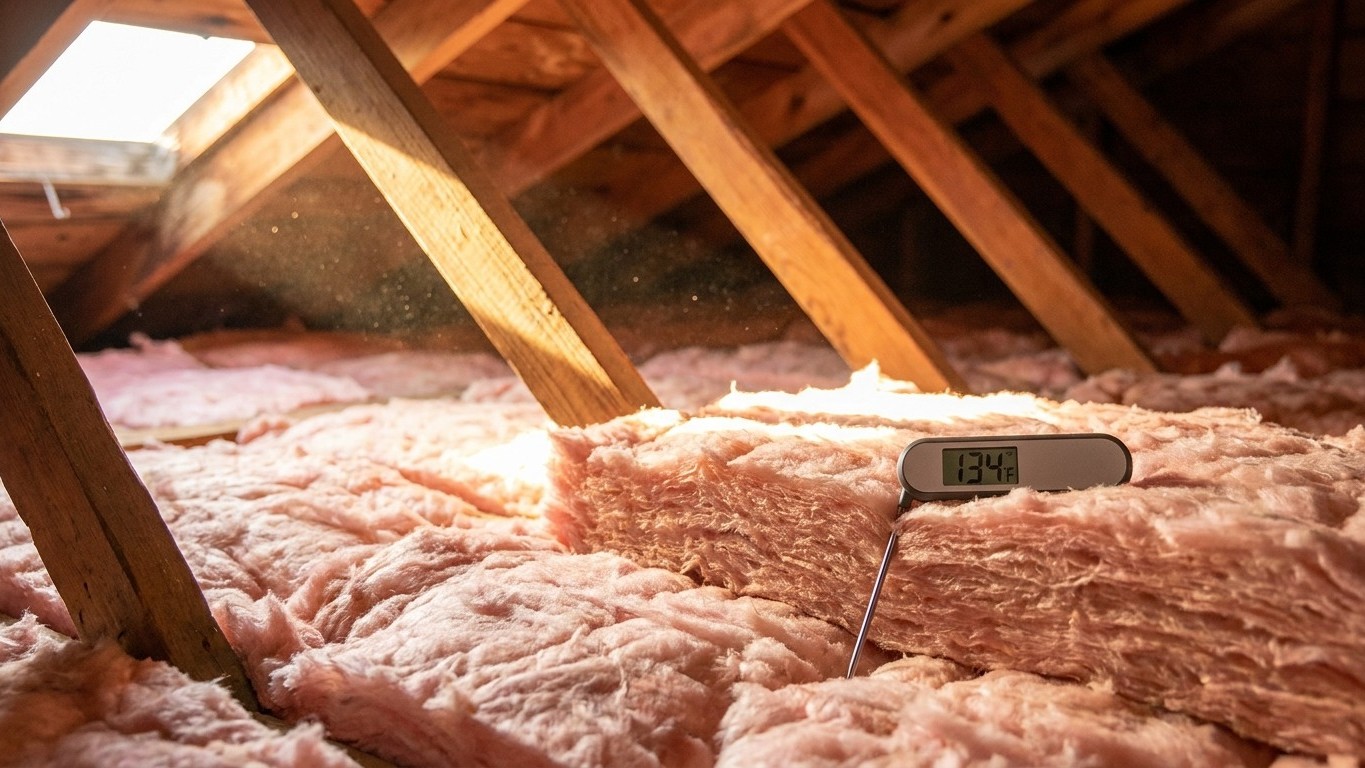
Even in a climate with almost no 90°F days, an attic can still get punishingly hot. A dark asphalt shingle roof absorbs solar radiation directly, and the attic space underneath it can run 40°F or more above the outdoor air temperature on a sunny afternoon, even one that never technically counts as a heat wave outside. Everything below that superheated roof deck, the ceiling drywall, any ductwork running through the attic, boxes stored up there, sits under that load for hours at a stretch.
The insulation that resists that heat is the same material, installed the same way, as the insulation that keeps a Quebec winter out. There is no separate summer product. Insulation works by resisting the flow of heat, full stop, and in winter that flow runs outward from a heated house into the cold; in summer, on a sun-loaded roof, it runs downward from a hot attic into the living space below. A ceiling insulated to a Zone 6 standard resists both directions equally. It’s the one upgrade on this list that serves winter and summer at the same time, which is worth remembering when the invoice for attic work arrives in October rather than July.
Recommended minimum levels for this zone
Natural Resources Canada’s own recommendations, tied to Zone 6, are the benchmark for a house served by the Montreal-area station. These are published minimums, not a code requirement on their own; the applicable provincial or municipal building code can ask for more in a given municipality.
| Building assembly | RSI | R-value |
|---|---|---|
| Walls | 4.8 | R 27 |
| Basement walls | 4.2 | R 24 |
| Roof or ceiling | 10.6 | R 60 |
| Floor over unheated space | 7.1 | R 40 |
Notice that the ceiling figure, R 60, is the highest number on the table, higher than the walls and higher than the floor over an unheated space or crawl space. That’s a winter-driven number, sized for a Zone 6 heating season, but it’s also exactly the depth of insulation that keeps a sun-loaded July attic from cooking the room below it. One project, two seasons of payback.
What homes in Quebec cool with
Statistics Canada’s Canadian Social Survey found that 69.3% of households in Quebec report having air conditioning, against 68.3% across Canada as a whole. That’s a share of households surveyed, not a share of the province’s housing stock physically fitted with a working unit, and the survey doesn’t say whether the remaining roughly 30% went without because summers here are mild or because the housing is older and never got retrofitted. Either explanation is consistent with a near-zero count of 90°F days at the reference station.
What that figure doesn’t break down is the type of equipment behind it, and that distinction matters for insulation. In a house with central air ducted through the attic, the supply ducts run through the same superheated space discussed above, and ceiling insulation does nothing to protect them; sealing and insulating the ducts themselves is a separate job, one covered on this site’s duct guides. In much of Quebec’s older housing stock, though, cooling more often arrives through a window unit or a ductless mini-split rather than a full central system, since a lot of the province’s homes were built around electric baseboard heat with no ductwork to retrofit air conditioning into. In that case there’s no attic duct run to worry about at all, and the insulation question shifts to the room itself: how well the walls, windows, and ceiling around that one unit hold the cooled air in. This site’s room air conditioner guides cover sizing and placement for exactly that setup.
Either way, the insulation conversation and the equipment conversation are related but separate. A well-insulated attic won’t make an undersized window unit perform like central air, and a brand-new ductless mini-split can’t fully compensate for an attic ceiling that’s still at half the recommended R-value.
What the heat asks for that the cold does not
Two products get marketed specifically for hot climates, and neither one fits a Zone 6 house with a near-zero count of 90°F days.
A radiant barrier is a reflective layer, usually foil-faced, installed in an attic to bounce radiant heat back toward the roof deck instead of letting it conduct into the space below. It carries no R-value; it isn’t insulation in the conventional sense, and it earns its keep only in climates where the sun-loaded roof deck is fighting the house for months at a stretch, the American South being the obvious example. In a territory where the reference station logs essentially zero days above 90°F, that fight barely happens. A radiant barrier isn’t the tool for a Montreal-area attic, and the dollars are better spent getting the ceiling insulation up to the R 60 minimum in the table above.
Vapour movement is the second hot-climate variable, and it runs backward from how most Quebec homeowners were taught to think about it. In a warm, humid climate, moisture-laden air sits outside the house for most of the year, which is why the model code doesn’t require an interior vapour retarder in the country’s warmest zones. Quebec’s Zone 6 sits on the opposite end of that spectrum, and the vapour logic that applies here is governed far more by winter conditions than by summer humidity. That’s a distinct enough question, with its own code requirements and failure modes, that it deserves its own answer rather than a paragraph tacked onto a summer-heat page; the vapour barrier guide for this territory covers it directly.
What the work is worth
The U.S. Environmental Protection Agency’s ENERGY STAR program puts a number on the combined payoff of air sealing and insulation work: “EPA estimates that homeowners can save an average of 15% on heating and cooling costs (or an average of 11% on total energy costs) by air sealing their homes and adding insulation in attics, floors over crawl spaces, and accessible basement rim joists.”
Both percentages matter, and neither works without its denominator. Fifteen percent is measured against heating and cooling costs combined, not against the summer cooling bill alone; eleven percent is measured against total household energy costs, a broader number that includes everything from water heating to the refrigerator. That’s precisely why the estimate belongs on a page about summer heat and not just on a winter-heating page: it’s a heating-and-cooling figure from the start, never split by season.
Two limits are worth keeping in view. First, this is an average pulled from energy modelling of a typical existing U.S. home, not a measurement of any specific house, in Quebec or anywhere else; a particular home could see more or less depending on its current condition and how much air sealing was already done. Second, the sentence names exactly where the modelled work happened: attics, floors over crawl spaces, and accessible basement rim joists. It says nothing about walls, windows, or doors, and stretching an eleven-or-fifteen-percent figure to cover a full envelope retrofit would be reading more into the number than ENERGY STAR put there. For a Zone 6 house, the attic ceiling table above is still the highest-leverage target on that list, doing its main work against the winter and its secondary work against whatever heat July manages to bring.