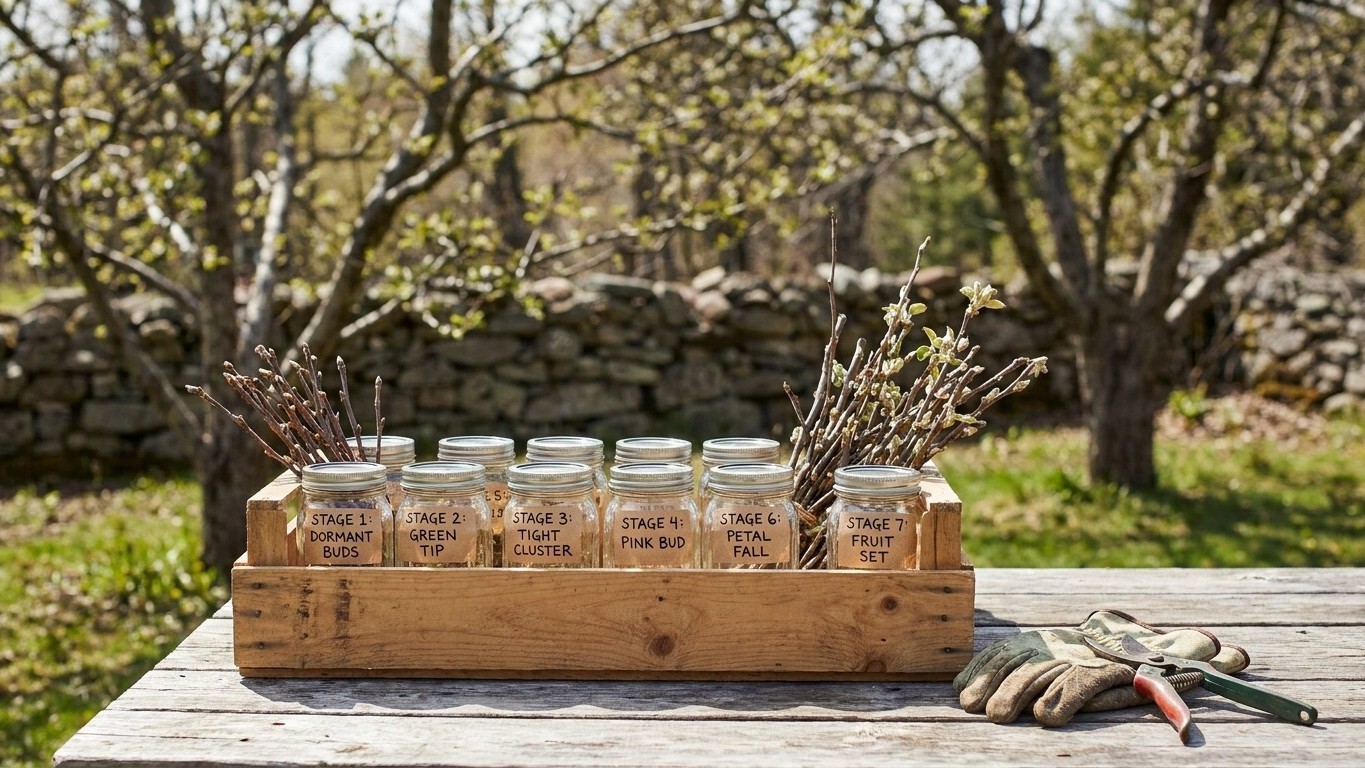

Quebec’s apple year runs dormancy, green tip, pink, bloom, petal fall, fruit set, and harvest, and the two dates that anchor all of it come from Environment and Climate Change Canada (ECCC): a mean last spring frost of May 6 and a mean first fall frost of October 5, both from the 1981-2010 Canadian Climate Normals at station Montreal/St-Hubert A. Check which stage your own trees are at against those dates, not the date on the wall, before you spray, thin, or decide harvest can wait another week.
The short answer for Quebec
For an orchard near Montreal, dormancy typically breaks in late March to early April, green tip shows through much of April, and bloom lands somewhere in the first half of May, straddling ECCC’s mean last spring frost of May 6, drawn from the 1981-2010 Canadian Climate Normals at station Montreal/St-Hubert A. Harvest for most eating apples runs from September into early October, ahead of ECCC’s mean first fall frost of October 5, recorded at the same station. That is the Montreal-area answer, and it describes a climate normal, not a guarantee for any one spring or fall.
The single detail that decides whether this calendar holds for your trees is bloom timing, because that is the stage most exposed to frost. Early-flowering cultivars can be in bloom before the mean frost date has even arrived, and because ECCC’s May 6 figure is a mean, not a safe cutoff, the real frost falls later than that in roughly one year out of two. A block of ‘Lodi’ or ‘Melba’ in bloom during the first week of May is gambling on a coin that comes up frost about half the time.
The second detail is winter cold itself. Montreal’s coldest month carries a mean daily minimum of -14.1 °C, according to ECCC’s 1981-2010 normals, and that number is what rules a variety in or out before bloom date ever matters. A tree that cannot take that kind of cold loses wood or dies back regardless of how well its bloom timing lines up with frost. Anyone still deciding what to plant before working through the calendar below should start with The Best Apple Varieties for Quebec and come back here once the cultivar is chosen, since the stages below assume a tree already suited to this winter.
Working through it

Every stage of the apple year is a decision point, and in Quebec each one is read against the two ECCC mean frost dates above rather than against a date on the wall calendar.
| Stage | Typical window near Montreal | Frost risk |
|---|---|---|
| Dormancy | November through March | None, wood is fully hardened |
| Green tip | Early to mid April | Low, buds still tight |
| Pink | Late April | Moderate, buds swelling and exposed |
| Bloom | Early May, around ECCC’s mean last frost of May 6 | Highest, open flowers killed near freezing |
| Petal fall | Mid May | Declining but present in some years |
| Fruit set | Late May into June | Low |
| Harvest | September to early October, before ECCC’s mean first fall frost of October 5 | Not applicable |
From dormancy to bloom
Dormancy is when the pruning gets done, while the tree is fully hardened and cuts won’t push tender growth into a cold snap. Green tip, when the first green shows at the bud tip through the brown scales, is the point most growers apply a dormant oil spray if scale or mite pressure was a problem the year before. Pink, when the flower cluster is visible but not yet open, is the last safe window to thin overcrowded spurs by hand, before bloom makes it obvious which flowers will set and which won’t.
Bloom is the stage that actually decides the year, not the calendar date it happens to fall on. An open apple flower is killed by a light freeze, and because ECCC’s mean last frost of May 6 is just that, a mean, bloom landing in the first two weeks of May carries real risk in any given year. If trees bloom into a forecast frost, the standard response is overhead irrigation or wind machines on a commercial block, and row cover on a home planting. Both work by holding the flower a few degrees warmer than the surrounding air, not by stopping the cold from arriving at all.
From fruit set to harvest
Petal fall is when you can finally count what set, and it’s also when the first cover fungicide spray usually goes on, since apple scab infects through the tender young leaf and fruit tissue left once petals drop. Fruit set, two to three weeks after bloom, is when hand-thinning to one apple per cluster happens, because a tree carrying too many apples this early produces small fruit and can skip bearing the following year, regardless of what the weather does later on.
Harvest is read off the fruit itself, not the frost date, though the frost date sets the outer limit. Late-season cultivars that need the full season to finish are pushing right up against ECCC’s mean first fall frost of October 5, and a grower who leaves them on the tree a few extra days for more color risks losing the crop, since the actual frost arrives after that mean about as often as it arrives before it.
What changes across Quebec
The dates above describe the St-Hubert station specifically, and Quebec’s apple country spreads well beyond that one point. Montérégie, the region south and southeast of Montreal toward the US border, sits at lower elevation, closer to the moderating influence of the St. Lawrence lowlands, and it’s generally where the province’s commercial apple orchards concentrate, carrying a longer frost-free stretch than higher ground nearby.
The Eastern Townships (Cantons-de-l’Est), southeast of Montreal, run at meaningfully higher elevation, and elevation delays green tip and bloom in spring while also pulling the first fall frost forward, since cold air is simply colder the higher you sit. A block of trees on a Townships hillside can run a week or more behind a Montérégie orchard at a similar latitude, on elevation alone.
Further north and east, around Quebec City and along the north shore toward Charlevoix, both latitude and, in Charlevoix, elevation work against the grower: spring arrives later, the frost-free window is shorter, and cultivar choice narrows toward the hardiest, earliest-ripening apples the province grows. River valleys and low ground anywhere in the province, including spots close to Montreal itself, can trap cold air overnight and run a working frost pocket that a single weather station never captures. If your own orchard sits in a hollow or at the base of a slope, treat the dates above as optimistic for your site, not as the number to plan against.
The mistakes this climate punishes
The mistake that costs a whole bloom is planting an early-flowering cultivar without checking it against the frost calendar. ‘Lodi’ and ‘Melba’ flower earlier than ‘Honeycrisp’ or ‘Cortland’, and an early bloomer in a low spot can be in full flower a week before ECCC’s mean last frost of May 6 even arrives, in an ordinary year, let alone a late one. The damage shows fast: blackened flower centers within a day or two of the freeze, and no fruit at all from that cluster.
The mistake that costs the tree itself, not just the crop, is planting something that was never bred for this winter. Montreal’s coldest month carries a mean daily minimum of -14.1 °C according to ECCC, and a cultivar or rootstock rated for milder winters than that shows cambium damage on the trunk’s south or west side, bark splitting or sinking in late winter, sometimes not obvious until the following summer when that whole side of the tree fails to leaf out.
The mistake that shows up every fall is feeding nitrogen too late in the season. A tree pushing soft new shoot growth into August or September hasn’t hardened that wood by the time ECCC’s mean first fall frost of October 5 arrives, and soft growth is what a light frost kills first, sometimes taking next year’s fruiting wood along with it. The fix is to stop nitrogen well before midsummer and let the tree slow on its own.
The mistake that costs the harvest itself is waiting for more color on a late cultivar. Fruit left on the tree past its own stage of maturity for the sake of a deeper red is fruit exposed to whatever frost arrives before or after that October 5 mean, and once a crop of ripe apples freezes on the tree, the flesh turns mealy within days even if it’s picked right after.
Checking this against your county
Every figure above comes from one station, Montreal/St-Hubert A, and Quebec’s apple country runs from the Montérégie plain to hillsides in the Eastern Townships and points well north and east of the city, so treat these dates as a starting frame rather than the answer for your own address. For a reading closer to your own municipality, whether that’s frost timing, pest pressure, or advice on adapting the calendar to a particular site, MAPAQ, the province’s agriculture and food ministry, is the reference to check. If the groundwork of siting and planting hasn’t been covered yet, that’s laid out in Growing Apples in Quebec: Varieties, Timing and Frost Risk.
Common questions
Why didn’t my apple tree fruit this year even though it flowered fine?
Pollination most likely failed rather than bloom itself. Bees don’t fly much in cool, wet weather, and a bloom that coincides with a cold, rainy stretch can open and close with almost nothing pollinated. A self-sterile variety without a compatible pollinizer blooming at the same time will also flower heavily and set little to nothing.
Does the calendar shift if spring comes early or late?
Yes, the stages track accumulated warmth, not the calendar page. A warm March can push green tip and bloom well ahead of an average year, and a slow, cold spring pushes them back by a similar margin. Read the bud stage on your own tree rather than counting days from a fixed date.
Can I grow apples north of Quebec City given how short the season runs?
Growers do, using the hardiest, earliest-ripening cultivars, though no source in this article documents frost dates or a growing-season length for that region specifically. Check with MAPAQ’s regional office for figures closer to that latitude before committing to a planting.
What’s the difference between hardiness and chill requirement in Quebec?
Hardiness is whether the tree survives the winter at all, and chill requirement is whether it flowers properly the following spring. Quebec’s long, cold winters supply far more chill hours than almost any apple cultivar needs, so chill is rarely the limiting factor here. Hardiness against the coldest month’s cold, not chill, is the filter that actually rules cultivars in or out.