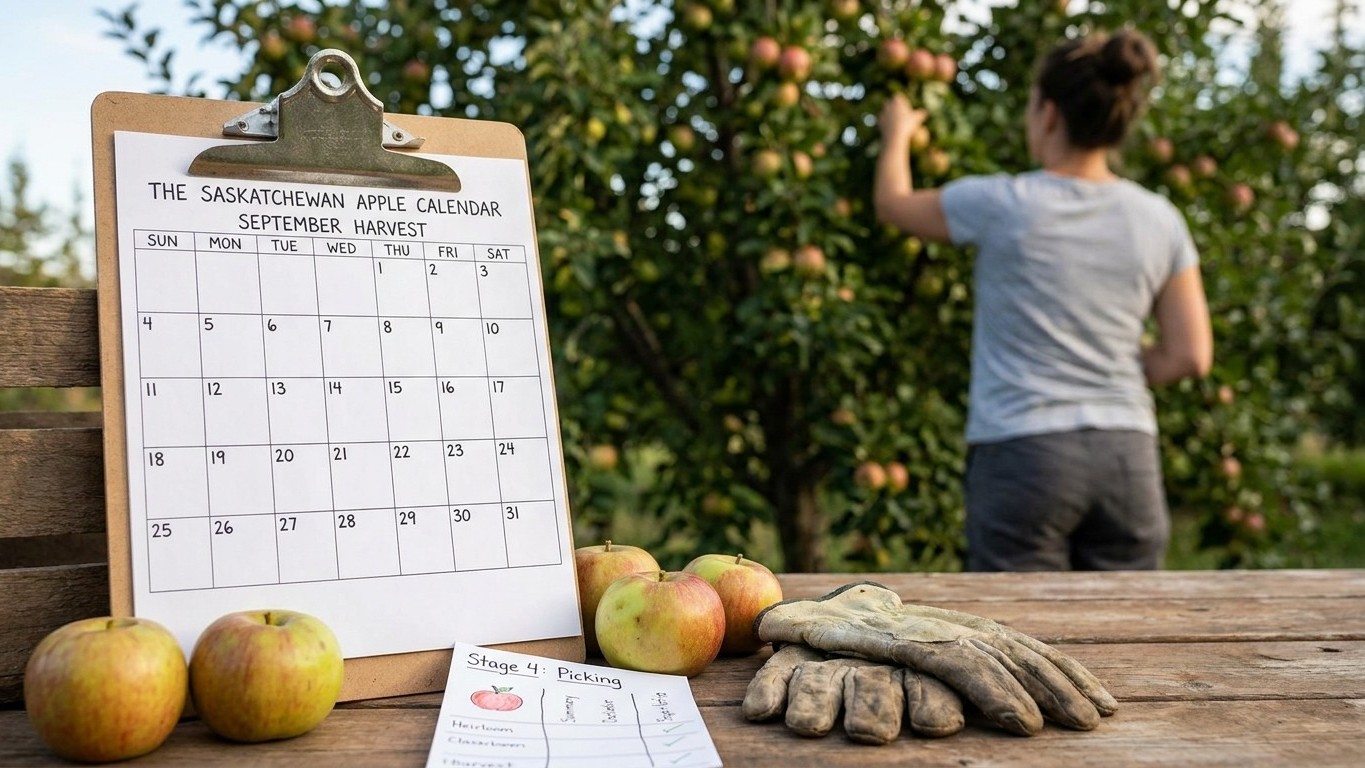

Saskatoon’s average last spring frost falls on May 18 and the average first fall frost on September 18, both from Environment and Climate Change Canada’s 1981-2010 normals at the Saskatoon SRC station. Those dates mark the middle of the window, not the edges of it. Check where your tree actually stands, dormant, at green tip, in bloom, against that frost window before deciding to spray, protect, or pick, rather than trusting the date on the wall calendar.
The short answer for Saskatchewan
The apple year in Saskatchewan runs on the tree’s stage, not the calendar. At Saskatoon, Environment and Climate Change Canada’s 1981-2010 Canadian Climate Normals put the average last spring frost at May 18 and the average first fall frost at September 18, both measured at the Saskatoon SRC station. Those are mean dates, not guarantees. In one year out of two, frost arrives later than May 18 in spring, or earlier than September 18 in fall. A grower who plans bloom around a fixed date instead of the tree’s own stage is planning around a coin flip.
What the calendar actually depends on is two separate filters: whether the tree survives winter, and whether it flowers well once it does. ECCC’s Saskatoon normals put the mean daily minimum of the coldest month at -20.7 °C, a level that rules out apple cultivars bred for milder regions and narrows the realistic list to prairie-hardy selections. Winter chill is the second filter, and Saskatchewan winters supply plenty of it. The bottleneck here is never chill. It is survival first, and then a short window to flower, set fruit and ripen before the first fall frost returns.
This calendar assumes the site and cultivar decisions are already made, a step covered in Growing Apples in Saskatchewan. If those decisions are still ahead of you, make them before worrying about stage timing, since the wrong cultivar makes the rest of the calendar academic.
Working through it

Every stage below is pinned to Saskatoon’s frost normals from ECCC, because a stage that arrives on schedule in a mild year can arrive two or three weeks earlier or later in a cold or warm one. Watch the tree, not the wall calendar.
| Stage | Frost sensitivity | Typical timing relative to Saskatoon’s frost normals |
|---|---|---|
| Dormancy | Very low, tree tolerates deep winter cold | Late fall through the coldest month of winter |
| Green tip | Low | Weeks before the May 18 mean last frost (ECCC) |
| Pink | Moderate | Approaching the May 18 mean last frost |
| Bloom | Highest of any stage | Around or just after the May 18 mean last frost |
| Petal fall | Dropping quickly | Just after the sharpest frost risk has passed |
| Fruit set | Low | Early summer, well clear of both frost dates |
| Harvest | Low, but exposed if delayed | Approaching the September 18 mean first fall frost (ECCC) |
Dormancy

From leaf drop in fall until the buds start to swell, the tree is dormant and needs little day-to-day management. This is the stage for pruning, for checking trunk guards against rabbits and voles, and for pulling mulch back a few inches from the trunk so the bark stays dry. Dormancy carries the tree through the coldest stretch of winter, the same stretch that produces Saskatoon’s -20.7 °C mean daily minimum, per ECCC, and it is the stage that decides whether a marginal cultivar survives to spring at all.
Green tip

Buds swell and split to show the first sliver of green leaf tissue, usually in the weeks running up to the mean last frost of May 18. This is the last easy window for a delayed dormant spray if scale or mite eggs were a problem the year before, since the tree still has almost no exposed tissue for a spray to burn.
Pink

Flower buds cluster at the shoot tips and show color before they open. Frost at this stage can still be shrugged off by a hardy prairie cultivar, but it is worth watching overnight lows closely once the calendar is anywhere near May 18, since half of all years run later than that mean.
Bloom

Open blossoms are the single most frost-sensitive stage of the whole year. A frost that would barely mark a dormant bud can blacken an open flower and take the whole crop for that spur. Because Saskatoon’s last frost date is a mean and not a safe cutoff, growers should favor cultivars documented as later-blooming and should keep frost cloth ready through the back half of the frost window rather than folding it away once the calendar date passes.
Petal fall

Petals drop and the small ovary behind each flower begins to swell. Risk from frost drops sharply once petals are down, though a hard freeze can still damage the young fruitlets underneath.
Fruit set

Fruitlets that survived pollination hold on the tree while the rest thin naturally or get thinned by hand to one or two per cluster. This stage runs through early summer, well clear of both frost dates, and is where feeding and watering decisions matter more than frost watching.
Harvest
Harvest timing is set by the cultivar’s own days-to-maturity count from bloom, crossed against the September 18 mean first fall frost from ECCC. A cultivar that needs a long season to color and sweeten is racing a frost date that, in half of all years, arrives before September 18. This is the stage where the choice made at planting either pays off or runs out of season, a decision covered in more detail in The Best Apple Varieties for Saskatchewan.
What changes across Saskatchewan
Saskatoon’s frost dates are a starting point, not a fact for the whole province. ECCC’s SASKATOON SRC normals describe one station in the middle of a province that runs from open prairie in the south to boreal forest in the north, and elevation and water change the local frost window as much as latitude does.
The Cypress Hills upland in the southwest sits well above the surrounding plain and stays noticeably cooler through spring and fall, so the frost-free window there runs shorter than at Saskatoon on both ends. The northern boreal fringe around Prince Albert and further north toward La Ronge trades summer heat for a shorter season outright. Growers there should expect the practical bloom-to-harvest window to run tighter than anything a Saskatoon-based normal suggests, and should lean on the shortest-season, hardiest cultivars available rather than anything bred for a longer summer.
Large water bodies work the other way. Lake Diefenbaker, the reservoir on the South Saskatchewan River southwest of Saskatoon, moderates conditions close to shore. Cold nights are buffered in fall, which can push the first freeze back for orchards sited near the water, though the same lake slows spring warm-up because stored winter cold takes longer to release. River valleys such as the Qu’Appelle collect cold air overnight, since cold air is heavier than warm air and drains downhill to pool on the valley floor. An orchard on a valley bottom can see frost on a night when a bench or slope just twenty feet higher stays clear, exactly the kind of local difference no province-wide normal can capture.
None of this changes the order of the calendar. Dormancy runs into green tip, bloom, fruit set and harvest in the same sequence everywhere in the province. What changes is how much margin a grower needs to leave at bloom and at the tail end of harvest, and that margin should be set from conditions on the actual site, not from the Saskatoon station alone.
The mistakes this climate punishes
Three mistakes account for most of the failed apple crops reported on the prairies, and all three trace back to treating a mean date as a safe one.
Planting for early bloom
A cultivar that flowers early is betting the whole crop on frost ending right on schedule. Since ECCC’s May 18 mean last frost at Saskatoon is exceeded in roughly half of all years, an early-blooming tree loses its flowers to frost in a large share of seasons. This shows up every few years as a tree that leafs out and looks healthy all summer but carries no fruit, because the bloom froze back in May and nobody connected the two events by the time harvest didn’t happen.
Choosing a cultivar without enough cold hardiness
Saskatoon’s -20.7 °C mean daily minimum for the coldest month, per ECCC, is an average across the whole month, not the coldest single night of the winter. A cultivar bred for a milder hardiness rating can survive a few winters and then die back to the rootstock, or outright, in the one winter that runs colder than the mean. This mistake usually shows up two or three years after planting, once the tree looks established, which is exactly when the loss is most discouraging.
Feeding or pruning late into summer
Nitrogen applied after midsummer, or pruning cuts made in late summer, push soft new growth that hasn’t hardened off by the time the first fall frost arrives. Because the September 18 mean first frost from ECCC is also exceeded in half of all years, in the other half frost arrives even earlier, catching soft growth before it had time to harden. The result is dieback on the newest wood over winter, visible the following spring as blackened tips on shoots that looked perfectly healthy in September.
All three mistakes share the same root cause: reading a mean date as a promise. Build in margin on both ends of the season, and choose cultivars whose published hardiness and bloom timing give that margin room to work.
Checking this against your county
Saskatoon’s frost normals and coldest-month minimum are useful anchors, but they describe one climate station in a large province. Before committing to a bloom-sensitive cultivar or skipping frost protection based on a mean date, check current conditions and any regional guidance against the Saskatchewan government’s agriculture and industry service, which covers producers across the province rather than one station. Local extension staff are the right check for anything specific to your municipality, soil, or microclimate, since no single set of normals from Saskatoon can stand in for conditions on your own land.
Common questions
Is Saskatchewan too cold to grow apples at all?
No, but the cultivar list is short. Saskatoon’s ECCC normals put the coldest month’s mean daily minimum at -20.7 °C, which rules out apple varieties bred for milder regions and leaves only prairie-hardy selections as a realistic choice.
Do I need a second apple tree nearby for pollination?
Most apple cultivars need pollen from a different variety, or from a crabapple, to set fruit reliably, since very few are reliably self-fertile. A single tree standing alone with no other apple or crabapple within bee range often blooms well and sets little fruit.
How can I tell green tip from pink stage on my own tree?
Green tip shows as a sliver of leaf tissue just breaking through the bud scales, with no flower color visible yet. Pink shows the flower buds themselves, clustered and still closed, with petal color visible before the blossom opens. The gap between the two stages is usually only a matter of days once temperatures warm up in spring.
Can I actually cover a full-grown apple tree if frost threatens at bloom?
Realistically only if the tree is still small, since frost cloth works by trapping ground heat under the canopy, and a mature tree’s canopy is too tall and wide to drape effectively. For an established tree, the more practical response is siting and cultivar choice made years earlier. A tree planted on a slope rather than a low spot, and a cultivar documented as blooming later in the season, does more good than any cover thrown on the night frost is forecast.