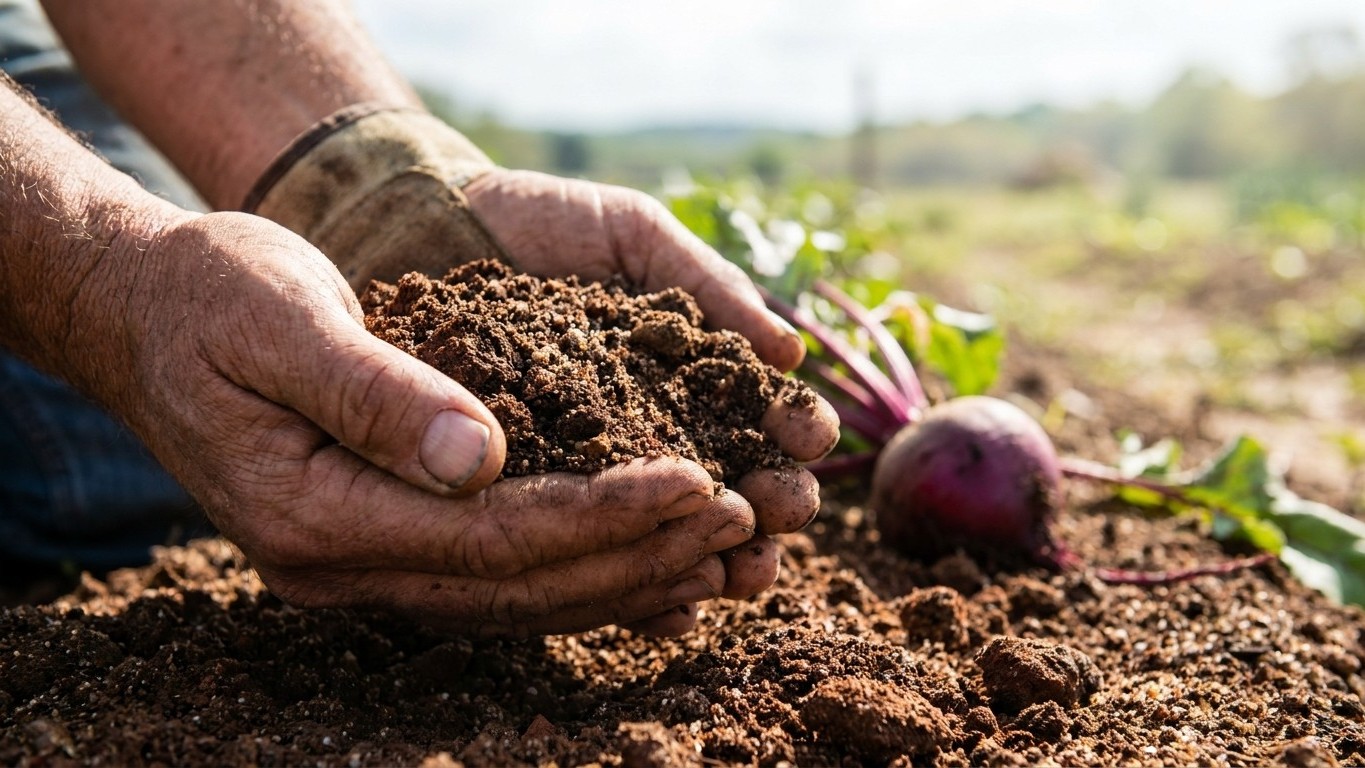

Quebec’s farmland leans acid, sandy loam, and naturally rich in organic matter, a combination that gives beet roots more of what they want than most people expect from a northern province. The real risk here isn’t the ground. It’s a short window in May and June, and a frost date that averages out to nothing near a guarantee.
The short answer
The dominant soil across Quebec’s mapped agricultural land is a Podzol, the acid, leached profile that forms under conifer forest once centuries of rain have carried the bases out of the topsoil. It covers 36 percent of the mapped surface, more than any other order, with Gleysolic soils coming in second. The median surface pH sits around 5.5, slightly acid, and the texture runs 51 percent sand, 15 percent clay, and 34 percent silt, a loam-to-silt mix that leans sandy. Organic matter averages about 6.2 percent, and drainage is classed as well drained. This comes from Agriculture and Agri-Food Canada’s Canadian Soil Information Service, pooling 248 mapped soil components across the province.
For a beet, that profile reads mostly in the plant’s favor. Utah State University Extension is blunt about what the crop wants: deep, sandy, well-drained soil, rich in organic matter, amended with no more than 1 inch of composted organic matter per 100 square feet. Quebec’s typical ground is already sandy-leaning and well drained, and it starts with more organic matter than a lot of gardeners work to build up elsewhere. That last point cuts both ways: with 6.2 percent already in the ground, there’s less reason to pile on compost past that 1-inch cap. Extra nitrogen-rich organic matter doesn’t make a beet grow faster so much as it makes the root fork and hair.
The acidity is the piece that needs checking, not assuming. A median pH of 5.5 is on the sour side, and while the sourced figures don’t tell a gardener what beets need in terms of pH, they do make clear that 5.5 is not neutral. That’s a job for a soil test kit, not a guess based on a provincial median.
On heat, the honest answer is that a days-above-90°F count for a reference Quebec city isn’t published in the figures behind this page, so it won’t be invented here. What can be said, from the Utah State guidance, is that heat above 85°F combined with water stress is what turns a beet root woody, a mechanism worth watching for regardless of the exact number of hot days a given summer delivers.
None of this replaces a soil test from your own bed. Quebec spans hundreds of individual soil series, from river-bottom silt to shallow upland till to reclaimed peat, and a province-wide median describes a tendency, not any one garden. Treat the Podzol profile as the starting assumption, then confirm it with a test kit and a shovel.
The six weeks that decide it here
Beets are sown directly in the ground, not transplanted, and the standard advice is to get seed in 2 to 3 weeks ahead of the last spring frost. In Quebec, that frost date averages out to May 6, based on Environment and Climate Change Canada’s Canadian Climate Normals for 1981-2010, drawn from the Montreal/St-Hubert A station. That means an early sowing in mid-to-late April, with the first six weeks of root development landing squarely in Quebec’s spring, before the region has settled into summer weather.
That May 6 figure is a mean, not a promise. Half of all years, by definition, see a later frost than the average, so a gardener who treats May 6 as a safe cutoff is gambling on the coin flip going their way. The Montreal/St-Hubert A station also represents one point in a province that stretches from the St. Lawrence lowlands to upland and northern districts running well behind it in the calendar. A garden in the Eastern Townships or the Laurentians should expect its own frost risk to trail this figure by days or weeks, not match it.
What that spring window usually brings is variability more than any single pattern, snowmelt saturating soil early, followed by stretches where surface moisture drops off fast once the ground warms and drains. That swing matters more for beets than steady wet or steady dry ever would, because the crop’s vulnerable period isn’t the whole season, it’s specifically the first six weeks after seeding. Utah State University Extension is direct on the mechanism: water stress during that early stretch causes premature flowering, meaning the plant bolts and sends energy into a seed stalk instead of a root, well before harvest.
That’s a separate failure from woodiness, and worth keeping separate in your head. Bolting is an early-season problem, tied to dry soil in the first six weeks after the seed goes in, right when Quebec’s spring is most likely to swing between saturated and dry. Woodiness comes later, tied to summer heat above 85°F layered on top of water stress once the root is already sizing up. Treating both as “just keep it watered” misses that the first is a timing risk built into a specific six-week window, while the second is a mid-summer heat-and-drought combination.
Where the risk actually sits
Given a May 6 average last frost and a 2-to-3-week head start on sowing, the six weeks that decide bolting risk in Quebec run roughly from mid-April through late May or early June, depending on how far behind the Montreal norm a given garden runs. That’s the stretch to watch soil moisture closely, independent of whatever the rest of the summer does.
What goes wrong here
- Bolting from dry soil in the first six weeks. Quebec’s variable spring can flip from saturated snowmelt to a dry stretch fast, and if that dry spell lands in the six weeks after sowing, beets read it as a signal to flower early instead of building a root. Utah State University Extension names this mechanism directly: water stress that early causes premature flowering. The remedy is steady moisture through that specific window, checked by hand in the top few inches of soil rather than assumed from rainfall totals.
- Acid soil holding back growth without any visible symptom. A median surface pH of 5.5 across Quebec’s mapped agricultural soil is acid enough to affect nutrient availability for a root crop, but the only way to know your own bed’s number is a soil test, since the provincial median isn’t your garden’s reading.
- Over-amending ground that’s already organic-matter-rich. With a provincial median of about 6.2 percent organic matter, piling additional compost past the recommended 1 inch per 100 square feet risks pushing a bed toward the kind of nitrogen-heavy, uneven soil that produces forked or hairy roots instead of a clean beet.
- Woodiness from mid-summer heat layered on drought. Once beets are sized up and past the early bolting window, heat above 85°F combined with water stress toughens the root’s texture. This is a distinct, later failure from bolting, and it calls for consistent watering through hot stretches rather than a one-time deep soak.
- Assuming the provincial soil profile matches your specific plot. The 51 percent sand, 15 percent clay, 34 percent silt figures describe the median across 248 mapped components, not a guarantee for any single yard. River-bottom ground, filled lots, and shallow upland soils can all diverge sharply from that mix, so a texture check by feel, or a lab test, is the only way to know what a beet root will actually meet in your soil.
Common questions
Is Quebec’s typical soil actually good for beets?
Mostly, yes, on the numbers available. A sandy-leaning loam-to-silt texture and well-drained classification line up with what Utah State University Extension describes as beets’ preference for deep, sandy, well-drained ground. The acid median pH of 5.5 is the one factor worth checking against your own soil test before assuming the match holds.
When should beets go in the ground in Quebec?
Utah State University Extension’s timing guidance calls for sowing 2 to 3 weeks before the last spring frost. With Quebec’s average last frost falling on May 6, based on Environment and Climate Change Canada’s 1981-2010 normals for the Montreal/St-Hubert A station, that points to a mid-to-late April sowing window for gardens near that station, adjusted earlier or later depending on how a given district’s frost timing compares.
How much compost do Quebec beet beds actually need?
Utah State University Extension caps organic matter amendment at 1 inch of composted material per 100 square feet. Given that Quebec’s mapped agricultural soil already averages about 6.2 percent organic matter, many beds may need less added compost than a gardener starting from leaner soil elsewhere, not more.
Does Quebec get hot enough to cause woody beets?
The figures behind this page don’t include a days-above-90°F count for any Quebec reference city, so that specific number isn’t published here. What is documented is the mechanism: Utah State University Extension identifies heat above 85°F combined with water stress as the cause of woody roots, a risk worth watching for during hot, dry stretches regardless of how many days a given summer crosses that mark.