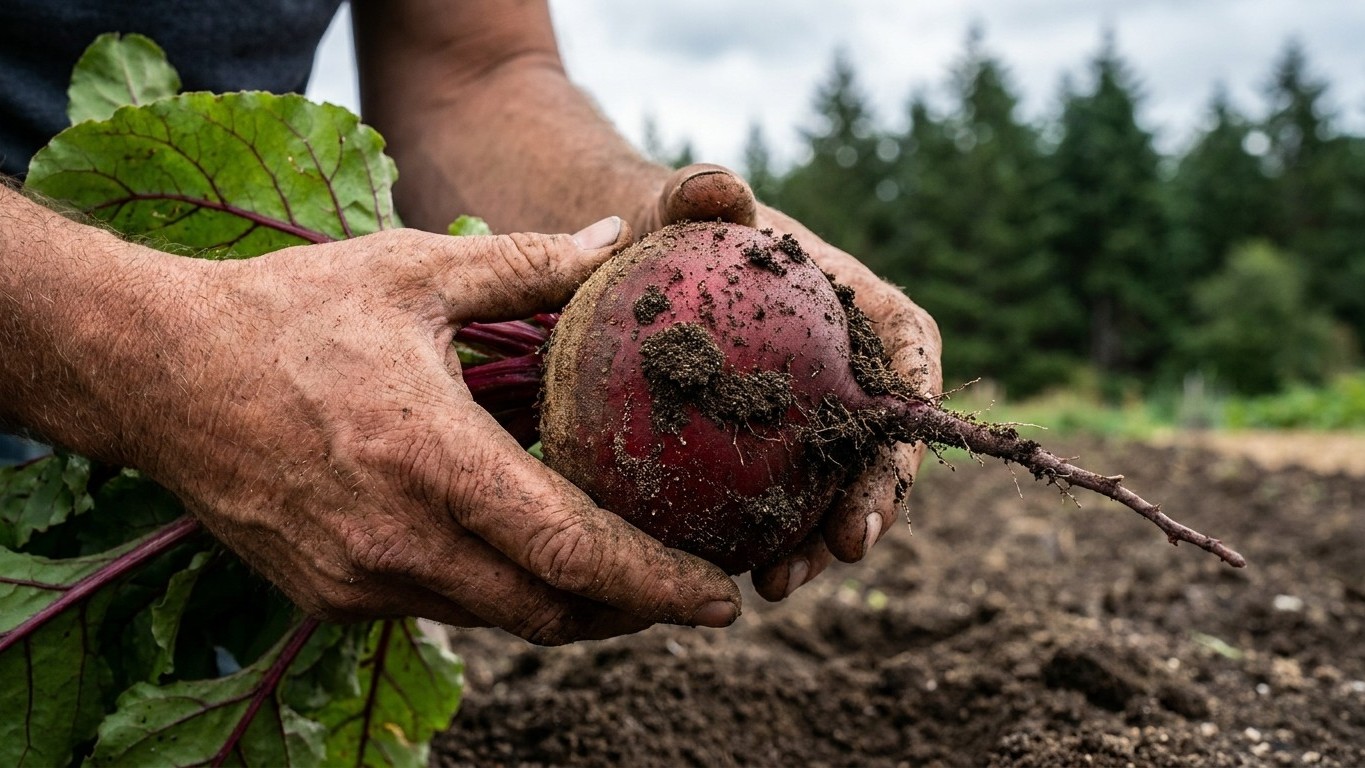

Quebec’s dominant soil, sandy and well drained but running acid under generations of conifer litter, gives beets a decent start on texture but a pH worth checking before planting. When to Sow Beets in Quebec comes down to sowing seed directly two to three weeks before the average last frost of May 6, then guarding the first six weeks against drought, since that stretch decides whether the row bolts. Heat past 85 F later in summer, paired with dry soil, is what turns the root woody. Test your own plot before trusting any province-wide number.
The short answer
Across Quebec’s mapped agricultural land, the dominant soil order is Podzol, the acid, leached ground that forms under centuries of conifer litter, covering 36 percent of the mapped surface (Gleysolic soils come next). The median surface sample runs 51 percent sand, 15 percent clay and 34 percent silt, a loam leaning toward sand, with organic matter around 6.2 percent and a well-drained profile. The median surface pH sits near 5.5, slightly acid. Those figures come from Agriculture and Agri-Food Canada’s Canadian Soil Information Service, reading the surface horizons of 248 mapped soil components across the province, a baseline worth understanding as Beet Soil in Quebec before planting.
For a beet, that mix cuts two ways. Utah State University Extension notes that beets want deep, sandy, well-drained soil rich in organic matter, and Quebec’s median profile already leans sandy and drains well, with organic matter well above what a garden typically starts with. The same extension caps amendment at roughly 1 inch of composted material per 100 square feet, a limit that matters more than it might seem on ground already carrying 6.2 percent organic matter. The acidity is the piece to check on your own soil, since the province-wide figures describe texture and drainage, not a beet-specific target.
Utah State University Extension also warns that heat above 85 F combined with water stress turns beet roots woody later in the season. How many days a year Quebec’s growing regions cross that mark isn’t part of the verified figures gathered for this page, so no specific count is offered here. What matters in practice is treating any stretch of hot, dry weather in mid-summer as a woodiness risk on this soil, whatever the exact tally turns out to be in a given year.
None of this describes one field. Quebec spans hundreds of soil series across regions from the Outaouais to the Bas-Saint-Laurent, and the podzol profile above is a province-wide median, not a verdict on any one backyard. A garden on old floodplain silt near a river, or on fill trucked in during a subdivision build, can sit nowhere near these numbers. Treat the figures as the general shape of the region’s ground, sand-leaning, well drained, acid, and send your own soil to a lab before deciding on lime or anything else.
The six weeks that decide it here
Beets go into the ground as direct-sown seed, never as transplants, and the usual 60 to 80 days to harvest counts from that seeding date, not from any later stage. Utah State University Extension’s advice to sow two to three weeks before the last frost lands the first six weeks of a Quebec beet row on a known stretch of the calendar: measured at the Montreal/St-Hubert A station, the average last spring frost falls on May 6, putting a typical direct sowing date somewhere in the second half of April into early May.
That date is a mean, not a guarantee. Environment and Climate Change Canada’s 1981-2010 climate normals put May 6 at the midpoint of a range, meaning in roughly one year out of every two, frost arrives later than that, sometimes well into the back half of May in cooler pockets or upland districts far from the reference station. Treat May 6 as the center of a window to plan around, never as a date to bank an entire row on.
What happens through those first six weeks is where bolting risk concentrates. Utah State University Extension is specific on this point: water stress in that early window, whether from a dry spell right after germination or a thirsty stretch before the plant has a real root system, pushes beets toward premature flowering, or bolting, before a usable root ever forms. Quebec’s spring is known for swinging between a saturated snowmelt period and drier weeks that follow, and a beet row sown into that swing needs steady moisture on either side of it, since the plant reacts the same way to drought as it does to simple neglect.
None of this relates to the woodiness beets can develop later in summer, which comes from heat above 85 F layered onto water stress, months after these first six weeks are behind the plant. The two failures start from different causes and show up at different points in the season. Treating them as one problem, more or less “keep it watered,” misses that the early failure is about germination-stage moisture and the later one is about a heat threshold hit long after the row has established.
What goes wrong here
- Bolting from a dry sowing window. Seed goes into the ground during Quebec’s variable late-April-to-May stretch, and a dry week right after germination stresses a beet before it has any root reserve, pushing it to flower instead of forming a usable root. The remedy is steady moisture for the full six weeks after sowing, checking the top few inches of soil directly rather than trusting the calendar or that week’s forecast.
- Woody roots from a hot, dry summer. Utah State University Extension ties woodiness to heat above 85 F arriving on top of water stress, a combination that shows up well after the early bolting window has closed. The remedy is deep, even watering through any hot stretch, plus mulch to keep the soil around the root from swinging between soaked and dry.
- Acid podzol ground holding beets back. A median surface pH near 5.5 across the province’s mapped agricultural soils sits on the acid side, and a garden close to that median may need lime to shift the bed. The remedy is a soil test before adding anything, since guessing at lime rates on acid ground can just as easily overshoot the target.
- Over-amending organic matter. Quebec’s median organic matter already runs near 6.2 percent, well-supplied ground by most garden standards, and piling on more compost past the roughly 1 inch per 100 square feet that Utah State University Extension recommends can push the balance toward leafy top growth at the root’s expense. The remedy is measuring the compost layer instead of eyeballing it.
- Sowing before the ground has actually warmed. Jumping ahead of the two-to-three-week window before the average May 6 frost puts seed into cold, often waterlogged soil left over from snowmelt, where germination stalls or fails outright. The remedy is waiting for the soil itself to warm and drain, using the date as a guide rather than a trigger.
Checking this against your own county
Every figure above describes a province-wide median, built from hundreds of mapped soil components and a single climate station near Montreal. A plot in the Eastern Townships, the Gaspé, the Saguenay, or any county far from that station can sit well outside the median in texture, drainage, pH or the date the ground actually thaws in a given spring.
The most direct next step is Quebec’s own ministry of agriculture, MAPAQ, which can point toward regional agronomic resources and soil testing services suited to a specific county or municipality rather than a province-wide average. A local soil test remains the only way to know where a given garden’s pH, texture and organic matter actually land against the figures cited here, and it’s a cheaper fix than losing a season’s beets to a guess.
Common questions
How long does it take to grow beets from seed in Quebec?
Utah State University Extension lists beets at 60 to 80 days from direct seeding to harvest, counted from the day seed goes into the ground, since beets are sown in place rather than transplanted.
When should beets be sown in Quebec?
Two to three weeks before the average last frost, which the Montreal/St-Hubert A station puts at May 6 based on Environment and Climate Change Canada’s 1981-2010 normals. That date is a mean, so plan around it rather than on it.
Does Quebec’s acidic soil hurt beets?
The province’s dominant podzol profile carries a median surface pH near 5.5, acid enough to be worth checking, though this figure is a province-wide median and any individual garden should be tested before lime gets added.
What’s the difference between bolting and woody beets?
Bolting comes from water stress in the first six weeks after sowing and shows up as premature flowering instead of a proper root. Woodiness comes later, when heat above 85 F combines with water stress on a root that has already formed. They are separate failures on separate timelines, not one problem with one fix.