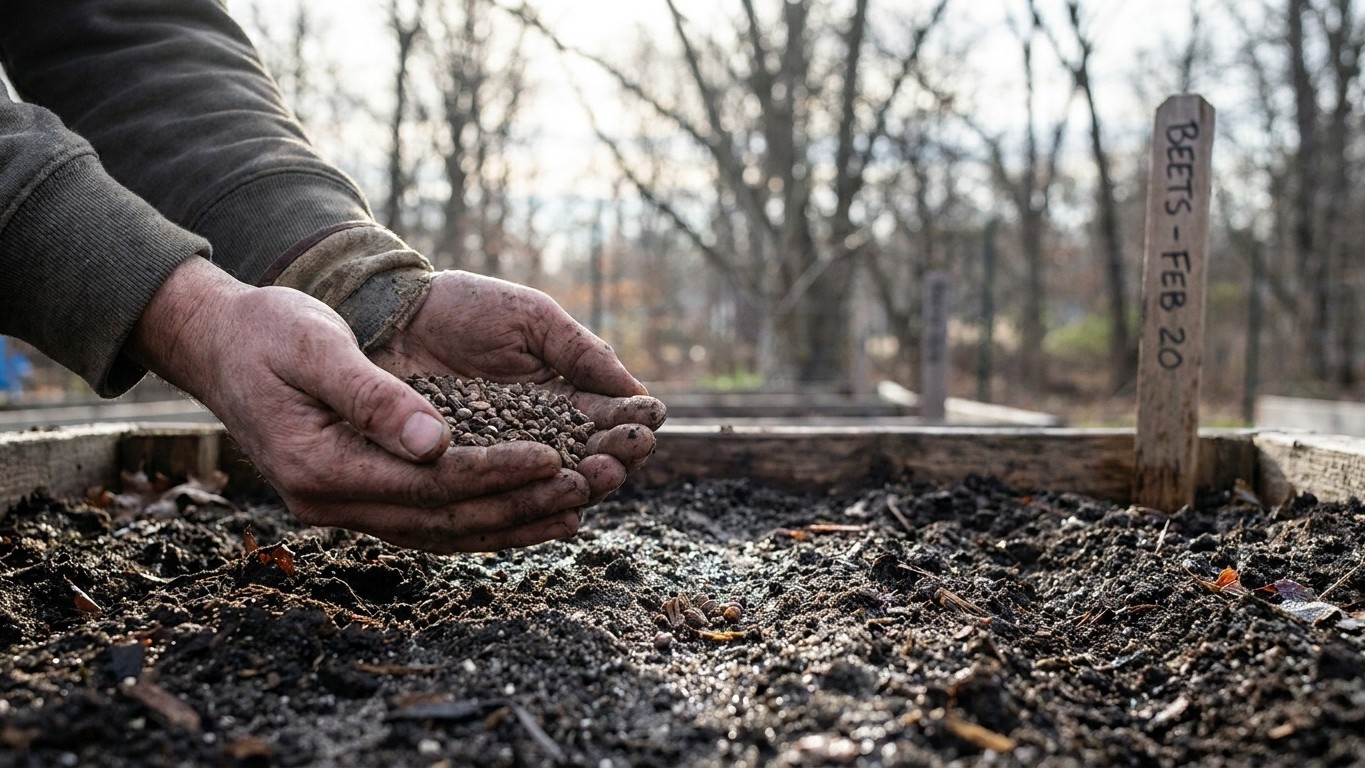

Sow beets in Quebec two to three weeks before the last spring frost, which lands on average around May 6 at the Montreal-area reference station. That points to a sowing window opening in mid-April for most of the province’s farmed valleys, with real dates sliding later the farther north or higher in elevation a garden sits.
The short answer
Start with the ground itself, because that’s what a beet root actually pushes through. Across Quebec’s mapped agricultural soils, the single most common profile is a Podzol, an acid soil that forms under conifer cover as rain leaches the bases out of the topsoil. It covers about 36 percent of the mapped surface, more than any other order, with Gleysolic soils as the runner-up. The median surface reading on that Podzol comes out slightly acid, around pH 5.5, with a texture of roughly 51 percent sand, 15 percent clay and 34 percent silt, an organic matter content near 6.2 percent, and good drainage.
Those numbers line up better with a beet’s wish list than a lot of garden soil does. Beets want deep, sandy, well-drained ground that’s rich in organic matter, and a 51-15-34 sand-clay-silt split with 6.2 percent organic matter is a loam leaning sandy, not a heavy clay that would crust over a germinating seed or squeeze a taproot sideways. The catch is the pH. At 5.5, a Podzol sits more acid than beets generally prefer, which can limit how efficiently the plant takes up boron and other micronutrients it needs to build a solid root rather than a corky, hollow one.
| Measure | Quebec’s dominant mapped soil (Podzol) |
|---|---|
| Share of mapped surface | 36 percent |
| Median surface pH | about 5.5 |
| Sand / clay / silt | 51% / 15% / 34% |
| Organic matter | about 6.2 percent |
| Drainage class | well drained |
None of this tells a gardener what their own plot is doing. Quebec’s agricultural land spans hundreds of distinct soil series, and the figures above are a median drawn from 248 mapped components, not a promise about any one backyard. River flats, drained wetland, and any lot a builder has cut and filled will read completely differently from the provincial median. Treat the Podzol profile as a starting point for guessing whether ground runs acid or holds water, then confirm it with an actual soil test before amending anything.
On heat, the picture here is incomplete by design rather than by accident: no verified count of days above 90 F for a Quebec reference city sits behind this page, so that figure isn’t published here. What is documented is the threshold at which heat becomes a problem for beets regardless of location: once temperatures climb past 85 F while the plant is also short on water, the root turns woody. Whether Quebec’s growing season delivers many such days or almost none isn’t a number this page can responsibly supply.
The six weeks that decide it here
Sowing two to three weeks ahead of a May 6 average last frost drops that critical early stretch, the first six weeks after seeding, into the coldest, most unsettled slice of the Quebec growing calendar. That’s deliberate: beets tolerate a light frost as seedlings, and getting them in early buys length on the back end of a season that isn’t overly long to begin with. But it also means the plant’s most bolt-sensitive phase overlaps with the weeks when spring weather in this region is least settled, swinging from a warm stretch that pulls soil moisture down fast to a cold snap that stalls growth, sometimes within the same ten days.
That swing matters more than either extreme alone, because it’s the water stress during those first six weeks, not the cold by itself, that pushes a beet toward premature flowering. A young beet plant that dries out even briefly while it’s forming its root can respond by bolting, sending up a seed stalk instead of building the root a gardener actually wants. In a spring that alternates between dry, wind-exposed stretches and sudden downpours, the risk isn’t a single dry month; it’s the gaps between waterings that a gardener doesn’t notice because the calendar says “spring, should be fine.”
The frost date itself deserves a caution the seed packet won’t give. May 6 is a mean pulled from the Montreal-area station’s 1981-2010 climate normals, not a line a gardener can plant against with confidence. By definition, half of all years bring frost after that date, so treating May 6 as a safe cutoff, rather than the midpoint of a wider window, is how a first planting gets nipped. And Quebec is not one climate: a garden well north of the Montreal corridor, or up in elevation, should expect that window to run weeks later, not on the same schedule as the reference station.
Because beets are sown directly into the ground rather than transplanted, every one of those first six weeks happens exactly where the seed landed. There’s no transplant shock to blame and no head start from a greenhouse tray; the seedling experiences this region’s actual spring from the moment it germinates, which is exactly why the sowing date matters as much as it does here.
What goes wrong here
- Early bolting from a dry spell right after germination. A Quebec spring that swings from warm and windy to cold and wet can dry out the surface inch of soil fast between rain events, and that’s precisely the depth where a young beet root is trying to establish. The remedy is a consistent watering check through the first six weeks after sowing, not just at planting, since it’s the gap in moisture rather than the average rainfall that trips the bolting response.
- Acid soil locking up micronutrients. With the province’s dominant mapped soil sitting near pH 5.5, a beet crop grown without any correction can struggle to pull in boron, leaving roots that are misshapen or internally corky even when watering has been fine. A soil test before sowing, rather than after a disappointing harvest, is the only way to know whether this applies to a given plot.
- Over-amending a soil that’s already fairly rich. At roughly 6.2 percent organic matter in the province’s typical mapped surface soil, a heavy hand with compost isn’t doing what it would on genuinely poor ground. The guidance caps additions at no more than 1 inch of composted organic matter per 100 square feet; piling on more doesn’t help a beet root and can push nitrogen too high relative to the boron and potassium the root actually needs.
- Woodiness from a late-season heat and drought combination. This is a separate failure from early bolting, and it shows up later, closer to harvest. Once air temperatures pass 85 F while the soil is also dry, the root fibers toughen up, and no amount of watering after the fact reverses it. Keeping soil moisture steady through any hot stretch, rather than only during the first six weeks, is what prevents this specific problem.
- Well-drained ground drying out faster than it looks. Good drainage, the general condition of the province’s dominant soil, is an asset against waterlogging but a liability against drought stress, since water moves through and past the root zone quickly. A mulch layer over the row can slow that loss without changing the amendment math above.
Common questions
How many days do beets take from sowing to harvest in Quebec?
Beets are grown from direct-sown seed rather than transplants, and that count of days to harvest runs from the seeding date, not from any later stage. Because the clock starts at germination in open ground, a Quebec sowing timed two to three weeks ahead of the mean May 6 last frost needs to reach the finish line before the season’s genuine end, which is one more reason an early, well-timed sowing matters more here than in a longer-season climate.
Should I test my soil before sowing beets in Quebec?
Yes, and the reasoning is specific to this province. The dominant mapped agricultural soil here runs acid, around pH 5.5, which sits below what beets generally prefer, but that figure is a median across 248 soil components, not a reading for any individual yard. A test is the only way to know whether a given plot needs a pH correction or is already closer to neutral.
Is Quebec’s soil naturally good for beets?
In texture, mostly yes: a sand-clay-silt split near 51-15-34 with well drainage and roughly 6.2 percent organic matter is a workable, loam-leaning base that suits a beet’s deep, straight taproot. The acidity is the one factor that tends to work against beets rather than for them, and it’s worth checking rather than assuming.
What causes woody beets, and is it the same as bolting?
No, they’re two different failures with two different causes. Bolting comes from water stress in the first six weeks after sowing and shows up as an unwanted seed stalk instead of a root. Woodiness comes later, from heat above 85 F combined with dry soil, and shows up as a tough, fibrous root even when the plant never bolted at all. Preventing one doesn’t automatically prevent the other.