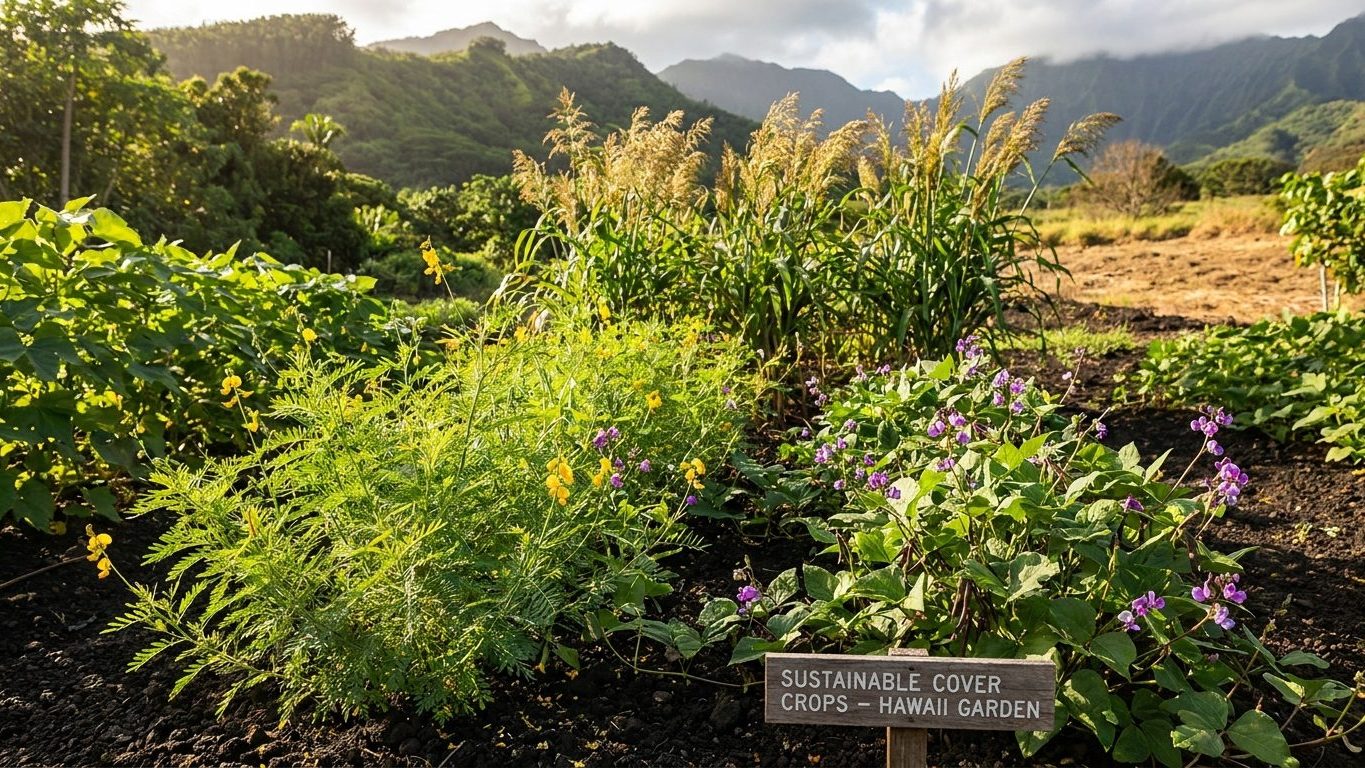

Winter cereal rye is the safest cover crop bet across most of Quebec, with oats and field peas as strong alternates. The province’s frost-free season runs only from roughly May 6 to October 5 on average, and winter lows drop to a mean minimum of -14.1°C, numbers that rule out most warm-season and marginally hardy species before you even pick a seed bag.
The short answer for Quebec
Break it down by type and the picture gets clearer. Cool-season cereals, cereal rye above all, handle Quebec’s climate better than almost anything else you could plant, because they keep growing at temperatures that would stall a legume and they shrug off the province’s brutal winter minimums. Rye seeded after a cash crop comes off in late summer will still put down roots and a few inches of top growth before the ground freezes, then resume growth the moment the snow retreats.
Oats sit right behind rye on the list, mostly because they solve a different problem: they winterkill reliably once temperatures fall into the range Quebec sees every year, so a grower gets ground cover through fall and early winter without having to terminate anything in spring. Field peas and hairy vetch bring nitrogen into the mix, but both need to go in the ground with enough of the season left to reach a useful growth stage. Vetch in particular is slow to establish and works best paired with a cereal nurse crop rather than sown alone.
Fast brassicas like forage radish or oilseed radish fill the gap for growers who only have a short window after harvest. They germinate fast, grow through cool fall weather, and then die back on their own after a hard freeze, leaving loosened soil and no residue to manage in spring. For a summer-only window between two vegetable plantings, buckwheat is the one true warm-season option that fits: it matures in about six weeks, smothers weeds, and dies at the first light frost, so there’s nothing to till under.
What decides all of this is the length of the frost-free period. The average last spring frost falls around May 6 and the average first fall frost around October 5, which pencils out to roughly 152 frost-free days in a typical year, and that’s a midpoint, not a guarantee, since frost arrives later than that average in half of all years and earlier in the other half. That window is short enough to eliminate most cover crops that need a long run of heat to reach maturity, and cold enough in winter to eliminate species bred for milder zones. Anything you plant here has to finish its job, or go dormant safely, inside that bracket.
What will not work here
Crimson clover is the classic mismatch. It’s a popular, cheap cover crop across the southern and mid-Atlantic United States, but it’s bred for winters that rarely see anything close to Quebec’s mean coldest-month minimum of -14.1°C. Seed it here and you’ll get a nice fall stand that dies over winter almost everywhere in the province, which defeats the purpose of a crop you were counting on for spring nitrogen.
Warm-season smother crops face the opposite problem. Cowpeas, soybean-based cover mixes, and sorghum-sudangrass all want a long run of hot nights to bulk up, and Quebec’s frost-free season is short enough on average, and unreliable enough at the edges, that these crops rarely reach the growth stage where they earn their keep. Even in a warm year, cool nights along the St. Lawrence Valley slow them down compared with what the seed tag promises.
Hairy vetch seeded alone, late, after a fall harvest is another common failure. Vetch germinates and grows slowly at first, and if it goes into the ground much past early September, it simply hasn’t logged enough growing time before the average October 5 frost to build the root mass it needs to overwinter reliably. Paired with rye as a nurse crop and seeded earlier, it does fine, but on its own and late, it’s a gamble that often ends in a thin, patchy stand.
Anything that depends on frequent irrigation to establish is also a poor fit for the way most Quebec gardens and fields are managed, not because the province is dry (it isn’t, especially in the humid inland regions) but because most growers seeding a cover crop after a main harvest aren’t set up to water it daily through germination. A cover crop that needs babying to get started defeats the purpose of choosing one in the first place, so slow, thirsty germinators lose out to rye, oats, and radish, which all establish from a single decent rain.
Treat close spacing with caution in the more humid pockets of the province, too. Thick, dense stands of clover or vetch sown too tightly hold moisture at the crown for longer after Quebec’s frequent fall rains, and that combination of cold and damp is often what actually kills a stand outright, more than the cold on its own.
What changes across Quebec
The zone figure most useful for reasoning through this page, Canadian hardiness zone 5b, describes conditions around the reference station used for these averages, in the St. Lawrence Valley near Montreal. It does not describe Quebec as a whole, and treating it as if it did is the single biggest mistake a gardener or grower can make on a province this size.
Quebec stretches from the mild river valleys of the Montérégie and the Eastern Townships, through the Laurentides and Mauricie uplands, up into Abitibi-Témiscamingue, Saguenay-Lac-Saint-Jean, the Côte-Nord, and the Gaspésie, before reaching the subarctic conditions of Nord-du-Québec. Natural Resources Canada’s own plant hardiness map, built from seven climate variables rather than one, shows this as a genuine gradient rather than a single number, and the zones assigned to municipalities in the northern and eastern parts of the province run considerably colder than the 5b used here.
That gradient matters for cover crop timing in a very practical way. A planting date or a species choice that works in the Montérégie can arrive weeks too late, or be built for a winter too mild, once you move north of the St. Lawrence or up into elevation in the Laurentides or the Appalachian foothills of the Eastern Townships. Growing seasons shorten and winter minimums drop as you move north and up, which pushes the safe window for slower legumes even tighter and makes a winterkilling cereal like oats an even more reliable default, since there’s less risk in a crop that’s designed to die on its own regardless of how cold the winter actually turns out to be.
None of this can be resolved from a provincial average. The only way to know which side of that gradient a given piece of land falls on is to check it directly on the interactive hardiness zone map, rather than assume the number attached to Montreal applies wherever you happen to garden or farm.
Where to check this for your own county
Everything above is built from a single weather station and a single reference zone. It’s a reasonable starting point for the province, but it isn’t a substitute for what’s actually recommended where you farm or garden, and the agency set up to make that call for Quebec is MAPAQ, the province’s ministry of agriculture, fisheries and food.
Start at mapaq.gouv.qc.ca and look specifically for two things. First, the regional planting and seeding calendars, which break the province down by agricultural region rather than by a single provincial average, and which will give you a realistic window for your soil and your climate rather than the St. Lawrence Valley figure used as the baseline on this page. Second, look for the variety and species trials run through the province’s regional agricultural networks, since MAPAQ and its regional partners test cover crop performance under real Quebec conditions, region by region, rather than relying on seed-tag claims written for a different climate entirely.
Quebec doesn’t organize its agricultural extension the way US states organize counties, but the province is broken into distinct agricultural regions, each with its own MAPAQ presence and its own set of local trial results. If you know your MRC or your nearest agricultural region, search the site directly for that name rather than for general terms, since a broad search tends to surface the same provincial averages already covered on this page.
This distinction matters more than it sounds. A provincial page like this one has to average conditions across hundreds of miles and dozens of distinct microclimates, which makes it a rougher tool than a recommendation built for your specific agricultural region or municipality. If what MAPAQ publishes for your area contradicts something written here, follow MAPAQ. A regional recommendation, tested locally, beats a provincial average every time.
Checking this against your own garden
Every date on this page is an average pulled from one weather station, and your own plot of ground will disagree with it more often than it agrees. Three simple checks, using nothing but your hands and your eyes, will tell you more about your actual microclimate than any provincial figure.
Start with the soil itself in spring. Grab a handful a few inches down: if it crumbles apart loosely, it’s dried and warmed enough to work and to seed a spring cover like oats or field peas; if it balls up into a wet, sticky lump, it’s still too cold and too saturated, no matter what the calendar says, and seeding into it now will rot more than it grows.
Watch for the first true leaves on whatever you seeded, rather than counting days from planting. A cover crop that’s slow to push past its seed leaves is telling you the soil is colder or the site is shadier than the provincial average assumes, and that’s useful information for how you time the same plot next year.
In fall, pay attention to the first morning you actually see frost whiten the grass, not the calendar date. That first visible frost on your own property is the real signal that it’s time to get a winterkilling cereal like oats into the ground if you haven’t already. Land near open water, in a low frost pocket, or up in elevation will all show that first frost on a different morning than the valley station this page is built on, sometimes by two or three weeks in either direction.