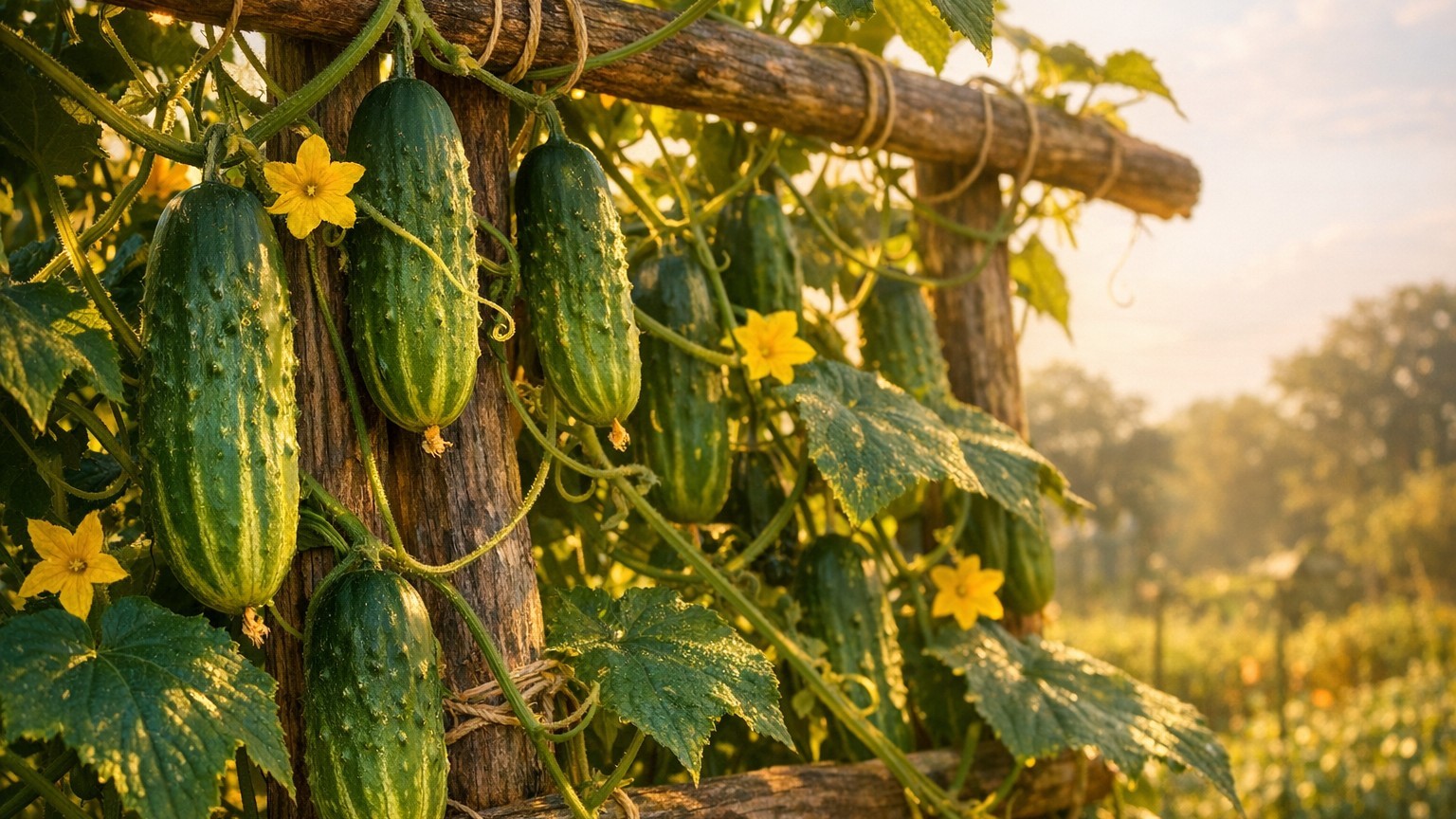

Quebec’s growing season runs on average from May 6 to October 5, a window of roughly five months bookended by two frost dates that are means, not guarantees. With summers that never hit 90°F and rainfall spread fairly evenly through June, July and August, the varieties that do best here are quick-maturing, cool-tolerant types rather than the long-season slicers bred for hotter climates further south.
The short answer for Quebec
Start with the two numbers that actually decide the outcome: an average last spring frost of May 6 and an average first fall frost of October 5. Those are mean dates from Environment and Climate Change Canada’s 1981-2010 normals for the Montreal/St-Hubert station, and a mean is not a safety margin. In one year out of two, the real frost falls later in spring or earlier in fall than these dates suggest. So the workable stretch for a cucumber crop is narrower than the raw 152 days between those two averages, and it shrinks further in any year that runs cold.
The other number that shapes the choice is 0.0, the mean number of days per year that reach 90°F at the reference station. That is a climate with almost no heat load. Cucumbers germinate and fruit fastest in warm soil and warm air, and a region that rarely delivers real heat is not going to rescue a slow variety with a late-summer hot spell the way a prairie or a mid-Atlantic garden might.
What that means by type
Put those two facts together and the decision is less about a brand name and more about a category. Quick-maturing, compact or bush-habit cucumbers make better use of a season that has no guaranteed heat surplus. Pickling types tend to run bushier and faster than large slicing types, which is an advantage when the clock is a mean date rather than a promise. Parthenocarpic types, the ones that set fruit without pollination, are worth knowing about specifically because they perform well under row cover or plastic mulch, two tools that let a Quebec grower bank a few extra degrees of soil warmth early in the season without waiting on open pollination.
Seed catalogs turn over their lineups, and the varieties that perform in a trial plot near Quebec City are not necessarily the same ones sold under the same name five years from now. The type is the durable answer; the specific cultivar is a question for MAPAQ and for the seed trial results published for your own region.
What will not work here

The clearest failure mode in this climate is a long-maturing vining slicer chosen because it looked productive in a catalog photo shot somewhere with a longer, hotter summer. A variety that needs many consecutive weeks of real warmth to finish sizing up is racing against an October 5 mean frost date with zero days of 90°F heat to help it catch up. Some years it will make it. In the years where frost arrives on the early side of that average, or where June and July run cool, it won’t, and there is no heat wave coming to bail it out.
Sowing directly outdoors right at the May 6 mean frost date is its own trap. Cucumber seed wants warm soil to germinate reliably, and a date that is only the 50th percentile for last frost means the ground is often still cold at that point, with a real chance of a colder-than-average spring pushing the safe window later still. Seedlings started too early into cold, damp soil tend to sit and sulk rather than grow, which erases whatever head start the gardener thought they were getting.
Watering and spacing habits borrowed from drier climates
A watering schedule copied from a drier, hotter state does not fit here. Summer rainfall across June, July and August averages about 10.6 inches, with the driest month, June, still delivering roughly 3.42 inches on its own. That is not a drought-prone summer. A rigid once-a-week deep watering routine designed for a place that gets a fraction of that rainfall risks pushing already-adequate soil moisture into the range where fungal disease takes hold.
That same rainfall pattern makes tight spacing and sprawling vines flat on damp soil a bigger risk than in a drier region. Regular summer moisture combined with mild temperatures is close to ideal for powdery and downy mildew on cucumber foliage. Crowding plants, or letting vines lie directly on wet ground instead of up a trellis or support, cuts the airflow that keeps leaves dry between rain events, and that is exactly the condition these diseases exploit.
What changes across Quebec
The 5b figure is a Canadian hardiness zone, not a USDA zone, and it applies specifically to the Montreal/St-Hubert reference station, not to the province as a whole. Quebec stretches from the milder river-valley pockets around the St. Lawrence to interior, upland, and far northern districts that run considerably colder, and a province of that size and shape cannot be reduced to one zone number without losing exactly the information a gardener needs.
The Canadian system itself is built differently from the American one worth flagging here: it weighs seven climate variables rather than one, and Natural Resources Canada is explicit that its zones do not convert cleanly onto the USDA scale used elsewhere on this site. A Canadian zone can span several USDA zones depending on which variable drives the difference in a given area, so treating 5b as a stand-in for a familiar USDA number would be a mistake in either direction.
A gardener working land north of the St. Lawrence lowlands, at higher elevation, or well into the Laurentides, the Abitibi region, or further toward the Gaspésie should expect a shorter frost-free window and cooler soil than the Montreal-area figures describe, and should shift sowing dates later and lean even harder toward the fastest-maturing types discussed above. Rather than guess at a second zone number, the right move is to check Natural Resources Canada’s Plant Hardiness Site for the zone that actually covers a specific municipality.
Where to check this for your own county
One reference station and one provincial-level source make this a starting point, not a final answer. The place to narrow it down is MAPAQ, Quebec’s Ministère de l’Agriculture, des Pêcheries et de l’Alimentation, which publishes regional guidance that goes well beyond what a single frost-date average from Montreal can tell a gardener two or three climate zones away.
Two things are worth hunting for specifically once there. First, a regional or local planting calendar, since MAPAQ and its regional partners track sowing windows adapted to conditions in different parts of the province rather than a single provincial date. Second, any published list of cucumber varieties that have actually been trialled in home garden or market garden conditions in your area. A variety that performs well in a trial plot in the Montérégie is a far more reliable pick than one recommended purely on the strength of a seed catalog description written for a national audience.
A county-level or regional recommendation will always beat a provincial one, and it’s worth being direct about that here: everything above is the provincial-scale picture, useful for understanding the mechanism (frost timing, heat load, rainfall) but not a substitute for what your own region’s extension resources say about your own conditions. If a MAPAQ regional bulletin and a provincial average ever disagree on timing, the regional source should win, because it is drawing on data closer to the actual garden.
Checking this against your own garden
Every date and average describes a reference station, not a specific yard, and the most reliable instrument any gardener has for closing that gap is direct observation of their own soil and plants. Three signs are worth tracking through the spring and into summer.
Soil warmth by feel is the first. Cold, damp soil that still feels cool to the back of a hand in mid-May, well after the May 6 mean frost date, is a sign that a particular garden runs behind the regional average, and that direct seeding should wait a bit longer regardless of what the calendar says. The first flush of male flowers is the second. Cucumber plants typically produce male flowers before female ones, and their appearance signals that the plant has moved from vegetative growth into reproductive growth, a useful check on whether the season is progressing on schedule for that particular spot. The first true leaves, the second set that appears after the rounder seed leaves, mark the point where a seedling has established a real root system and stopped depending entirely on stored seed energy.
Together, those three observations tell a gardener more about their own microclimate, whether it sits in a frost pocket, on a warm south-facing slope, or in a low spot that holds cold air, than any single provincial average ever could.