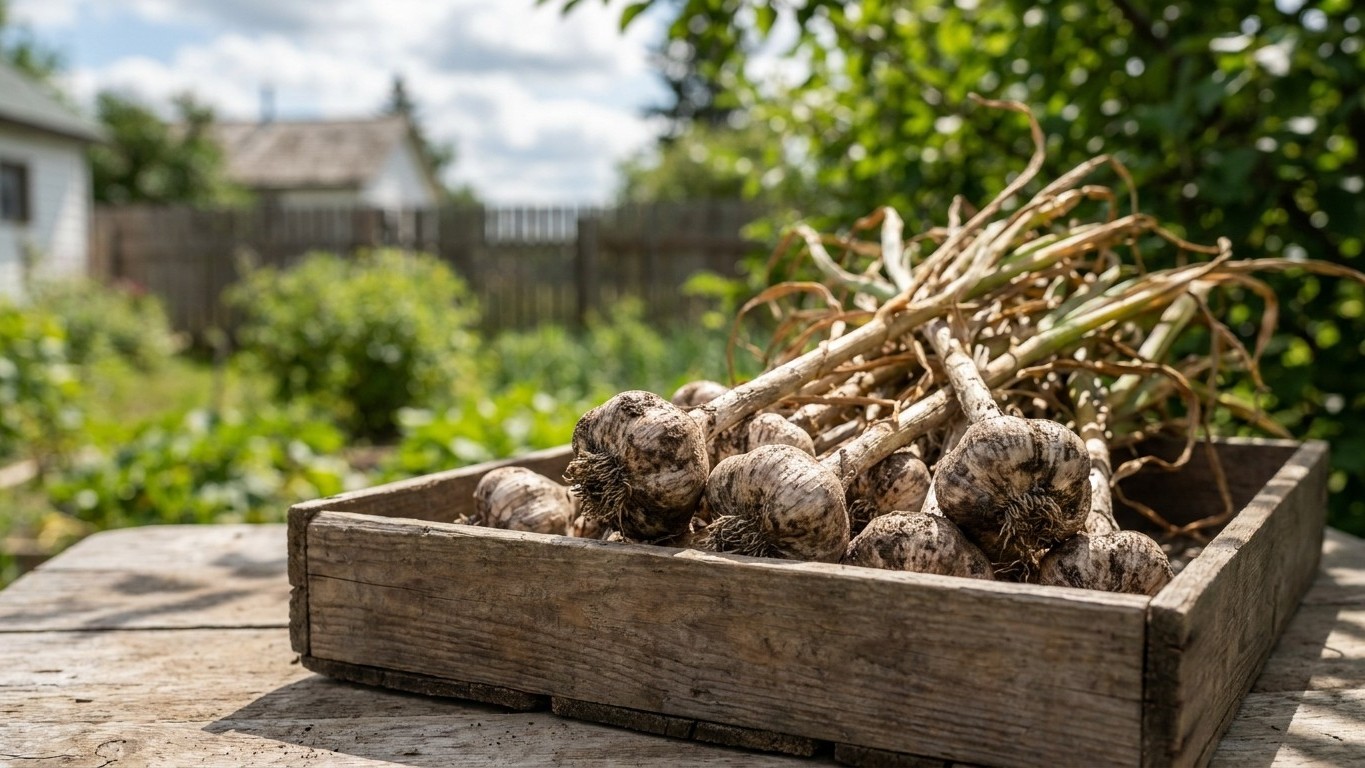

Garlic planted the previous fall in Quebec is typically ready to lift in mid-to-late July, once the bottom third to half of the leaves have browned while four or five up top stay green. Curing takes two to three weeks in a shaded, well-ventilated spot, roots and tops left on, before you trim, clean, and move the bulbs to cool, dark storage for the winter ahead.
When garlic is ready to lift in Quebec
The harvest date traces back to a planting decision made months earlier. Garlic goes into the ground in autumn, not spring, and the window for that planting is tied to the first fall frost. For the Montreal area, Environment and Climate Change Canada’s Canadian Climate Normals (1981-2010) put the average first fall frost at October 5, based on the MONTREAL/ST-HUBERT A station. That figure is a midpoint, not a guarantee: in one year out of two, frost arrives later than that date, sometimes weeks later. It also reflects one station near Montreal. Regions farther north, at higher elevation, or away from the moderating effect of the St. Lawrence run behind that average by a stretch that isn’t captured in this single number.
Growers usually get cloves in the ground a few weeks ahead of that average frost date, giving roots time to establish before the soil locks up, without so much top growth that leaves get shredded by early cold. That autumn timing sets the clock for the following summer’s harvest, roughly ten months later.
Leaf color is the main signal to watch, not a calendar date. Hardneck types tend to show the lower leaves yellowing and drying first, while the upper leaves hang on green a bit longer. Pull one test bulb before committing to the whole row: a properly sized bulb has plump cloves and wrappers that are still intact, not split or papery-thin at the neck. Wait too long past that point and the wrappers start to degrade in the ground, wide open to soil moisture and mud splashed up during a heavy July rain, both of which shorten storage life dramatically. Lift too early and the cloves stay small and the wrappers never fully form, leaving bulbs that shrivel fast once out of the ground.
Quebec’s July and August weather swings between hot, humid stretches and sudden downpours, which means the harvest window can close faster than expected. A soaked field a day before you planned to dig is common enough that many growers check the forecast and pull garlic ahead of rain rather than after it, even if the leaves haven’t fully browned.
Curing it, and where to hang it here
Curing is really just controlled drying, and it happens with the whole plant intact, roots, stems, and leaves left attached rather than trimmed off at the moment of harvest. Fresh out of the ground, a garlic bulb carries a lot of moisture in its wrappers and neck. Curing lets that moisture leave slowly, which firms up the wrappers into the papery layers that protect the cloves later. Rush this step and the bulbs go soft or moldy in storage within weeks.
Shade matters more than most people expect. Direct sun on freshly pulled bulbs can scorch the wrappers or even partially cook the outer cloves, especially during a hot Quebec afternoon in late July. Garlic should go straight from the ground into a shaded, airy spot, never left lying in full sun to “dry” for a few hours before moving it. An open shed, a covered porch, a barn with the doors cracked for airflow, or a garage with a window fan running all work, as long as air moves through and humidity doesn’t pool.
Bundling and spacing
Bulbs need airflow on all sides, so crowding them defeats the purpose of curing. Options that work in a typical backyard setup include:
- Loose bunches of six to eight plants tied by the stems and hung from a rafter or line, spaced so bulbs don’t touch
- Bulbs laid in a single layer on a screen, an old window frame with hardware cloth, or a wire shelf
- Mesh onion bags hung individually, which allow airflow through the sides
Two to three weeks is the general range most growers work with before checking on progress, though a stretch of damp, humid weather (not unusual in a Quebec August) can push that longer. Curing is done when the outer wrappers feel dry and papery, the neck above the bulb has tightened and lost its green flexibility, and the roots have dried to a stiff, brittle tuft. At that point, trim the roots close to the base, cut the stem down to an inch or two above the bulb, and brush off loose soil by hand rather than washing it, since water at this stage reintroduces the moisture curing just removed.
Storing it through a Quebec winter
Once cured and trimmed, garlic keeps best somewhere cool, dark, dry, and out of direct airflow that’s too dry or too humid at the extremes. That combination is trickier to find in a Quebec house than it sounds. Heated basements run warm and dry through the winter months, which can cause bulbs to shrivel or start sprouting early, especially by February or March when the heating season has been running for months. Unheated attached garages or three-season porches swing the other way, cold enough in a January cold snap to risk freezing the cloves outright, which turns them soft and unusable once thawed.
A cold room, an unheated closet on an exterior wall, or a section of an unheated basement stairwell tends to land closer to the ideal middle ground many growers look for, cool without dipping to freezing, and dry enough that mold isn’t a constant fight. Mesh bags, cardboard boxes with ventilation holes, or open baskets all work better than sealed plastic containers, which trap moisture against the wrappers and invite rot.
Braiding softneck varieties is a traditional storage method that also makes it easy to spot a bulb going soft before it affects its neighbors, since braided bulbs hang with space around each one. Hardneck types don’t braid well because of their stiff central stem, so mesh bags or open trays suit them better. Whatever the storage method, check bulbs periodically through the winter and pull any that feel soft or show mold, since one compromised bulb in a bag or braid can spread rot to bulbs touching it.
Softneck garlic generally holds up longer in storage than hardneck garlic, which is one reason some Quebec growers plant a mix of both, hardneck for early winter eating and softneck for the bulbs meant to last into spring. Save the largest, best-formed bulbs from the harvest as seed stock for the next autumn’s planting rather than buying new seed garlic every year, since garlic saved from a crop that performed well in local soil and climate tends to adapt to those conditions over a few seasons.
What goes wrong here
Rot showing up a month or two into storage almost always traces back to a curing shortcut, bulbs bagged up while the necks were still a little soft, or wrappers that got wet from rain before the plants were pulled. There’s no fixing that after the fact. The only real prevention is giving the crop the full two to three weeks of dry, shaded airflow before it goes anywhere near a storage container.
Pests are a smaller factor for garlic specifically than for many other garden crops, but a few are worth watching for. Neighboring extension services document several pests relevant to allium crops and stored bulbs in this region: onion maggot, leek moth, seedcorn maggot, and white grubs all appear on lists maintained by the Cornell University CALS Insect Diagnostic Laboratory, UNH Cooperative Extension, and University of Maine Cooperative Extension. Onion maggot larvae tunnel into bulbs at the base, seedcorn maggot targets germinating cloves right after fall planting, and white grubs feeding in the soil can damage developing bulbs from below. None of these are unique to garlic, and none are guaranteed to show up in a given Quebec garden, but they’re the documented pests relevant to allium beds in this broader region, and it’s worth checking plants for damage at harvest rather than assuming a soft or hollow bulb is simply a curing failure.
For planting dates, soil preparation, and variety recommendations suited to Quebec conditions, MAPAQ, the province’s agriculture ministry, publishes guidance through its main site at mapaq.gouv.qc.ca.
Common questions
Can I harvest garlic before the leaves turn brown?
Pulling too early, while most leaves are still green, means the cloves haven’t finished sizing up and the wrappers haven’t formed properly, which shortens storage life. Waiting for the bottom leaves to brown while the top few stay green is the signal most growers rely on rather than a fixed date.
How long does cured garlic keep in Quebec?
Storage life depends heavily on variety and how well the bulbs were cured, with softneck types generally outlasting hardneck types in storage. No specific duration in months is published for this region in the sources behind this article, so treat storage life as variable rather than fixed, and check bulbs periodically through winter for any that are softening.
What is the safest fall frost date to plant garlic in Quebec?
There isn’t a single safe date. The October 5 average first fall frost from Environment and Climate Change Canada’s Canadian Climate Normals (1981-2010), recorded at the MONTREAL/ST-HUBERT A station, is a midpoint: frost falls later than that in about half of all years. It also reflects one station near Montreal, and areas farther north or at higher elevation typically see frost arrive earlier than this figure suggests.
Do pests documented in neighboring states also affect Quebec garlic?
Quebec shares growing conditions with parts of northern New York, New Hampshire, and Maine, and pests such as onion maggot, leek moth, seedcorn maggot, and white grubs are documented by extension services in those states as relevant to allium crops. That doesn’t guarantee any of them will appear in a specific Quebec garden, but it’s a reasonable list to check against if a garlic crop shows unexplained damage.