
Thirty weeks a year of sub-40°F cold, spread across a Quebec winter, is roughly four times what garlic needs to split into cloves instead of coming up as a single round bulb. That’s the whole answer to whether your winter is cold enough: it is, almost everywhere in the province, by a wide margin. Only a sheltered dooryard hugging the St. Lawrence or tucked against a warm wall might shave that margin down, never enough to matter.
Will garlic get the cold it needs in Quebec

Garlic that never gets cold enough after planting comes up as a single round bulb the following summer, not a head of cloves. The plant needs a sustained stretch of temperatures below 40°F to trigger that split, and a mild winter or a very late planting can rob it of the trigger entirely.
What the numbers show
Environment and Climate Change Canada’s climate normals for the Montreal area, station Montreal/St-Hubert A, 1981-2010, put roughly 30.4 weeks a year at a mean temperature below 40°F. University of Georgia Extension publication C854 puts the requirement for clove division at six to eight weeks of that kind of cold following planting. Quebec’s winter clears that threshold several times over, and it does so almost everywhere in the province, not just around Montreal. Growers farther north, in the Saguenay region or on the Gaspé, run colder still, so the shortfall these numbers describe practically never happens here.
If your site runs milder
A sheltered dooryard close to the St. Lawrence or tucked against a warm south wall might see a little less exposure than the open-field average, though nothing close to a genuinely mild winter climate. Where a grower still doubts a site gets enough chilling, the two fixes that work are the same anywhere: refrigerate the cloves for four to six weeks before planting to force the vernalization artificially, or plant a softneck type, which needs less cold to divide and tolerates a mild spell better than a hardneck ever will, a choice covered in more detail in this guide to Garlic Varieties That Suit Quebec Winters. Iowa’s continental winters clear the same threshold the way Quebec’s do (Growing Garlic in Iowa: Planting Dates, Varieties and Winter Cold), which is one reason both places lean toward hardneck stock rather than softneck.
When to put the cloves in
Garlic planted in fall needs enough time in still-workable soil to grow roots before the ground locks up, but not so much time that it pushes tall green shoots into the season’s first hard freeze, which is why knowing When to Plant Garlic in Quebec matters so much to growers who rely on it. Environment and Climate Change Canada’s 1981-2010 normals put the average first fall frost at October 5 for the Montreal area, measured at the Montreal/St-Hubert A station.
Reading the frost date correctly
That October 5 date is a midpoint, not a guarantee. In roughly half the years on record the first frost lands later than that, and in the other half it lands earlier. Never treat October 5 as a safe date to plan around. Treat it instead as the center of a window that can shift two or three weeks either direction in any given year, and keep an eye on the actual forecast as fall closes in rather than counting days on a calendar.
What shifts the window
Elevation, a large body of water, and how exposed the plot sits all move that window. A garden close to the St. Lawrence or one of the province’s larger lakes holds heat longer into fall and can push safe planting a little later than an inland or elevated plot at the same latitude. Higher ground, and anywhere well north or east of the Montreal area, runs colder and earlier, so soil there can start freezing while a Montreal garden is still workable. The catalogue guidance for the varieties named below calls for setting cloves out in mid-September, which fits comfortably ahead of an average October 5 frost and gives roots several weeks to establish before the ground freezes solid.
Which types suit Quebec
Hardneck or softneck is not a matter of taste in this climate. It’s a matter of what kind of winter the bulb is going to sit through.
Why hardneck fits
Hardneck garlic (Allium sativum var. ophioscorodon) evolved for, and still performs best in, a winter with real sustained cold. It sends up a flowering stalk called a scape, forms fewer but larger cloves arranged around a central stem, and generally carries a stronger, more complex flavor than softneck types. Its trade-off is storage life. Most hardneck bulbs hold for four to six months in good conditions, shorter than a softneck’s. Given the sustained cold Quebec’s winters put on the ground, hardneck garlic is the type that reliably performs here, and it’s what most established growers in the province plant.
Named varieties for Quebec gardens
The following hardneck varieties are all set out in mid-September in this territory, giving them several weeks of root growth before the average October 5 frost: German Red, German White, Duganski, Chesnok Red, Georgian Crystal, Georgian Fire, Bavarian Purple, Blue Music, Fall Festival, and Ivan.
- German Red and German White: reliable producers with a classic hot, robust flavor.
- Duganski: purple-streaked wrapper, strong flavor that holds up well in cooking.
- Chesnok Red and Georgian Crystal: Georgian-heritage types often favored for roasting.
- Blue Music and Bavarian Purple: large cloves, dependable scape production.
Softneck types (Allium sativum var. sativum) trade some flavor intensity for a longer shelf life and no scape to manage. They tolerate a milder winter better than hardneck does, which is one reason growers in a place like Rhode Island, with its shorter and gentler cold season (Growing Garlic in Rhode Island: Planting Dates, Varieties and Winter Cold), lean softneck by default. In Quebec a softneck like Inchelium Red or Lorz Italian still grows well and stores considerably longer in the pantry, useful for a household that wants bulbs on hand into the following spring. Early Red Italian and Italian Late round out the softneck options, all set out on the same mid-September schedule as the hardnecks.
Soil and bed preparation
Garlic sits in the same bed for nine to ten months, through freeze, thaw, and spring melt, so drainage has to be sorted before anything else gets attention. Standing water over winter rots cloves faster than any disease in the ground, and a heavy clay soil that pools water after a fall rain is the single biggest reason a garlic bed fails before it’s ever cold enough to matter.
Drainage and raised beds
Where the native soil is heavy clay, common across parts of the St. Lawrence lowlands, raised beds or ridged rows solve the drainage problem better than any amendment does on its own. Working a couple of inches of finished compost across the bed in the weeks before planting loosens clay soil, adds organic matter, and improves the crumb structure that lets water move through instead of sitting on the surface.
Feeding the bed before planting
Garlic wants a moderately fertile bed, not a rich one. Avoid fresh manure at planting time, since it’s a common source of the rot organisms that attack a clove sitting in cold, damp soil all winter. Well-rotted compost or a balanced organic fertilizer worked in a week or two ahead of planting is a safer bet. A simple soil test before amending anything tells a grower whether pH needs adjusting. Garlic does best in soil that isn’t strongly acidic, and this is one of the few checks worth repeating every few years rather than guessing.
What the climate here favours, and what it does not
UC IPM’s Pest Management Guidelines for Onion and Garlic, UC ANR Publication 3453, list the soil temperature ranges in which several major garlic diseases stay active. Matching those published ranges against the Montreal area’s growing-season air temperatures gives a rough read on which diseases find a welcome window here, not a forecast of infection. The published thresholds are soil temperatures, and the figures used here are air temperatures, which lag behind air and swing less through the day, so a month that averages inside a disease’s range does not mean the whole month, or the whole garden, actually sat inside that range.
White rot and fusarium basal rot
White rot, caused by Sclerotium cepivorum, has a published range of 50 to 75°F. Montreal-area air temperatures fall inside that range in four months of the growing season, September, May, June and July, using the same UC IPM figures. Fusarium basal rot, caused by Fusarium oxysporum f. sp. cepae, has a published range of 59 to 90°F, and the Montreal area’s air temperature falls inside that range in three months: September, June and July. Both organisms persist in infected soil for years once introduced, so the real safeguard is planting clean, certified seed stock rather than replanting cloves saved from a bulb of unknown origin.
Southern blight and pink root
Southern blight, caused by Sclerotium rolfsii, has a published optimum of 86 to 95°F, and pink root, caused by Setophoma terrestris, has a published optimum of 75 to 85°F. No month of the Montreal-area growing season reaches either range on average. That does not mean a garden here is safe from them. Infected planting stock or contaminated soil carried in on tools can introduce either pathogen regardless of climate, but Quebec’s air temperatures simply don’t favor the level of activity these two diseases show in a hot climate. Outside its optimum, a disease is slowed, not eliminated.
| Disease | Pathogen | Published range | Months in range here |
|---|---|---|---|
| White rot | Sclerotium cepivorum | 50-75°F (soil) | 4 (Sept, May, June, July) |
| Fusarium basal rot | Fusarium oxysporum f. sp. cepae | 59-90°F (soil) | 3 (Sept, June, July) |
| Southern blight | Sclerotium rolfsii | 86-95°F (soil, optimum) | 0 |
| Pink root | Setophoma terrestris | 75-85°F (soil, optimum) | 0 |
Getting it through the winter
A layer of straw or shredded leaves over a newly planted garlic bed does two jobs. It slows how fast the soil freezes, giving roots a little more time to establish, and it buffers the freeze-thaw cycles that can heave a clove out of the ground over the course of winter.
Mulch timing and depth
Lay mulch once the soil has started to cool but before a hard freeze locks it in, rather than right after planting, so the ground still gets some of the early cold that vernalization depends on before it’s insulated from the air above. A thick, loose layer works better than a thin, packed one, since it’s the air trapped inside the mulch that does the insulating, not the material itself.
Spring heaving
Cloves planted too shallow are the ones most likely to heave, pushed partway out of the ground as soil freezes and thaws repeatedly through late winter and early spring. A heaved clove sitting exposed on the surface dries out or freezes outright, and losing part of a row this way is one of the more common and preventable failures in a cold-winter garden. Planting at a proper depth in fall and leaving mulch in place through the coldest stretch does more to prevent heaving than anything done in spring. Once the weather turns reliably warm and green shoots are visible, pulling the mulch back into the row middles lets the soil warm faster and gives the emerging shoots room, though a light layer left in place also keeps weeds down through early summer.
Harvest and curing here
Garlic tells a grower when it’s ready far more reliably than any date on a calendar does.
Reading the leaves
Lift the crop when the lower third to half of the leaves have browned and dried while the upper leaves are still green, since each leaf corresponds to a wrapper layer around the bulb, and pulling too early or too late costs either size or storage quality. Scrape soil away from one or two bulbs to check clove definition before committing to a full harvest day.
Curing in a humid summer
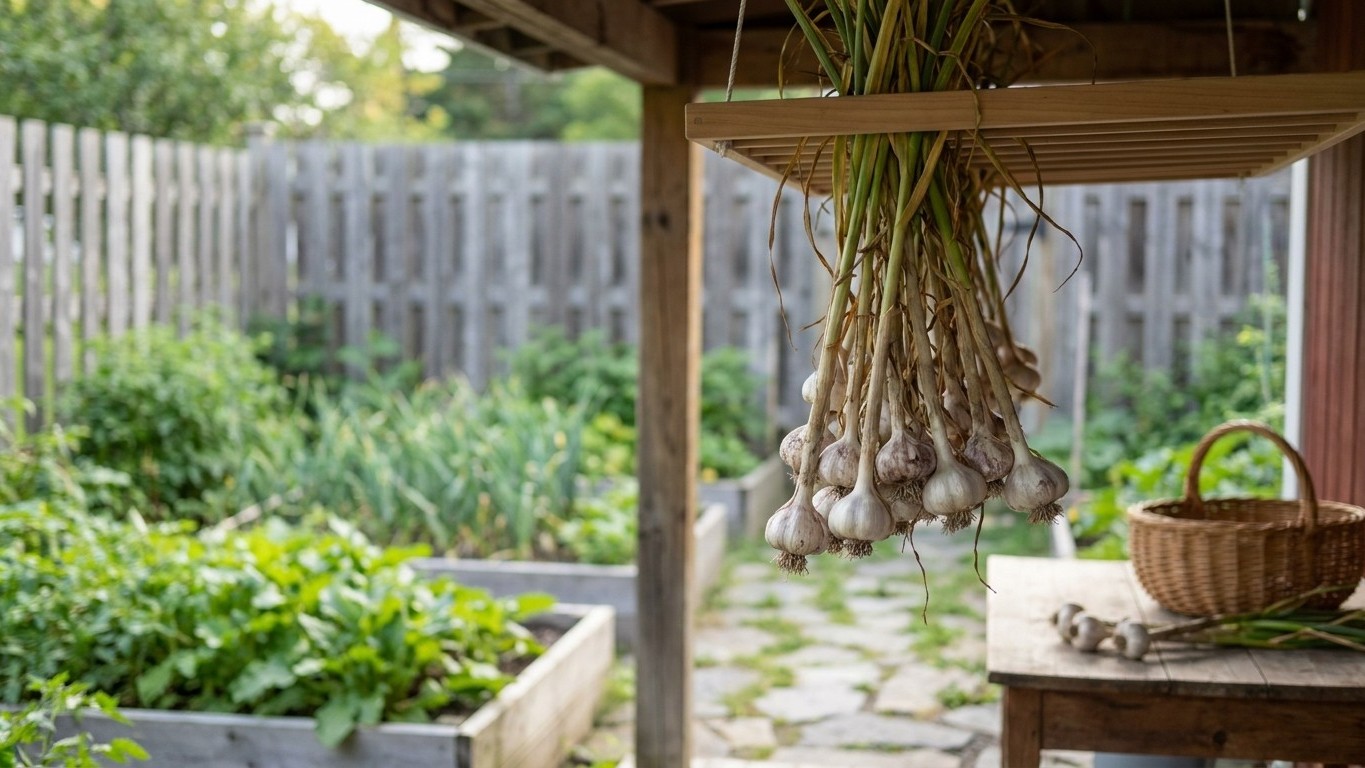
Quebec summers bring enough humidity that garlic left to cure outdoors in the open sun can mold before it dries down properly. Cure in a shaded, airy spot with good circulation, a covered porch, a barn with the doors open, or a shed with a fan running, rather than in direct sun or a closed, damp space. Bulbs need roughly three to four weeks hanging or laid out in a single layer before the necks are fully dry and the wrappers have tightened. Rushing this step is what turns a good harvest into a moldy loss by autumn.
Local help
For county-level planting dates, certified seed stock sources, and soil testing, contact MAPAQ, Quebec’s Ministry of Agriculture, Fisheries and Food. A soil test through MAPAQ or a regional agronomist is worth doing before amending a new bed, since the guidance above is general and a specific plot’s pH and drainage can differ from the Montreal-area figures used throughout this piece.
Common questions
Can I Plant Garlic in spring instead of fall in Quebec?
Garlic grown in this climate is planted in fall and lifted the following summer, not planted in spring. A clove that misses the fall window and goes in come spring skips most or all of the cold period it needs to divide, and the result is usually a single small round bulb instead of a full head.
What happens if I miss the mid-September window and it’s already October?
Get it in the ground as soon as possible rather than waiting for spring. Roots establish more slowly in cooler soil, but garlic planted into early October still generally has time to root before the average October 5 frost, especially with a layer of mulch to hold soil warmth a little longer. Watch the actual forecast rather than the calendar once you’re this late.
Do I need snow cover to protect garlic over winter?
No, and it’s not something to count on. Snow does insulate soil where it falls and stays, but an early winter with thin or patchy snow cover leaves the ground more exposed, which is exactly what a mulch layer is for. Treat mulch as the reliable protection and snow as a bonus in years it happens to be deep and early.
Can I plant garlic from the grocery store?
You can, but it’s a gamble worth avoiding if you can source certified seed stock instead. Grocery garlic is often treated to slow sprouting, may carry diseases like white rot or fusarium basal rot without visible symptoms, and is rarely labeled with a variety name, so there’s no way to know if it’s suited to a cold winter at all.
How many cloves do I get back from planting one clove?
One planted clove grows into one bulb, and that bulb typically holds somewhere around four to twelve cloves depending on the variety, hardneck types generally forming fewer, larger cloves than softneck types do. Save the largest cloves from your own harvest as next fall’s seed stock and the strain tends to adapt to your specific soil and site over a few seasons.