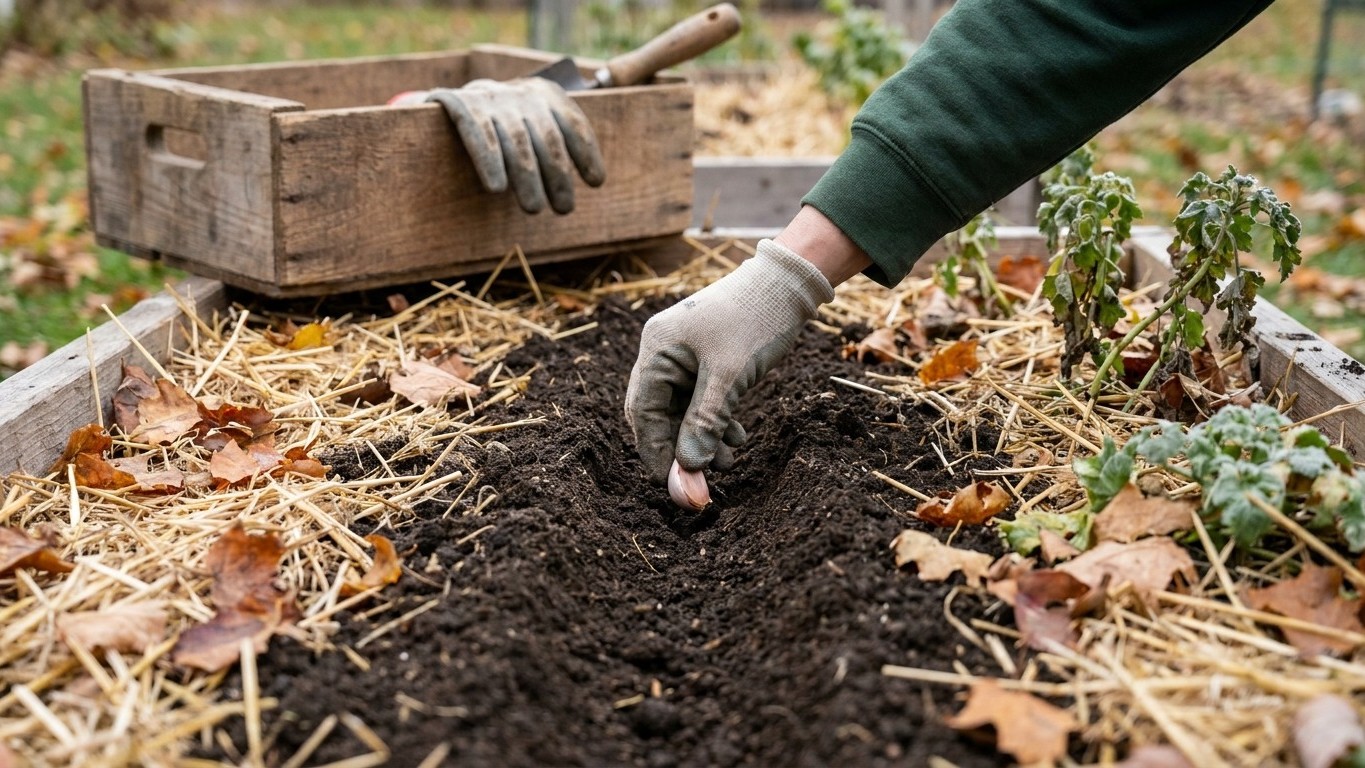

In Quebec, November opens after the average first fall frost has already passed, so this is a closing-down and setup month rather than a sowing month. Garlic and shallot cloves still go into workable ground, cold frames stretch a few hardy greens further, and bare-root fruit stock can go in before the soil locks up for good. Indoors, forced bulbs and a windowsill of microgreens keep something growing. Canadian hardiness zone 5b, the reference for the Montreal area, sets the outer limit for what survives outside from here on.
What goes in the ground in November

The average first fall frost for the Montreal area lands around October 5, according to Environment and Climate Change Canada’s 1981-2010 climate normals for the Montreal/St-Hubert A station. That figure is a mean, not a guarantee: in one year out of two, frost shows up later than that date, and in the other half it arrives earlier. By the time November begins, most Quebec gardens have already taken at least one hard freeze, often several. What decides whether anything can still go into open ground isn’t the date on the calendar but two other numbers: soil temperature and how many workable days are left before the ground freezes solid.
Garlic and shallots are the exception that proves the rule. Both want soil that has cooled below roughly 50°F but hasn’t frozen yet, set 2 to 3 inches deep with a similar layer of mulch on top so a freeze-thaw cycle doesn’t heave the cloves back out of the ground. That window often falls squarely inside this month across southern Quebec, and later still further north or at elevation, where the ground locks up sooner. Peas and other spring crops don’t get the same pass: they need soil that’s warming, not cooling, and have no place going into a November bed no matter how mild the air feels.
For everything else, the honest question isn’t what can be sown but what can be protected or forced instead. Cold frames and low tunnels buy a few more weeks for cold-hardy greens already established from an earlier planting. Bare-root fruit trees, roses and cane fruit can go in on any mild, workable day, since they’re dormant and unbothered by cool soil. Rhubarb crowns and chicory roots lifted from the garden can be brought indoors and forced in the dark for a harvest that has nothing to do with the weather outside the window.
What to start under cover
With outdoor sowing done for the season, starting anything “under cover” in November mostly means two separate things: winter sowing aimed at spring, and indoor cropping that ignores the frost calendar entirely.
Winter sowing works backward from the average last spring frost, May 6 for the Montreal area, which is itself only a midpoint: in half the years frost lingers past that date, so treat it as a planning anchor rather than a green light. Many perennial and native seeds need 60 to 90 days of cold, moist stratification before they’ll germinate at all. Counting back from a spring start, seed sown into containers left outdoors now, or into an unheated cold frame, gets that chilling naturally over the winter and breaks dormancy on its own timeline once the weather turns. Start too early and the seed can sprout during a January thaw, only to die in the next freeze. Start too late and it never accumulates enough cold to break dormancy, so nothing comes up in spring at all.
The second track skips soil temperature altogether. Microgreens and sprouts, grown on a windowsill or under a grow light, are ready in one to three weeks no matter what’s happening outdoors. Forced bulbs such as paperwhites or amaryllis, potted now, bloom in four to eight weeks. Neither depends on frost timing, which makes them the simplest way to keep a growing habit alive through the darker part of the year without betting on soil that’s already turned cold.
What is ready to pick
Outdoors, the list is short by this point in the season, and that’s simply where the calendar sits rather than a sign anything went wrong. Leeks and kale left in the ground, particularly varieties chosen for cold tolerance, keep going through several light freezes and often taste better for it, since cold converts stored starches into sugars in both crops. Once snow arrives, a loose layer of mulch or straw over the row keeps the ground from freezing solid enough to block harvest, and roots can still be dug as needed into early winter.
Cold frames still holding spinach, mâche or other hardy greens planted earlier in the fall can keep giving light pickings on any day the inside of the frame stays above freezing, even with cold air outside it.
Indoors, sprouts and microgreens are the most dependable harvest of the month, cut as soon as the first true leaves appear, usually within one to three weeks of sowing.
The other job right now is checking what’s already in storage. Squash, potatoes, onions and other roots put away earlier should get a hands-on inspection: any squash with a soft spot or a sweet smell, any potato going soft or sprouting, any onion turning papery and dark at the neck needs to be pulled and used or composted before it spreads rot to the rest of the batch. One soft squash sitting in a bin of a dozen others can take down half of them within a couple of weeks.
The jobs that matter this month

The tasks that matter most in November are the ones with a hard deadline attached: the ground still workable, the trees dormant but not yet buried under snow, the good seed varieties still in stock.
Pruning, planning and stored crops
Dormant pruning of fruit trees, grapevines and cane fruit can begin once the leaves have dropped and the wood is fully dormant. Cutting now, while a plant’s energy sits in the roots rather than moving through the branches, reduces stress and makes the structure of the tree easier to see without foliage in the way. Wait too long, into a stretch of active spring sap flow, and the same cuts bleed and heal more slowly.
Seed catalogs for the season ahead start going up for order now, and popular varieties, especially open-pollinated and heirloom types from smaller seed houses, can sell out well before planting time. Ordering early has less to do with eagerness and more to do with avoiding a scramble in spring for a variety that’s already gone.
This is also a natural point to plan the coming season’s rotation on paper: which beds grew heavy feeders like tomatoes or squash, which grew soil-building legumes, and where the alliums and brassicas need to shift to avoid the pest and disease buildup that comes from planting the same family in the same spot two years running.
Soil, tools and repairs
Soil testing and amending pays off more now than in spring, since amendments like lime or compost have the whole winter to work into the ground before anything is planted into it. Turning the compost pile one more time before it freezes solid keeps decomposition going a little longer into the cold.
Tools deserve the same attention as the beds: cleaning sap and rust off pruners and shovels, sharpening blades and oiling wooden handles before a winter of sitting unused extends their working life by years. Fencing and raised bed frames that took a summer’s worth of weather should get any repairs done while the ground is still soft enough to reset a post.
What not to do in November
The most common mistake this month is timing garlic and shallot planting by the weather that day rather than by the ground itself. A stretch of unseasonably mild air can make it feel like there’s no rush, but soil freezes based on the trend of the past two weeks, not the afternoon high. Wait for a warm spell to plant, and the ground can lock up within days of it breaking, leaving cloves half in or not planted at all until spring.
A second trap is leaving tender bulbs, dahlias, gladiolus, canna, in the ground on the assumption that a light frost blackening the foliage is as bad as it gets. In Canadian hardiness zone 5b, ground can freeze deep enough to destroy those bulbs outright, so the safer move is to lift them once the foliage dies back and store them somewhere cool and dry rather than leave them and hope for the best.
Uncovering cold frames and low tunnels too readily during a mild stretch is a third habit worth breaking. Hardy greens underneath tolerate a surprising amount of cold as long as they’re shielded from wind and sudden swings; pulling the cover for “some fresh air” on a 50°F afternoon just resets that protection right before the next freeze hits the plants unshielded.
Feeding nitrogen at this point in the season, on the idea that a tired-looking plant needs a boost, does more harm than good. Nitrogen pushes soft new growth that has no time to harden off before a freeze, and that new growth is usually the first tissue to die and rot back into the crown.
Checking this against your own county
Everything above is built around a single station, Montreal/St-Hubert A, and a single reference point for hardiness. Quebec is not one climate: the Gaspé Peninsula, the Laurentians at elevation, and the Eastern Townships all run their own frost timing, sometimes weeks apart from the Montreal area and from each other. Elevation alone can push a first frost back by ten days or more over just a few hundred feet of rise, and spots near the St. Lawrence River often lag inland areas by a similar margin in the other direction.
Treat the dates and the zone number here as a starting point, not an instruction for a specific yard. For a planting calendar and advice built around local conditions, the Quebec Ministry of Agriculture, Fisheries and Food (MAPAQ) is the reference to check.
Common questions
Can garlic still be planted in Quebec in November?
Yes, as long as the ground is workable and not yet frozen. Garlic and shallots go in 2 to 3 inches deep with mulch on top, ideally once soil has cooled below roughly 50°F but before it locks up for winter.
What Canadian hardiness zone is Quebec in?
The Montreal area sits in Canadian hardiness zone 5b, based on Natural Resources Canada’s 1991-2020 data. This is the Canadian system, built on seven climate variables, and it does not convert directly to a USDA zone.
Is there anything to harvest outdoors in Quebec in November?
Cold-hardy leeks and kale can still come out of the ground, especially once light freezes have sweetened them, and greens under a cold frame keep producing on any day it stays above freezing inside.
When is the last spring frost in Quebec?
For the Montreal area, the average last spring frost falls around May 6, based on Environment and Climate Change Canada’s 1981-2010 normals. That’s a mean date, not a safe one: frost arrives later than that in about half of all years.
Gardeners who plant by the Moon can check the November 2026 moon planting calendar, a tradition rather than a proven method.
Related guides
Elsewhere? See what to plant in November in every state and province.