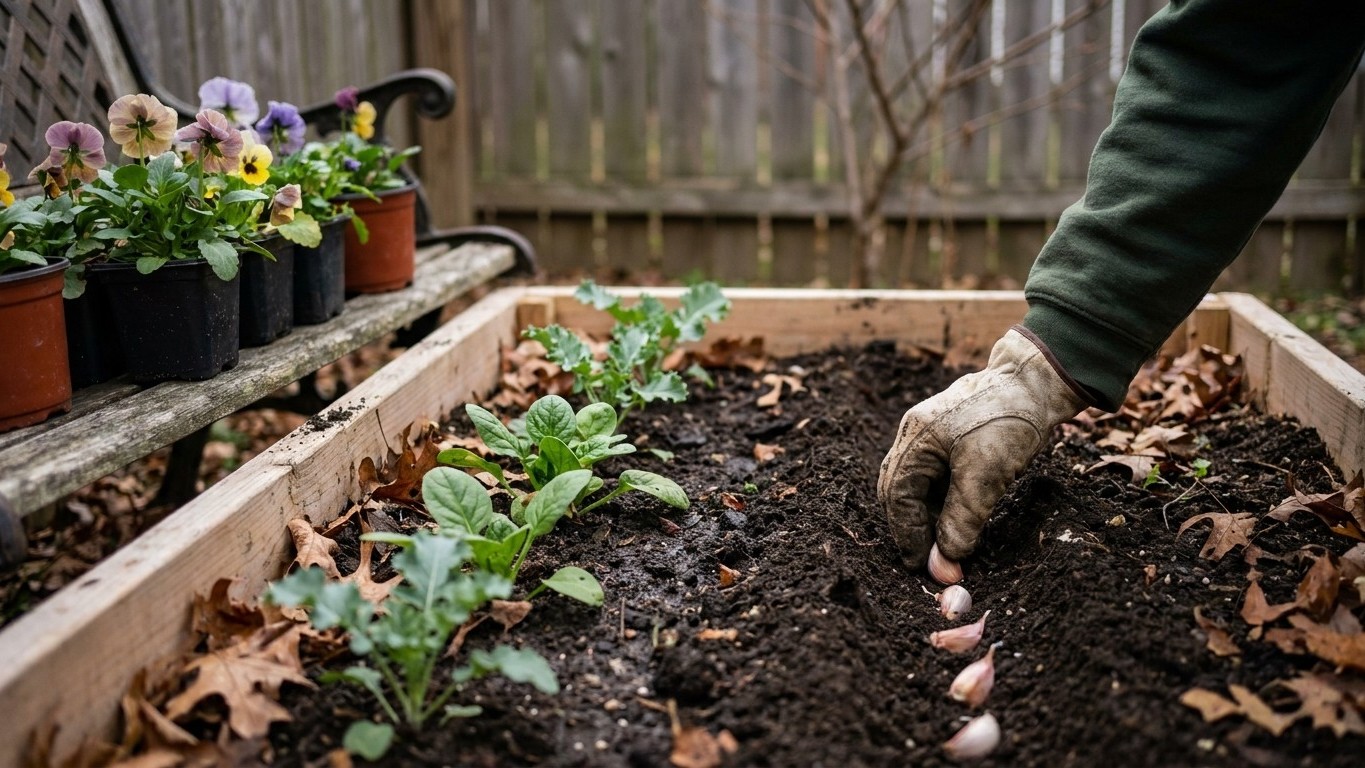

October in Quebec sits right on top of the average first fall frost, which lands around October 5 at the Montreal-area reference station. That means the safe planting window for anything tender has already closed by the time most of the month plays out. What’s left is a short list: garlic and shallots still go into open ground, bare-root trees and dormant perennials move in while soil is workable, and the rest of the work shifts indoors, into cold frames, or onto next season’s planning.
What goes in the ground in October

The number that decides everything this month is not the calendar, it’s the average first fall frost of October 5, recorded at the Montreal/St-Hubert A station by Environment and Climate Change Canada’s Canadian Climate Normals. That figure is a mean, not a guarantee: in one year out of two, frost arrives later than that date, and in the other half it arrives sooner. By the second or third week of October, most of the province has already crossed that line, and colder pockets, higher elevations and the north shore run weeks behind the reference station, meaning frost there can show up in September.
That leaves a narrow but real list of things worth planting. Garlic and shallots are the headline crop: both need six to eight weeks of root growth before the ground freezes solid, and planting them now, while soil still works with a spade, sets up next summer’s harvest. Bare-root fruit trees, shrubs and hardy perennials can also go in as long as the hole can still be dug, since roots keep growing slowly even after top growth stops. Cold frames and low tunnels extend the window for spinach, mâche and other hardy greens sown a few weeks earlier, buying an extra month of growth before real cold shuts things down.
What doesn’t belong on this list is anything that needs warm soil to germinate. Beans, squash, tomatoes, anything in that family, are done for the season regardless of a mild afternoon. The table below separates what’s a reasonable move from what’s a gamble not worth taking.
| Crop or planting | Status in October | Why |
|---|---|---|
| Garlic, shallots | Safe, priority job | Needs weeks of root growth before ground freezes |
| Bare-root trees, shrubs, perennials | Safe while soil is workable | Roots grow at soil temperatures too cold for top growth |
| Hardy greens under cover (spinach, mâche) | Safe if sown early in the month, under a low tunnel | Cold frame buys weeks past the open-ground frost date |
| Beans, squash, tomatoes, warm-season direct sowing | Gamble, effectively closed | Requires warm soil that isn’t coming back this season |
What to start under cover
Counting backward from a spring frost date doesn’t apply this month the way it does in spring, since the season is closing rather than opening. What still makes sense under cover is sowing hardy greens, like spinach or mâche, into a cold frame early in the month so they get several weeks of root establishment before growth all but stops for winter. Miss that window and the seedlings stay too small to survive; sow too early in a warm frame and they can bolt or grow soft, then get hit hard by the first real cold snap.
Indoors, this is also the month to start continuous batches of microgreens and sprouts, which don’t depend on outdoor temperature at all and can fill the gap while the garden winds down. If overwintering onions or hardy lettuce transplants for a very early spring start is part of the plan, the arithmetic works backward from the average last spring frost of May 6: count back the seedling’s normal weeks-to-transplant size, then add a buffer, since starting too early leaves rootbound, leggy plants sitting in trays for months, and starting too late means the transplants never catch up before the ground warms.
The two failure modes are worth naming plainly. Sow too early under cover and the plants outgrow their space long before conditions are right to move them, turning stringy and stressed. Sow too late and there isn’t enough daylight or warmth left before the season locks down, so the seedlings stall rather than establish. October under cover is about hardy greens and long-game planning, not fast crops.
What is ready to pick
October is one of the fullest harvest months of the year here, and most of it needs to come in before that average October 5 frost line, or right after a light one for crops that improve with cold. Winter squash and pumpkins should be cut once the skin resists a fingernail and the stem has started to dry; leaving them out past a hard freeze ruins storage life. Potatoes come out once the foliage has died back, and onions once their tops have flopped and dried. Apples, depending on variety, are ready when they separate from the branch with a gentle twist rather than a pull.
Root crops like carrots, beets and parsnips can often stay in the ground longer than gardeners expect, since cold soil actually sweetens them, and a heavy mulch layer keeps the ground workable enough to dig even after the surface has frozen. Brassicas like kale and Brussels sprouts follow the same rule: a light frost converts starches to sugars and makes them taste better, not worse, so there’s no rush to pull them the moment temperatures drop.
Once the bulk of the harvest is in, the job shifts to storage checks rather than picking. Squash, potatoes and onions in storage should get a weekly look for anything going soft, sprouting early, or showing a sour smell, since one turning specimen can spread rot through a whole bin if it’s left in place.
The jobs that matter this month

Frost-tender bulbs are the deadline that can’t slip. Dahlias, gladiolus and other tender corms need to come out of the ground once their foliage blackens with the first frost, cured for a few days, then stored somewhere cool and dry; leave them in the ground past that point in most of the province and they rot before spring.
Soil work pays off disproportionately this month because the ground is still workable but the pressure of the growing season is gone. Testing pH and adding lime or amendments now gives them the whole winter to work into the soil, rather than scrambling in spring when there’s no time to wait. Turning finished compost into empty beds does the same job, feeding soil biology through the cold months instead of sitting idle in a bin.
Cleanup matters more than it looks like it should. Diseased plant material left in beds overwinters right along with the pathogens it carries, so pulling and discarding (not composting) anything with blight, mildew or rot denies next year’s problems a head start. Mulching beds that are emptying out protects soil structure and moderates the freeze-thaw cycles that heave perennials and shrubs out of the ground over winter.
Two jobs are easy to skip and expensive to skip: ordering seed, and tool care. Seed catalogs move fast on popular varieties well before spring, so placing an order now avoids settling for whatever’s left. Cleaning and sharpening tools before they sit unused all winter keeps rust and dull edges from turning easy spring jobs into hard ones.
What not to do in October
The most common mistake this month is trusting a mild afternoon over the calendar of average frost dates. A warm stretch in early October doesn’t mean the season has extended, it means the average first frost of October 5 hasn’t happened yet this particular year, and it’s coming. Planting anything warm-season based on a few nice days wastes seed and effort.
Feeding nitrogen late in the season is another classic error. Nitrogen pushes soft, leafy new growth, and that growth has no time to harden off before cold arrives, making the whole plant more vulnerable to frost damage rather than less. If fertilizing is needed at all this late, it should favor potassium and phosphorus, which support root and stem hardening rather than leaf growth.
Covering and uncovering season-extension crops inconsistently also backfires. Pulling a row cover off during a warm spell, then failing to get it back on before the next cold night, exposes plants to exactly the frost the cover was meant to prevent. And leaving tender bulbs or tropical container plants outside “just one more week” after the first light frost is how a whole season’s dahlias or cannas are lost to a hard freeze that follows a few days later.
Checking this against your own county
A provincial average is a starting point, not a set of instructions for one specific yard. Elevation, proximity to a large lake, and the gap between the milder south and the colder north of the province can move real frost dates by weeks in either direction from the Montreal-area figures used here. A garden in the Laurentians or on the north shore should expect frost well ahead of a garden near Montreal, while some sheltered river valleys run milder. For local specifics, the Ministère de l’Agriculture, des Pêcheries et de l’Alimentation du Québec (MAPAQ) is the reference point worth checking.
Common questions
Is it too late to plant garlic in October in Quebec?
No, October is generally the right window. Garlic needs roughly six to eight weeks of root growth before the ground freezes solid, and planting it while soil is still workable, even late in the month in milder areas, usually still fits that timeline.
What hardiness zone does Quebec fall under?
The reference city used for these pages sits in Canadian hardiness zone 5b, according to Natural Resources Canada’s Plant Hardiness Site. That’s a Canadian zone, built from seven climate variables, and it does not convert directly to a USDA zone, which uses only one. The two systems shouldn’t be compared on the same scale.
Can vegetables still grow after the first fall frost?
Some can. Hardy crops like kale, Brussels sprouts, carrots, beets and parsnips tolerate a light frost well and often taste better afterward, since cold converts starches to sugars. Tender crops like tomatoes, beans and squash are done once frost hits.
Why does the average frost date not guarantee safety?
Because it’s a mean drawn from decades of records, not a threshold. Frost falls later than the average date about half the time and earlier the other half, so treating October 5 as a hard cutoff, in either direction, misreads what the number actually measures.
Gardeners who plant by the Moon can check the October 2026 moon planting calendar, a tradition rather than a proven method.
Related guides
Elsewhere? See what to plant in October in every state and province.