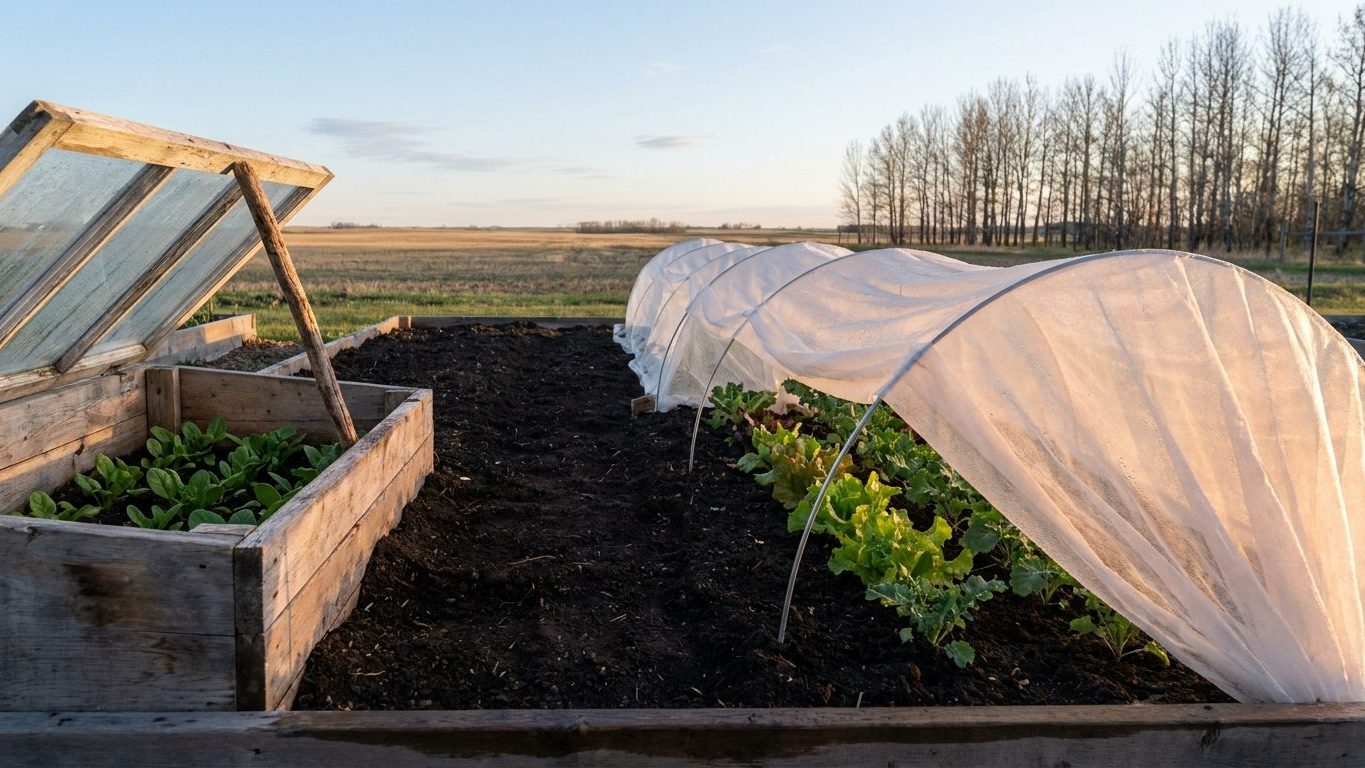

Charlottetown’s average last spring frost falls on May 16 and its average first fall frost on October 17. Season extenders work at both ends of that window, and the ones that suit Prince Edward Island best are the low, simple, wind-proof kind: floating row cover, low tunnels and cold frames. Tall structures and heat-hungry tricks pay off less. The right choice depends on the crop and on how exposed your garden is.
The short answer for Prince Edward Island
Start with low tunnels covered in floating row cover, add a cold frame for hardening off and early greens, and keep clear plastic for tomatoes and peppers. That trio handles most of what a vegetable garden here asks of it, and none of it costs much or needs a building permit.
The frost dates come from Environment and Climate Change Canada’s 1981-2010 normals for the Charlottetown A station. They are mean dates, so they mark the middle of a window. In one year out of two the last spring frost comes later than May 16, and in one year out of two the first fall frost arrives earlier than October 17. A cover helps you through the edges of that window, where a light frost is the threat. It does little against the cold soil that holds back spring on an island surrounded by water.
Which extender suits which job?
| Extender | Best use | Main thing to manage |
|---|---|---|
| Floating row cover | Lettuce, spinach, brassicas and carrots in early spring and late fall | Wind; the edges need anchoring |
| Low tunnel on hoops | Early transplants, fall salad crops | Heat on sunny days; open the ends |
| Cold frame | Hardening off, early greens, late salad | Overheating; prop the lid on mild days |
| Black plastic mulch | Warming soil for squash, peppers and tomatoes | Water has to reach the soil beneath it |
| Clear plastic hoop tunnel | Tomatoes and peppers | Humidity and leaf disease; ventilate |
How much extra time do extenders buy?
A single layer of light cover adds a few degrees on a frost night. That is enough for a light frost and nowhere near enough for a hard freeze. Gardeners commonly gain a couple of weeks at each end of the season with a tunnel or cold frame. Anything beyond that takes a second layer, a sturdier structure, or hardier crops. For the wider picture of how these tools fit together, see Extending the Growing Season in Prince Edward Island.
What will not work here
Winter growing of tender crops fails. The mean daily minimum of the coldest month at Charlottetown is -12.1 °C (10.3 °F). One layer of row cover or an unheated cold frame will not hold lettuce through that. Hardy crops such as spinach, kale and mache can sit under a double layer through the cold, but they barely grow in midwinter, when daylight at 46.29 degrees north is short. Think of a winter cover as a way to store a crop already grown, with a small harvest on mild days.
Why is planting on May 16 still a gamble?
Because the date is a midpoint. Half of all years bring a frost after it, so tender transplants such as tomatoes, peppers and squash set out on that day with no cover on hand are a coin flip. Keep the row cover or an old bedsheet within reach through the end of May. Warm-season crops also want warm soil, and cool nights near the Gulf of St. Lawrence slow that down.
Which crops will extenders not rescue?
Watermelon, okra and sweet potatoes need long stretches of real heat. A cloche cannot add summer to a season that starts with a cool spring. Melons are borderline: black plastic mulch and a clear tunnel can work in a warm year and disappoint in a cool one. Short-season varieties and quick-maturing crops are the better bet.
What goes wrong with wind, snow and damp?
Wind comes first. Light fabric that isn’t pinned down along every edge will end up in the neighbor’s field, so use soil, boards or sandbags, and keep hoops snug. Heavy wet snow in late fall or early spring can crush thin hoops, so take plastic off or brace the frames once winter weather settles in. Humidity is the third problem. A closed plastic tunnel in damp, foggy weather invites fungal disease on tomato and cucumber leaves, so open the ends on any mild day.
What changes across Prince Edward Island
The island does not have a single answer. Charlottetown reads as zone 5b in Canada’s plant hardiness system, based on Natural Resources Canada’s 1991-2020 normals for that city. That is a Canadian zone, built from seven climate variables, and it does not convert to a USDA zone. Natural Resources Canada says plainly that no simple conversion exists between the two systems.
Inside the province, conditions shift with distance from the water, with elevation and with exposure to wind. Northern and upland districts run weeks behind the Charlottetown station, both for the last spring frost and for the first fall frost. A gardener in one of those places should plan on a later spring start, cover crops earlier in the fall, and lean toward hardy crops and shorter-season varieties. Coastal gardens with open exposure face a different issue: wind and salt spray can do more damage than frost. A hedge, fence or snow fence on the windward side often does more than another layer of cover.
To find your own zone, use the municipality lookup on Natural Resources Canada’s plant hardiness site. Enter your community rather than guessing from a neighbor’s garden. Keep in mind that the frost dates above come from 1981-2010 normals while the zone map uses 1991-2020, so recent years may sit a little differently from either.
Latitude matters for one group of crops. Onions respond to day length when deciding to form bulbs, and the 46.29 degrees north figure belongs to Charlottetown. The island is narrow, so the difference from one end to the other is small, but a reader well away from Charlottetown should check their own latitude before choosing a bulbing variety.
Where to check this for your own county
Prince Edward Island is divided into Prince, Queens and Kings counties, and a recommendation for your county beats one for the whole province. A provincial overview like this one gives you a starting point and a sense of the risks. Local conditions decide the rest.
The place to look is the Prince Edward Island government’s agriculture pages. Two things are worth finding there. The first is a planting calendar for your part of the island, ideally one that lists dates by crop rather than a single frost date for everything. The second is any information on varieties trialled locally: which tomatoes ripened, which brassicas bolted, which carrots held up in cool springs. A variety that performed well in a trial near you is a better choice than one that looked good in a catalog.
If the site does not list what you need, contact the provincial agriculture office and ask directly. Staff there can say how your area compares with Charlottetown, and whether late spring frosts or early fall frosts are the bigger issue where you live. Ask about wind exposure and soil temperatures as well, since both change how well a row cover or tunnel will work. For timing on covers, When to Cover Your Garden in Prince Edward Island sets out when each tool goes on and comes off.
Checking this against your own garden
Your own observations outrank any date in a table. Three things are worth watching, and none of them needs equipment.
- Soil warmth by feel. Push your hand into the bed in the morning. If it aches within a few seconds, the soil is too cold for beans, squash and tomatoes, whatever the calendar says. A bed that warms sooner than the one next to it is sheltered or well drained, and that is where early crops go.
- The first male squash flowers. Squash and cucumbers open male flowers before female ones. When they show up in your garden, summer warmth has arrived there. If they appear weeks later than a neighbor’s, you have a cooler spot and should choose short-season varieties.
- The first true leaves. The seed leaves come out first and look alike on most seedlings. The true leaves that follow tell you the plant is growing rather than just surviving. If seedlings under cover stall before reaching that stage, the cover is too cold, too wet or too shaded.
Write down the dates for each of these for a couple of seasons. Your notes will show how far your garden runs ahead of or behind the Charlottetown averages, and that gap tells you which extender to buy first.
Common questions
Is row cover or a cold frame the better first purchase on PEI?
Row cover is cheaper and more flexible, since it works over beds of any size and on hoops. A cold frame is better if you start plants from seed and need a place to harden them off. Many gardeners end up with both.
Can I grow tomatoes outdoors with a season extender?
Yes, with early-maturing varieties, black plastic mulch and a clear tunnel or cover on cool nights. Do not set out transplants on May 16 without protection on hand, because half of all years bring a frost after that date.
When should I take covers off in spring?
Open tunnels and cold frames on mild, sunny days, since temperatures inside can climb fast. Remove row cover from crops that need pollination, such as squash, once flowers open. The timing details are in the guide to when to cover your garden.
Can I harvest vegetables through the winter?
Only hardy crops such as spinach, kale and mache, protected by a double layer, and only in small amounts. With a coldest-month mean daily minimum of -12.1 °C at Charlottetown and short midwinter days, growth nearly stops. Plan on harvesting what you grew in fall.