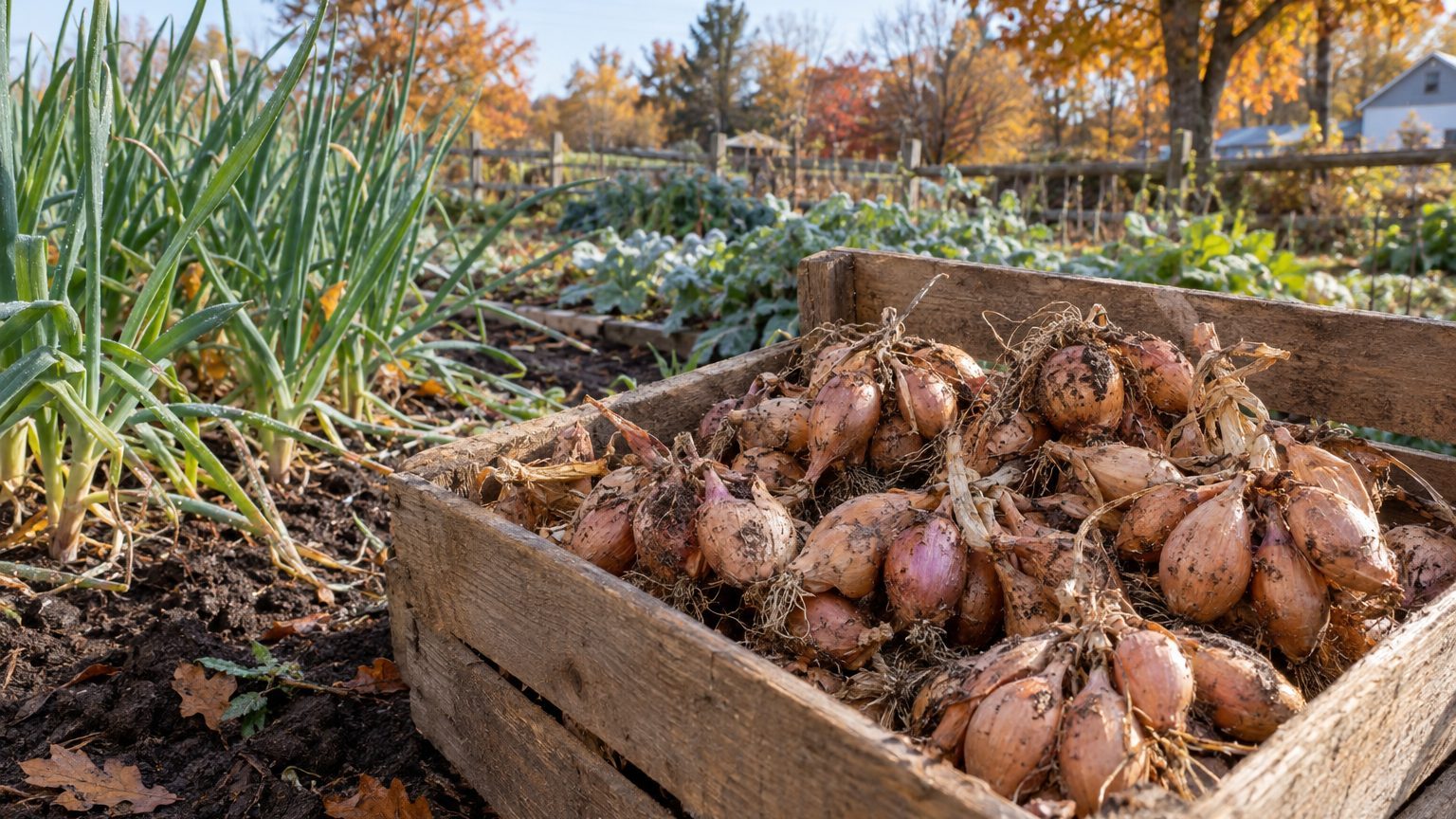

For most Quebec gardens, the best shallots are hardy multiplier types grown from bulbs and planted in fall under a winter mulch. Seed-grown shallots come second, and slow, long-season specialty bulbs trail far behind. This page sorts shallots by type rather than by brand name, because the season here favors one kind of shallot over any particular label. The full routine is in Growing Shallots in Quebec.
The short answer for Quebec
Pick multiplier shallots grown from bulbs, and plant them in fall if you can. Spring-planted bulbs are the fallback, and seed-grown shallots started indoors are the third option. The reasoning comes from the length of the season, and the numbers behind it are specific.
At the Montréal/St-Hubert A station (Environment and Climate Change Canada, 1981-2010 normals), the last spring frost falls on average on May 6, and the first fall frost on average on October 5. Count the days between those two means and you get about 152. That is a decent window for a crop that wants cool weather early and dry weather at the end.
Both dates are means, though, not guarantees. In one year out of two, the last spring frost lands later than May 6, and in one year out of two the first fall frost arrives before October 5. Treat each date as the middle of a window, never as a safe date. These are also Canadian normals for 1981-2010, while the US figures elsewhere on this site cover 1991-2020, so the two sets are not strictly comparable.
Winter is the other half of the answer. The mean daily minimum of the coldest month is -14.1 °C (6.7 °F, for readers comparing with US gardens). That is an average, and individual nights run colder. Shallots can sit through that kind of winter underground, which is why fall planting works, but a mulch layer and reliable snow cover make the difference between a clean stand and gaps in the row.
| Type | When it goes in | Fit for Quebec’s season | Main risk |
|---|---|---|---|
| Multiplier bulbs, fall-planted | After the summer harvest, before the ground freezes | Best: roots in fall, grows at first thaw | Heaving and winter loss without mulch |
| Multiplier bulbs, spring-planted | As soon as the soil can be worked | Good: fits the window comfortably | Later harvest, wet-soil rot |
| Seed-grown, started indoors | Sown indoors, set out after frost risk eases | Good if started early | Seedling care, slow start |
| Seed-grown, sown outdoors | Direct in the garden | Marginal | Not enough time to size up |
For the dates themselves, When to Plant Shallots in Quebec takes the frost figures further.
What will not work here
Anything slow. With roughly 152 days between the mean frost dates, a shallot that needs a long, hot run to finish has little room for error. Half of all years the first fall frost arrives before October 5, so a variety that is still sizing up its bulbs in late September is gambling on a late frost.
Direct-sowing seed outdoors in spring is the clearest example. The soil is cold and often wet in early May, which is the average last-frost date and therefore later than that in half the years. Seedlings that finally emerge in late May have lost weeks they cannot make up before fall. Shallots grown from seed do better when started indoors, which gives them a head start the calendar does not.
Late fall planting fails for a different reason. A bulb needs time to root before the ground locks up, and the mean first frost on October 5 is only the start of a descent toward a coldest-month mean minimum of -14.1 °C. Bulbs pushed in at the last minute, with no mulch, face a winter of freezing and thawing that can heave them out of the soil. Rooted bulbs under a thick mulch layer behave far better.
Advice written for warmer places also misleads. Guides from the US South often tell you to plant in late fall or winter and harvest in early summer, which assumes mild winters. Copy that schedule in a place where the January nights average -14.1 °C and you will be digging up mush. The same goes for any advice that treats May 6 as a safe planting date. It is the middle of the risk window, and a hard frost after it is entirely normal.
Wet weather is the last thing to plan around. Shallots that finish in a damp stretch and cannot dry down properly are harder to cure and store. Choose varieties known for tight skins and good keeping, and give them room for air to move between the plants.
What changes across Quebec
Quebec is not one garden. The only hardiness figure this page has is Canadian zone 5b, for the reference city of Montréal, from Natural Resources Canada’s 1991-2020 normals. It describes that city, not the province. The page does not have zone values for the north or for upland districts, so there is no single answer to give for the whole of Quebec.
This is also a Canadian zone, not a USDA zone, and it does not convert. The Canadian system is built from seven climate variables, the USDA system from one. Natural Resources Canada itself says there are no simple conversions between them, and that Canadian zone 4a overlaps nine USDA zones, from 3a to 7a. So do not read 5b as a USDA 5b.
To find your own zone, use the Canada’s Plant Hardiness Site map from Natural Resources Canada and look up your municipality there. Do not borrow the zone of the nearest city if you live on a hillside or in a valley, because both change the answer.
If you garden in the north or at altitude, expect frost dates weeks behind the St-Hubert station. A May 6 average last frost becomes a later, riskier window, and an October 5 average first frost becomes an earlier one. Shift accordingly: favor fall planting under a heavy mulch, since a bulb in the ground before winter skips the slow spring start, and lean on early-maturing types. If you grow from seed, start indoors and treat outdoor sowing as out of the question.
Where to check this for your own county
Start with the Ministère de l’Agriculture, des Pêcheries et de l’Alimentation du Québec (MAPAQ). It is the provincial agriculture authority, and it is the address this page has for Quebec. I can say it was reachable when checked in August 2026. I have not confirmed that it carries a shallot-specific planting calendar, so treat it as a starting point, not a guarantee.
When you get there, look for two things. The first is a local planting calendar, ideally one built for your region rather than for the province as a whole. The second is a list of varieties trialled where you live, meaning grown side by side in your climate with results published. A variety that did well in a regional trial beats any general ranking, including this one.
A county or regional recommendation will always outrank a provincial one. This page is the provincial one, and even its frost figures come from a single station south of Montréal. A grower in the Laurentians, the Eastern Townships or the Gaspé sees a different season from what these numbers describe, so use the page for the logic of choosing a type, then let local sources set the dates.
If you do not find a Quebec calendar for shallots, a calendar for garlic or onions from a nearby region is a better proxy than a US one, because the timing of fall planting is driven by when the ground freezes, not by the crop name. Treat it as a rough guide, not a rule.
Checking this against your own garden
Your own observations outrank every date above. Three are worth watching, and none needs equipment.
Soil warmth by feel. In spring, squeeze a handful of soil. If it is cold and clammy and clumps into a wet ball, it is too early. If it crumbles and feels cool rather than icy, bulbs can go in. The week you reach that point, compared with your neighbors’, tells you how far your yard runs ahead of or behind the average.
The first true leaves. For seedlings, the first true leaf, after the thin grass-like blade, shows they are established enough to harden off. For fall-planted bulbs, the first green shoots through the mulch mark the true start of your season. Write down the date each year.
The first frost on tender plants. Note the morning when basil, squash or tomato foliage blackens. Compared with October 5, it shows whether your garden is a warm pocket or a cold one, and it tells you how much time your shallots had to finish.
Two or three seasons of notes will give you a calendar tuned to your own yard, which no regional average can match.
Common questions
Can I plant shallots in spring in Quebec?
Yes. Plant bulbs as soon as the soil can be worked. Spring planting finishes later than fall planting, so choose varieties that mature in a reasonable time and give them early-season care.
Are seed-grown shallots worth the trouble?
They can be, if you start them indoors early. Outdoor sowing leaves too little of a roughly 152-day window between mean frost dates, and the soil is slow to warm.
Is May 6 a safe date to plant?
No. It is the mean last spring frost at one station, so a frost after that date is normal in about half of years. Use it as the middle of a window, and check your own soil.
Does Canadian zone 5b mean the same as USDA zone 5b?
No. The two systems measure different things, and Natural Resources Canada says there are no simple conversions between them. Name the system whenever you quote a zone, and use the NRCan map for your own municipality.