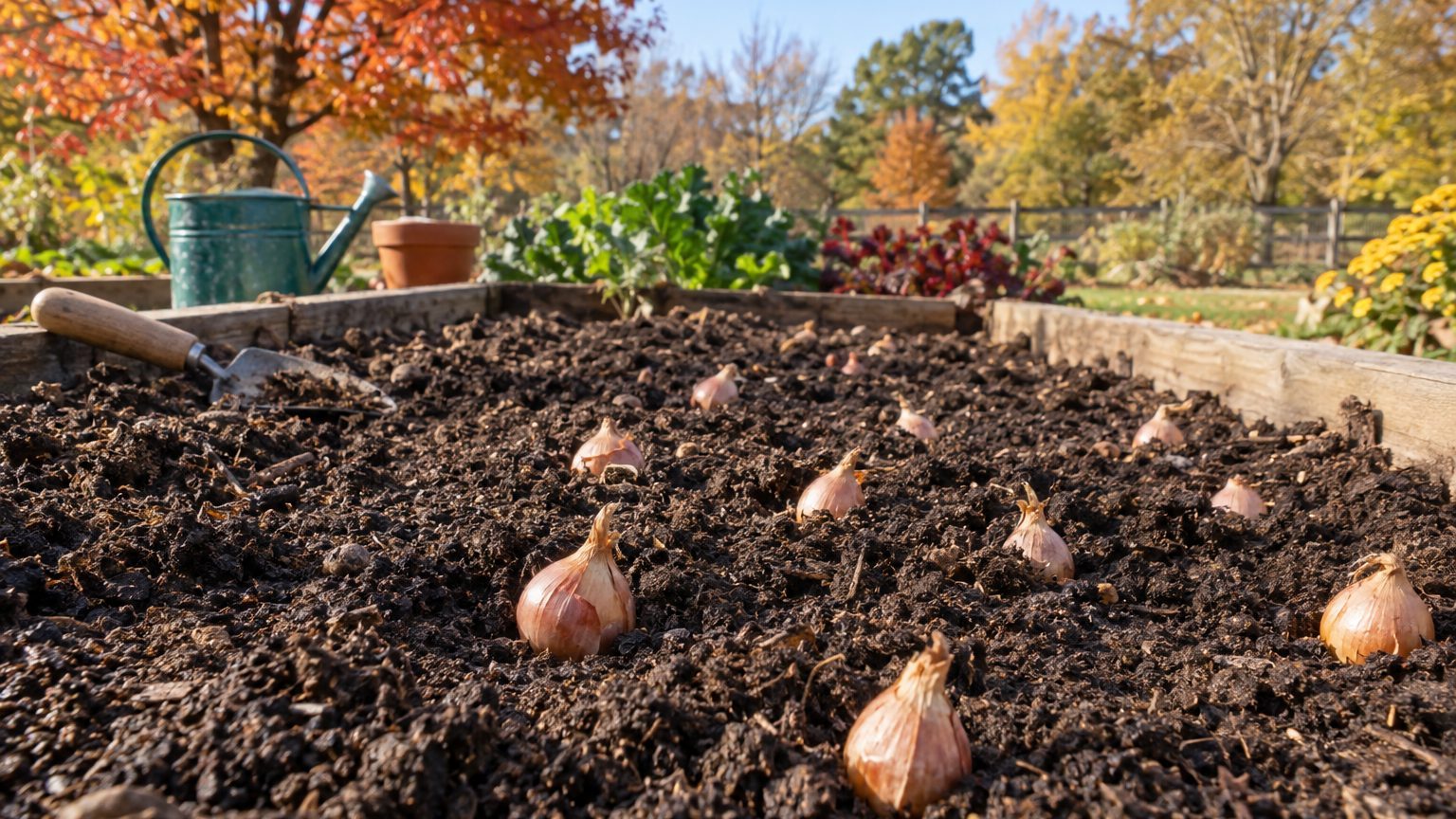

Shallots are forgiving about cold, which gives Quebec gardeners two planting windows instead of one. The calendar hangs on two frost dates from a single Montreal-area weather station, and both are averages, not guarantees. Knowing what those averages measure, and where they stop applying, matters more than memorizing the dates.
The short answer for Quebec
Plant shallots in spring as soon as the soil can be worked, which in many years happens before the average last frost of May 6. For a fall planting, wait until the first frosts have arrived around the average first fall frost of October 5, and plant before the ground locks up. Both dates come from Environment and Climate Change Canada’s 1981-2010 normals for the MONTREAL/ST-HUBERT A station (climate ID 7027320).
What are those dates a probability of? They are mean dates, the midpoint of a spread. In roughly one spring out of two, the last frost lands later than May 6. In roughly one fall out of two, the first frost arrives earlier than October 5. Neither is a safe date, and neither is a deadline. Between them sits a frost-free stretch of about 152 days (May 6 to October 5, counted on the calendar), or five months in an average year.
Spring planting
Shallot bulbs and sets tolerate light frost, so the May 6 mean is not a signal to wait. It tells you the soil is unlikely to see hard freezes by then, which is a different thing. The practical trigger is a bed you can dig without it clumping into wet clods. Plant sets with the tip just showing at the surface, and expect a late frost to nip leaf tips now and then without harming the bulb.
Fall planting
Fall planting is the second window, and it suits gardeners who want an early summer harvest. The goal is roots, not top growth: the set should settle in before the ground freezes, then sit through winter under mulch. This page does not have a measured ground-freeze date for Quebec, so I can’t give you a fall cutoff. The rule of thumb here is editorial, not a measured figure: aim for the weeks after the first frost, not before it.
| Window | Reference point | What it is |
|---|---|---|
| Spring | Soil workable; average last frost May 6 | Midpoint of a spread, not a safe date |
| Fall | After the first frosts; average first fall frost October 5 | Midpoint of a spread, not a deadline |
For the full growing picture, see Growing Shallots in Quebec.
What will not work here
Waiting for May 6 and treating it as a guarantee fails. Half of all years run later than that, and a gardener who sows the day the average passes is betting on a coin flip. The opposite mistake costs more: planting into cold, saturated soil in the first warm spell and watching sets rot before they root. The frost date does not tell you about soil moisture, so look at the bed itself.
The slowest shallots fail too. With about 152 frost-free days in an average year, and fewer in cooler districts, a variety that needs a very long season leaves little margin if you also plant late. Choosing early-maturing types and getting them in the ground early is the surer play. Our guide to The Best Shallots to Grow in Quebec goes through varieties by type.
Fall planting without winter protection is the next failure. The mean daily minimum of the coldest month in Montreal is -14.1 °C (6.7 °F), and that is an average night, not the worst one. Bare sets with no mulch face freeze-and-thaw cycles that can heave them out of the soil. A generous blanket of straw or shredded leaves after the ground has cooled is the standard answer, and it is worth doing every year, not only after a hard winter.
Fall planting too early backfires as well. A set that puts up a tall green shoot before winter has spent its energy and exposed tender tissue to the cold. Fall timing is about rooting, so planting while the soil still feels warm in September invites exactly that growth.
A final trap is borrowing a calendar from somewhere else. US sources on this site use 1991-2020 normals, while the Canadian figures here cover 1981-2010. The two periods don’t line up, and a Vermont or New York calendar will not match a Quebec garden. The data on this page also says nothing about rainfall or summer humidity, so I will not claim spacing or watering rules that depend on them. Follow the seed packet’s spacing, and read your bed after rain.
What changes across Quebec
Quebec is not one garden. The figures above come from a single station in the Montreal area, and the province stretches far beyond it. Northern and upland districts run weeks behind the St-Hubert dates, both in spring and in fall.
The hardiness figure shows the same limit. The reference city sits in zone 5b of the Canadian system, according to Natural Resources Canada’s Plant Hardiness Site (1991-2020 normals). That is the Canadian system, built on seven climate variables. It does not convert to a USDA zone, and Natural Resources Canada says there is no simple conversion between the two. It is also the zone of one reference city, not of the province. This page does not have the zone figures for other Quebec municipalities, so it cannot give you the spread. What it can say is that no single zone answers for Quebec as a whole.
If you garden in the north or at altitude, shift your plan in three ways. Plant in spring later than the Montreal calendar suggests, since the soil thaws later. Lean toward early-maturing types, because your frost-free stretch is shorter than 152 days. And if you plant in fall, mulch more heavily and plant a little earlier relative to your own first frost, because the ground freezes sooner than at the reference station.
I will not tell you which zone you are in. Look up your own municipality on the map linked above, then compare it with what you actually see in your garden.
Where to check this for your own county
The next step is Quebec’s provincial agriculture ministry, MAPAQ. Start from its site for regional advice and horticulture resources, and look specifically for a local planting calendar for your region and any shallot or allium varieties trialled where you live. If your region has an agricultural advisory club or a regional office, that is where the most local numbers tend to sit.
A recommendation for your county beats a recommendation for the province, and this page is the provincial one. It rests on one weather station and on averages, and it cannot tell you whether your valley holds frost into late May or whether your hillside thaws early. A county-level calendar built on local records and local trials will be tighter and more trustworthy.
When you search, I also suggest checking which normals the calendar uses. A source drawn from 1991-2020 data will not match one from 1981-2010, so note the period before comparing dates. And as a last check on any calendar: if it gives one date for the whole province, treat it as a rough guide, not a rule.
Checking this against your own garden
Your own observation outranks every date on this page. Three signs are worth watching, and none needs equipment.
- Soil warmth by feel. Push your hand into the bed in the morning. If the soil feels cold and sticky, it is too wet and too cold to plant. A bed that crumbles and feels cool, not icy, is ready. Comparing two spots shows you which part of your yard warms first.
- The first flush of male flowers. Flowering trees and shrubs on your street, such as maples, are a better guide to local spring than any station. Note the week they open each year. If it runs late compared with a neighbor’s, your garden sits in a cold pocket.
- The first true leaves. Once shallot shoots appear, watch how fast green leaves unfold. Slow growth after a cold snap tells you your microclimate is cooler or wetter than average.
Write the dates down for two or three seasons. A short log of when the soil crumbled, when the first flowers opened and when the shoots broke through will give you a calendar tuned to your own plot.
Common questions
Can I plant shallots before the last frost?
Yes. Shallots tolerate light frost, and the May 6 average last frost is a midpoint, not a cutoff. What limits early planting is soil that is still frozen or waterlogged.
Is fall or spring planting better in Quebec?
Neither wins everywhere. Fall planting gives a head start and an earlier harvest but needs winter mulch against a coldest-month average night of -14.1 °C. Spring planting is simpler and carries less winter risk.
Does the October 5 date mean I must plant by then?
No. October 5 is the average first fall frost at the St-Hubert station, and it is a midpoint, not a planting deadline. Roughly half of all years bring the first frost earlier. This page has no ground-freeze date, so use the state of your own soil.
Do these dates apply to northern Quebec?
Not directly. They come from one station in the Montreal area, and northern and upland districts run weeks behind. Use them as a starting point, then adjust with what your own garden tells you.