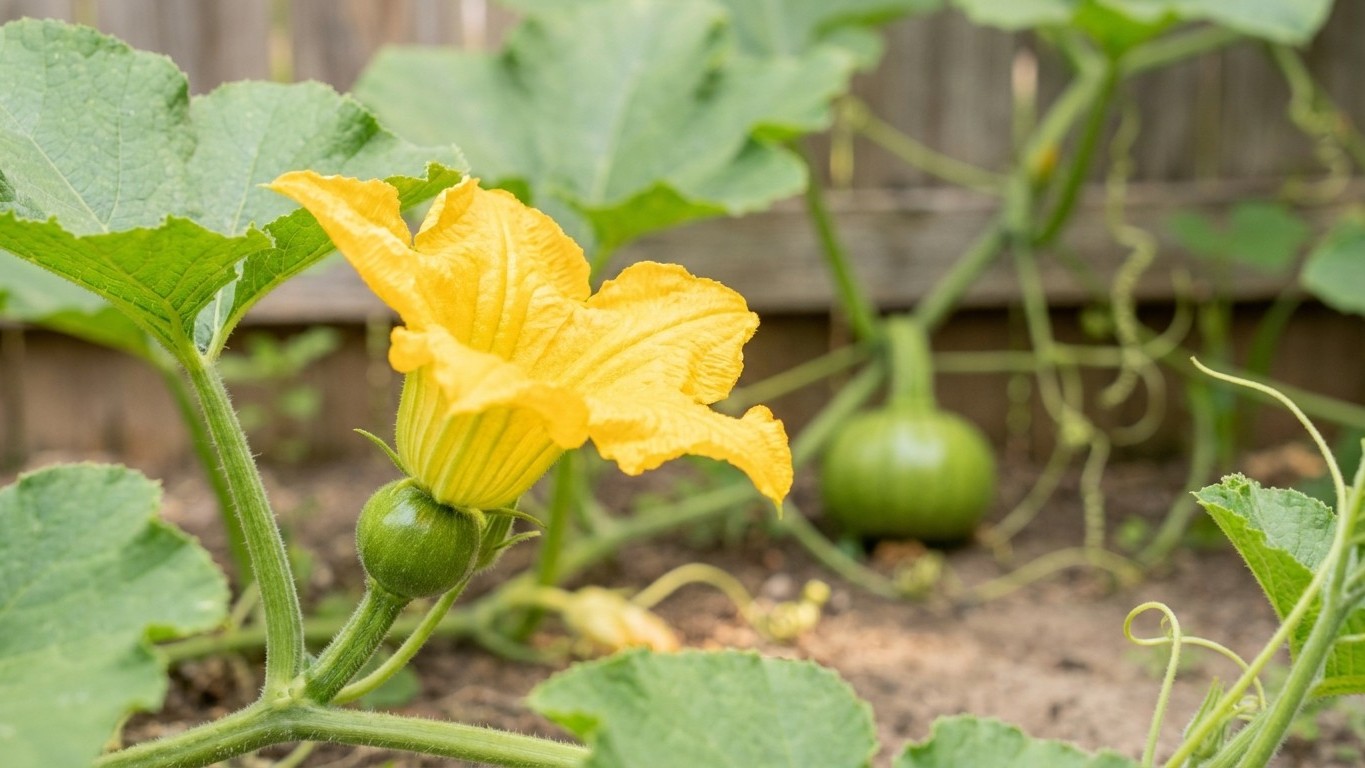

Two insects account for most of the documented summer squash damage in Quebec: the striped cucumber beetle and the squash vine borer. Flea beetles and seedcorn maggot show up too, but earlier and on younger plants. Timing matters more than the species, a plant hit at the seedling stage handles it differently than one hit at flowering.
Which pests attack Summer Squash in Quebec
Three extension services document insect activity for this region: Cornell University CALS Insect Diagnostic Laboratory, UNH Cooperative Extension, and University of Maine Cooperative Extension. Their combined records for the broader region list a range of species, but only a handful actually feed on summer squash.
The striped cucumber beetle and the squash vine borer are the two pests built for this crop specifically, cucurbits are what they target, full stop. Flea beetles and seedcorn maggot round out the list: neither is a cucurbit specialist, but both routinely damage squash at the seedling stage, before the plant has enough leaf area to shrug off the loss.
Everything else on the documented list belongs somewhere else in the yard, not the squash bed. Colorado potato beetle wants potatoes, tomatoes and other nightshades. Cabbage maggot and imported cabbageworm work brassicas exclusively. Apple maggot and emerald ash borer are tree pests with no reason to visit a vegetable garden. Japanese beetle and white grubs turn up in lawns and on roses more than on squash foliage, and while a wandering beetle might nibble a leaf edge, it isn’t a documented squash feeder here. If a reader spots one of these species near squash plants, it’s likely passing through, not settling in.
What decides whether these four pests become a real problem is less about which species exists in the province and more about when the plant is exposed to them. A squash seedling planted into cold, wet soil sits vulnerable to seedcorn maggot for days longer than one planted into warm soil. That single variable, soil temperature at planting, does more to predict damage than any insect count.
Quebec’s growing season runs on a frost-free window that averages from May 6 to October 5, based on Environment and Climate Change Canada normals for the Montreal/St-Hubert A station. That’s a mean, not a guarantee. In one year out of two, the last frost lands later than May 6, and gardens north of the reference station run behind it. Anyone planting squash by a fixed calendar date without checking local soil conditions is planting on faith, not on evidence.
When each one shows up, and what it does first
Seedcorn maggot arrives first, and it arrives underground. It targets squash seeds and very young seedlings sown into cool, slow-draining soil, the kind of ground still cold in the weeks bracketing that May 6 average last frost. The first sign isn’t a visible bug at all, it’s a seed that never comes up, or a seedling that collapses at the soil line within days of emerging. By the time the plant is a few inches tall and growing steadily, the risk window has mostly closed.
Flea beetles follow soon after, once seedlings have true leaves. They show up as a scatter of tiny, round holes across the leaf surface, sometimes so dense the leaf looks like it was hit with buckshot. Young transplants take the worst of it because their leaf area is small enough that a few dozen holes matter. Once a squash plant develops several full-size leaves, flea beetle damage becomes cosmetic rather than threatening.
Striped cucumber beetle typically appears as plants start vining, drawn to open flowers and tender new growth. The first sign is usually the beetle itself, a small yellow-and-black striped insect clustered at blossoms or chewing ragged edges into leaves. The bigger concern isn’t the chewing, it’s what the beetle can carry: a bacterial pathogen that causes sudden wilting later in the season, well after the beetles themselves have moved on.
Squash vine borer is the latecomer, laying eggs at the base of the plant once vines are established and the season is well underway, generally the second half of the frost-free window rather than the start of it. The first visible sign almost never involves seeing the insect at all, it’s a single vine wilting during the heat of the day while the rest of the plant looks fine, and a small pile of moist, sawdust-like frass sitting at the base of that vine.
Telling the damage apart from everything else
Squash problems get misdiagnosed constantly, mostly because wilting and yellow leaves have so many possible causes. The detail that actually separates insect damage from everything else is almost always something physical: a hole, an insect body, a texture of frass, not just a color change.
| Symptom | Likely cause | What distinguishes it |
|---|---|---|
| Single vine wilts in daytime heat, recovers or worsens | Squash vine borer | Moist, sawdust-like frass at the base of that specific vine |
| Whole plant wilts suddenly across several vines | Bacterial wilt (carried by cucumber beetle) or drought stress | Cut the stem and press out sap: stringy, sticky sap signals bacterial wilt; dry, clean sap points to water stress |
| Small round holes scattered across young leaves | Flea beetles | Damage concentrated on seedlings and young leaves, not mature foliage |
| Seeds fail to emerge or seedlings collapse at the soil line | Seedcorn maggot | Occurs in cool, wet soil early in the season; digging reveals small maggots near the seed |
| Yellowing between leaf veins, no holes or insects present | Nutrient deficiency | No physical damage anywhere on the plant, pattern follows veins |
| Torn or bruised leaf edges, no insects present | Wind, hail, or mechanical damage | Damage appears after a specific weather event, not gradually |
The rule that actually helps in the moment: if there’s no insect, no frass, and no hole to point to, treat it as a growing-condition problem first. Insect damage leaves physical evidence. A nutrient gap or a stretch of dry weather doesn’t. A local Ministry office can confirm a diagnosis with a sample or a photo when the signs overlap, which they often do.
What actually works here, and what is a waste of time
On a growing season this short, timing a physical barrier correctly does more good than any product applied after the fact. Floating row cover placed over squash seedlings right at transplanting keeps flea beetles, cucumber beetles, and egg-laying vine borer moths off the plant during the exact weeks each one is most active. The catch is that squash needs pollination to set fruit, so the cover has to come off once flowers open, not before and not much after. Leave it on too long and there’s no crop; take it off too early and the barrier never did its job.
Crop rotation helps for a different reason: squash vine borer and cucumber beetle both overwinter in soil near where squash grew the previous season. Planting in the same spot every year hands next year’s pests a head start. Moving the bed, even by a modest distance, breaks that cycle more reliably than most people expect.
Checking under leaves and at the base of vines every few days during the vining stage catches vine borer eggs and early cucumber beetle activity before either does real damage, this costs nothing but attention, and it’s the single habit that separates gardeners who lose vines from those who don’t.
What tends to waste effort is reaching for a treatment without knowing which pest is actually present, since the timing and method differ by species and a mistimed application misses the vulnerable stage entirely. This site doesn’t recommend specific products or active ingredients, what’s approved for home garden use changes and varies by product, and that question belongs with the extension service below, not with a generic article.
Where to check this for your own county
Insect pressure inside Quebec is not uniform. A garden in a warmer, earlier-thawing pocket of the province sees these pests on a different schedule than one in a cooler district that lags weeks behind the reference station. What’s documented at the provincial or regional level describes a pattern, not a guarantee for any single backyard.
The Ministère de l’Agriculture, des Pêcheries et de l’Alimentation du Québec (MAPAQ) is the starting point for anyone who wants pest information specific to their own area, reachable at mapaq.gouv.qc.ca. Its regional offices track local conditions more closely than any province-wide summary can, and they’re set up to take a photo, a sample, or a description and turn it into an actual answer.
The next useful step isn’t reading further, it’s calling or emailing the regional MAPAQ office before the next planting window opens, not after a vine has already wilted. Regional staff can confirm which of these pests are active nearby this particular season, which matters more than any provincial average, since populations shift year to year with winter severity and spring moisture.