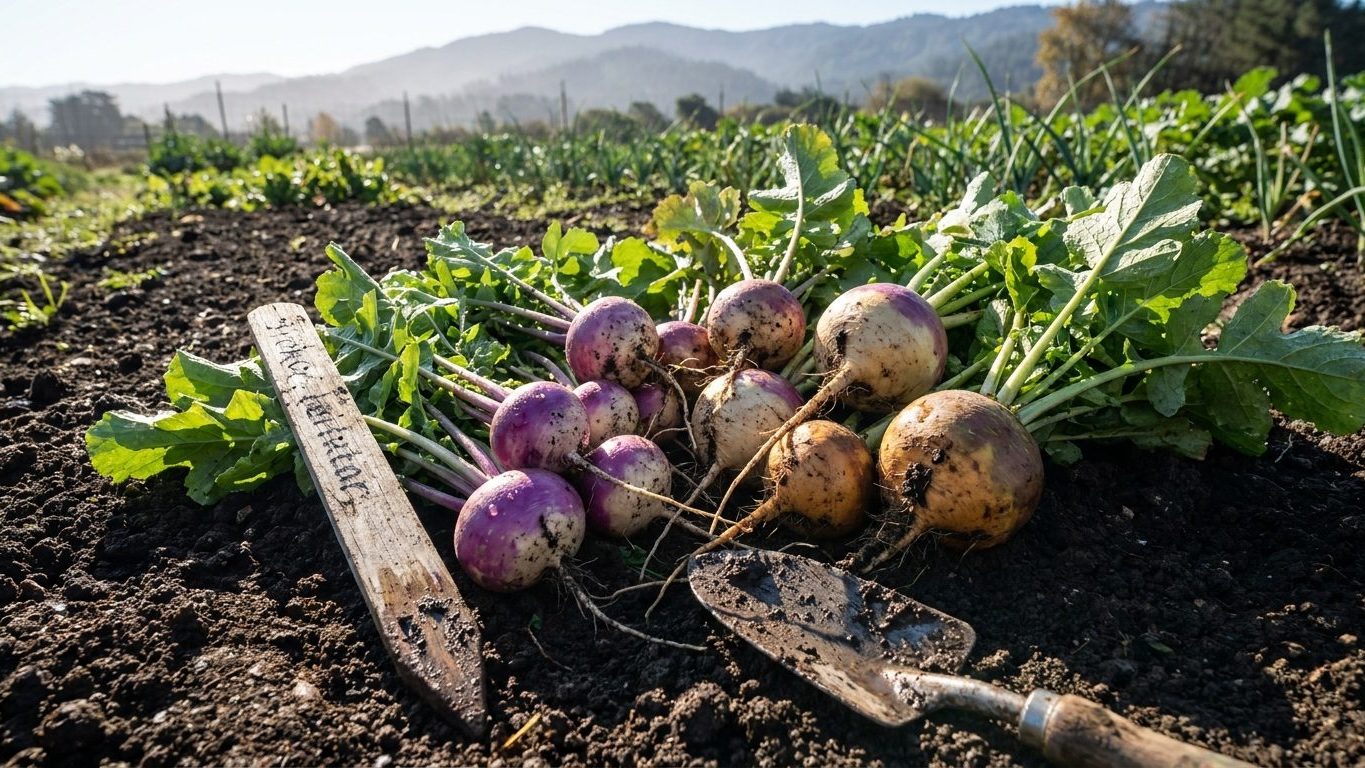

Choose by type, not by name: quick white salad turnips for spring and early fall, a firmer storage turnip for autumn keeping, and rutabaga as the long-season root that likes Quebec’s cool nights. At the Montreal/St-Hubert station, frost leaves on average May 6 and returns on average October 5. That window fits all three types, though rutabaga is the one that punishes a late start.
The short answer for Quebec
For most Quebec gardens, rutabaga is the best performer, with a fast salad turnip alongside it and a storage turnip as the third choice. Cool autumn weather suits all three, and the season is long enough for each if you sow on time.
The frost figures come from Environment and Climate Change Canada’s 1981-2010 normals for MONTREAL/ST-HUBERT A. The last spring frost falls on average on May 6, and the first fall frost on average on October 5. Both are mean dates, which means each is the midpoint of a window. In one year out of two, the last spring frost lands later than May 6, and in about half of years the first fall frost arrives before October 5. Neither is a safe date. Between them sit roughly five months, enough for a long crop but not enough for a careless one.
| Type | Best role in Quebec | Sowing logic | Main risk |
|---|---|---|---|
| Salad turnip (white, quick) | Spring crop and a second sowing for fall | Early spring, then again late summer | Bolting and woody roots if it matures in midsummer heat |
| Storage turnip (purple-top, firmer) | Autumn harvest to keep in a cold cellar | Late summer, timed to size up in cool weather | Small roots if sown too late |
| Rutabaga | Main root crop, harvested late in the fall | Late spring to early summer, early enough to use the whole season | Undersized roots from a late sowing |
Turnips and rutabaga are cool-season roots, so a light frost rarely ends them. The fall frost date works as a planning marker rather than a deadline. What actually limits you is root size before the ground freezes hard. Read the days to maturity on the seed packet and count back from October 5, leaving a margin because half of all years the frost comes sooner.
For week-by-week sowing, see When to Sow Turnips in Quebec. The wider routine, from soil prep to storage, sits in Growing Turnips and Rutabaga in Quebec.
What will not work here
A late rutabaga sowing is the first casualty. With about five months between the mean frosts, a crop sown after midsummer has too little time to bulk up. You get leaves and a root the size of a golf ball. Slow types need the early part of the window, and the seed packet’s days to maturity will tell you if you’ve already missed it.
Overwintering in the ground fails too. The mean daily minimum of the coldest month at the reference station is -14.1 °C, and the Canadian hardiness zone for the reference city is 5b. Frozen soil will turn a rutabaga left in the bed into mush by spring. Harvest in late fall and store the roots cold and humid, in a cellar or an unheated space that stays above freezing.
Trusting May 6 is another quiet mistake. Because it’s an average, half of years still have a frost after it. Turnips handle a light frost without much trouble, but a long cold snap after sprouting can push some varieties to bolt. Sowing in the first days of May works if you accept that you may reseed a row, or cover it for a night or two.
Spring salad turnips don’t belong in a midsummer sowing. A type bred for quick spring growth that matures in July heat tends to turn woody or hot-flavored. In Quebec the better move is to sow the quick types in early spring, then again in late summer so they size up in the cooler weeks heading toward October 5.
The least obvious failure is copying a calendar from another place. The St-Hubert station sits on the south shore near Montreal, and a province is not one climate. Gardeners in northern or upland districts run weeks behind these dates. Anyone who sows by the Montreal numbers up there will be sowing into cold ground and harvesting into hard frost.
One more mismatch to keep in mind: the frost normals cover 1981-2010, while the hardiness zone is built on 1991-2020 data. They are not wrong, only measured over different decades, so treat both as guides rather than guarantees.
What changes across Quebec
Quebec is not one garden. The zone this page can give you is 5b, in the Canadian plant hardiness system, for the reference city of Montreal. That is one point on a province-wide map, not the range inside the province, and this page does not carry the spread from south to north. There is no single answer for the whole province.
The Canadian system should never be read as a USDA zone. It is built on seven climate variables, where the USDA system uses one, and Natural Resources Canada states that there are no simple conversions between the two. A US reader who sees 5b here should not assume it matches a 5b zone in Vermont or New York. Look up your own location on Natural Resources Canada’s plant hardiness site, which lists zones by municipality, rather than assuming one.
What should a reader in the north or at altitude change? Mostly the timing and the type mix. The spring window opens later, so sowing slides back by weeks, and the fall frost arrives sooner, so the late crops have less time. Favor the earliest-maturing rutabaga on offer and lean harder on salad turnips, which finish in a fraction of the time. A second sowing for fall becomes a gamble in cold districts, so check how long your garden holds warm weather before you commit seed to it.
Gardeners in the south can stretch the other way. A fall sowing of salad turnips pushed a little later, or a rutabaga sown with comfortable room before October, makes sense where the frost-free stretch runs longer. I’d still keep the margin. Half of all years the frost beats the average, and a root harvested slightly small is better than one lost to a hard freeze.
Where to check this for your own county
The best next stop is the Ministère de l’Agriculture, des Pêcheries et de l’Alimentation du Québec (MAPAQ). Quebec’s agricultural ministry is the provincial authority here, and much of its material is likely in French. This page does not carry a Quebec-specific sowing calendar from it, so what follows is what to look for rather than what it says.
Two things matter most. First, a local planting calendar for turnips and rutabaga, ideally tied to your region rather than the province as a whole. Second, any variety trials run near you: which rutabaga and turnip types were grown, how they matured, and how they stored. A trial in your own region tells you more than a catalog description written for the whole of North America.
A regional recommendation beats a provincial one, and this page is the provincial one. It gives you a type-based decision and frost dates from a single station. A regional office or local extension-style advisor knows the frost pockets, the soil, and the pest pressure in your district, including which areas need extra care against root maggots and flea beetles.
Write down what you find and compare it against this page. If the regional frost dates differ from May 6 and October 5 by a week or more, trust the regional ones and move your sowing dates to match.
Checking this against your own garden
Your own observation outranks every date on this page. Three things are worth watching, and none needs equipment.
- Soil warmth by feel. Push your bare hand a few inches into the bed in spring. If it feels cold and clammy, wait. Compare a sunny south-facing bed with a shaded or low one, and you will see which warms first.
- First true leaves. The first sowing of turnips will show its real leaves after the small seed leaves. If they appear slowly or the seedlings stall after a cold night, your spot runs cooler than the station numbers suggest.
- The first frost in your low spot. Note the date you first see white on the grass or the garden, and note where. Frost settles in hollows first, so that spot tells you how much earlier or later your fall really is.
Keep these in a notebook for a few seasons. Three years of your own dates will say more about your garden than a 1981-2010 average from a station that may sit hours away.
Common questions
Is rutabaga better than turnip in Quebec?
Rutabaga is the stronger main crop because it stores well and likes cool autumn nights, but it needs the longer part of the season. Salad turnips are faster and forgiving, so most gardens benefit from growing both.
Can I sow turnips on May 6?
You can, but May 6 is only the average last spring frost at the St-Hubert station. In one year out of two a frost comes later. Turnips tolerate light frost, so the risk is manageable, but be ready to cover or reseed the row.
Can rutabaga stay in the ground over winter?
No. The mean daily minimum of the coldest month is -14.1 °C at the reference station, and the ground freezes. Harvest in late fall and store the roots in a cold, humid place above freezing.
Is Quebec’s zone 5b the same as a USDA zone 5b?
No. The 5b given here is Canadian, based on seven climate variables, and it does not convert to a USDA zone. Natural Resources Canada says there are no simple conversions between the two systems.