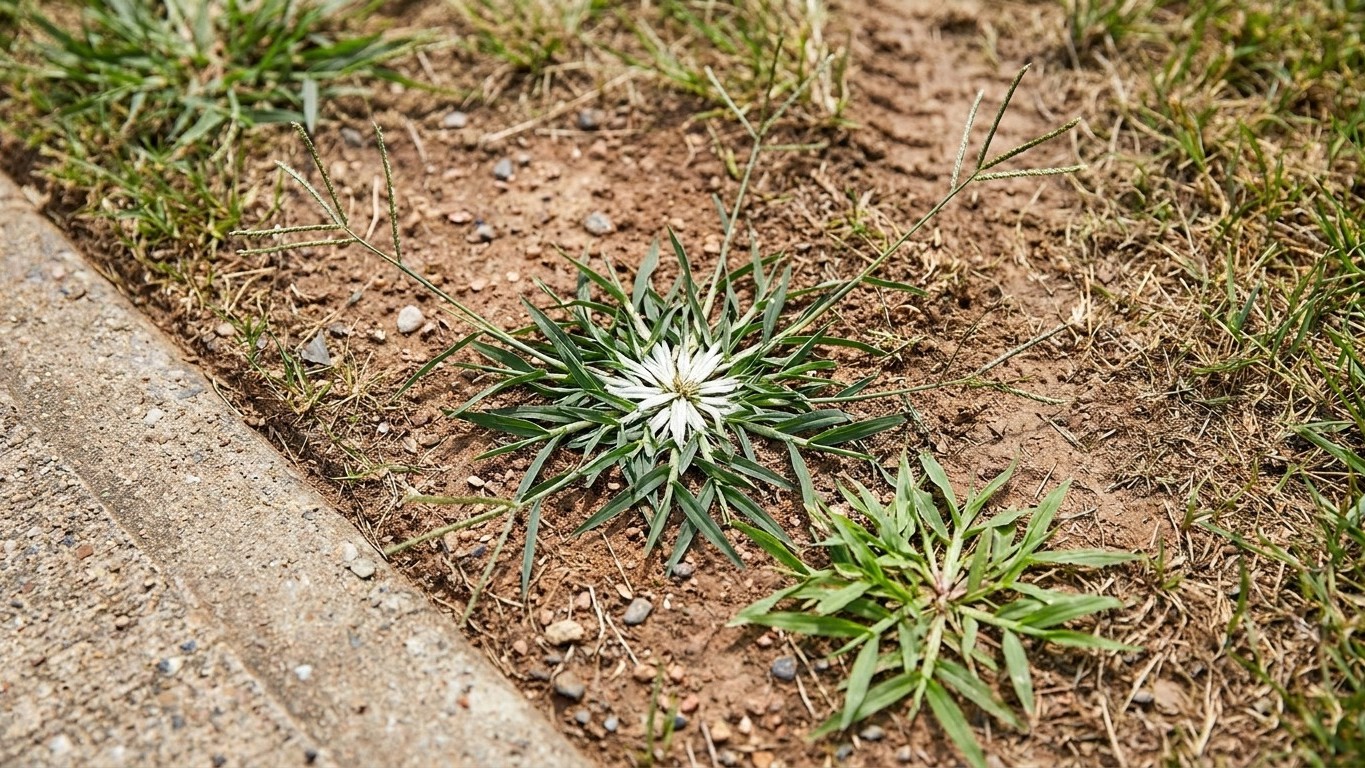

Most Rhode Island lawns never need dethatching. Cut a wedge of turf with a spade and measure the spongy brown layer under the green: below 0.5 inch, leave the rake alone. Above 0.75 inch, dethatch in early fall, while the grass is still growing hard and ahead of the first frost window. At the airport reference station, that window opens October 24. Spring is the fallback, not the plan.
Do you need to dethatch at all?
Thatch is a tangle of living and dead stems, crowns and roots that sits between the green blades and the soil. A thin layer does the lawn good. It cushions foot traffic and insulates the crowns. The trouble starts when it gets thick enough to shed water like a doormat and keep air and fertilizer from the soil beneath.
Measure it with a spade
Cut a wedge of turf a few inches deep, lift it out and look at the side. The thatch is the brown, spongy band between the green growth and the dark soil. Hold a ruler against it. Check three or four spots, because a shady backyard corner and a sunny front slope often differ by a quarter inch or more.
The thresholds are simple. Under 0.5 inch is healthy. Between 0.5 and 0.75 inch is a gray zone where you adjust your habits and re-measure next year. Above 0.75 inch, act. Other signs back up the ruler: a lawn that feels bouncy underfoot, water that pools or runs off after a rain, or a mower that scalps the high spots.
Why some lawns build more than others
Species matter. Kentucky bluegrass spreads by underground stems and tends to pile up thatch. Tall fescue and perennial ryegrass grow in bunches and rarely build much. Heavy nitrogen, frequent shallow watering, compacted ground and acidic soil (common in New England) all slow the microbes that break thatch down.
Clippings are not the culprit. They are mostly water and decompose fast, so you can keep mulching them. The lawn grasses that fit Rhode Island are the cool-season group: fine fescues, Kentucky bluegrass, perennial ryegrass, rough bluegrass and tall fescue. Cool-season grasses are the only kind that will hold here.
The season to do it in Rhode Island
Cool-season grasses grow fastest in early fall and again in spring, so those are the windows when a torn-up lawn can knit back together. Early fall is the better one. Soil is still warm from summer, nights are cool, and the weeds that compete with new seedlings are winding down. Crabgrass, the main spring pest, dies with the first hard frost.
Frost dates give you the back end of that window. In the NOAA NCEI U.S. Climate Normals for 1991-2020, the airport reference station shows the last spring 32°F freeze in the 30-70% probability band from April 7 to April 17. The first fall freeze falls from October 24 to November 3. Those are reference-city figures, not a state-wide guarantee. Suburban and rural yards usually see the last spring frost later and the first fall frost earlier than an airport does, often by one to two weeks, and more at elevation. Coastal lots in Newport and Washington counties tend to run milder than inland ones, and the hillier northwest corner of the state runs colder. Check your own county before you pencil in a date.
The practical rule: finish dethatching and overseeding early enough that new grass has several weeks of active growth before your own first frost. Waiting until late October is a gamble.
Spring works when you missed the fall window, but wait until the last frost window has passed and the grass is visibly growing. Spring has a drawback. Raking opens bare soil right as crabgrass seed is germinating, and a crabgrass preventer will also block the grass seed you want to sow. Summer is out. Heat-stressed cool-season turf does not recover from being ripped up in July.
A warm-season grass would take the opposite schedule, dethatched in midsummer. It would not last here, though. Warm-season species go dormant and turn tan when cold sets in, and New England winters can kill them outright. Gardeners in other states follow different calendars, as you can see in the guides for When to Dethatch a Lawn in Iowa and When to Dethatch a Lawn in Kansas. For the general method, see Dethatching a Lawn.
Rake, power rake, or core aeration
The tool should match the thatch depth and the size of your lawn. Soil should be moist, not soaked and not dusty dry. Mow a little shorter than usual beforehand so the tines reach the thatch.
| Method | Best for | What to know |
|---|---|---|
| Dethatching rake | Small lawns, thatch just over 0.75 inch | Hard on the back, and it pulls only the top of the layer. Free of machine rental. |
| Power rake (vertical mower) | Larger lawns, thick thatch | Set the blades to cut into the thatch, not deep into the soil. Expect heaps of debris and a rough-looking lawn for a couple of weeks. |
| Core aeration | Gray-zone thatch, compacted soil | Pulls plugs and lets soil mix into the thatch, which speeds breakdown. It thins the layer but does not strip it. |
A hand rake is plenty for a small yard. Pull it through with firm, short strokes until the pile of brown fiber stops growing. A power rake saves hours on a typical suburban lot, but one pass is often enough. A second pass at right angles to the first is for stubborn spots, and going over the same ground repeatedly shreds healthy crowns.
Core aeration is the gentler choice for thatch in the 0.5 to 0.75 inch band, especially if the soil is compacted from foot traffic or heavy clay. It also opens channels that make overseeding work better, so aeration plus seed is a common fall pairing. Neither machine is a fix for the cause. If thatch keeps returning, look at your nitrogen schedule and watering habits.
What the lawn needs afterwards
Rake up and remove the debris, since leaving it on top smothers the grass you are trying to help. Then overseed right away, while the soil is open. Seed that touches soil beats seed perched on fiber.
The rates below come from extension guidance and are for a new lawn, in pounds per 1,000 square feet. Overseeding an existing lawn takes half. More seed is not insurance, because crowded seedlings compete and thin themselves out.
| Grass | New lawn (lb per 1,000 sq ft) | Overseeding (half rate) |
|---|---|---|
| Tall Fescue | 6 to 8 lb | 3 to 4 lb |
| Fine Fescues | 4 to 6 lb | 2 to 3 lb |
| Rough Bluegrass | 2 to 3 lb | 1 to 1.5 lb |
| Kentucky Bluegrass | 1 to 3 lb | 0.5 to 1.5 lb |
| Perennial Ryegrass | 4 to 10 lb | 2 to 5 lb |
Water lightly and often at first, so the top inch stays damp until seedlings emerge, then shift to deeper, less frequent watering. Hold off on heavy nitrogen, which feeds thatch. A soil test tells you whether lime or fertilizer is needed at all, and University of Rhode Island Cooperative Extension can point you to testing and to the state’s rules on lawn fertilizer, which are stricter near water.
Common questions
Can I dethatch in spring instead of fall?
Yes, once the last frost window has passed and the grass is actively growing. Expect more crabgrass pressure, since raking exposes bare soil just as crabgrass seed wakes up.
Do grass clippings cause thatch?
No. Clippings break down quickly. Thatch comes from stems, crowns and roots, and it builds faster with heavy nitrogen, shallow watering and spreading species like Kentucky bluegrass.
Are the frost dates my frost dates?
Probably not exactly. The April 7 to April 17 and October 24 to November 3 ranges come from one airport reference station in the NOAA NCEI 1991-2020 normals. Inland, rural and higher-elevation yards usually see a later last frost and an earlier first frost, often by one to two weeks, so look up your own county.
How often will I need to dethatch?
Only when the spade test says so, and for many lawns that is never. Re-measure each fall in the same spots, and note that a lawn dethatched once will rebuild the layer if the underlying habits stay the same.