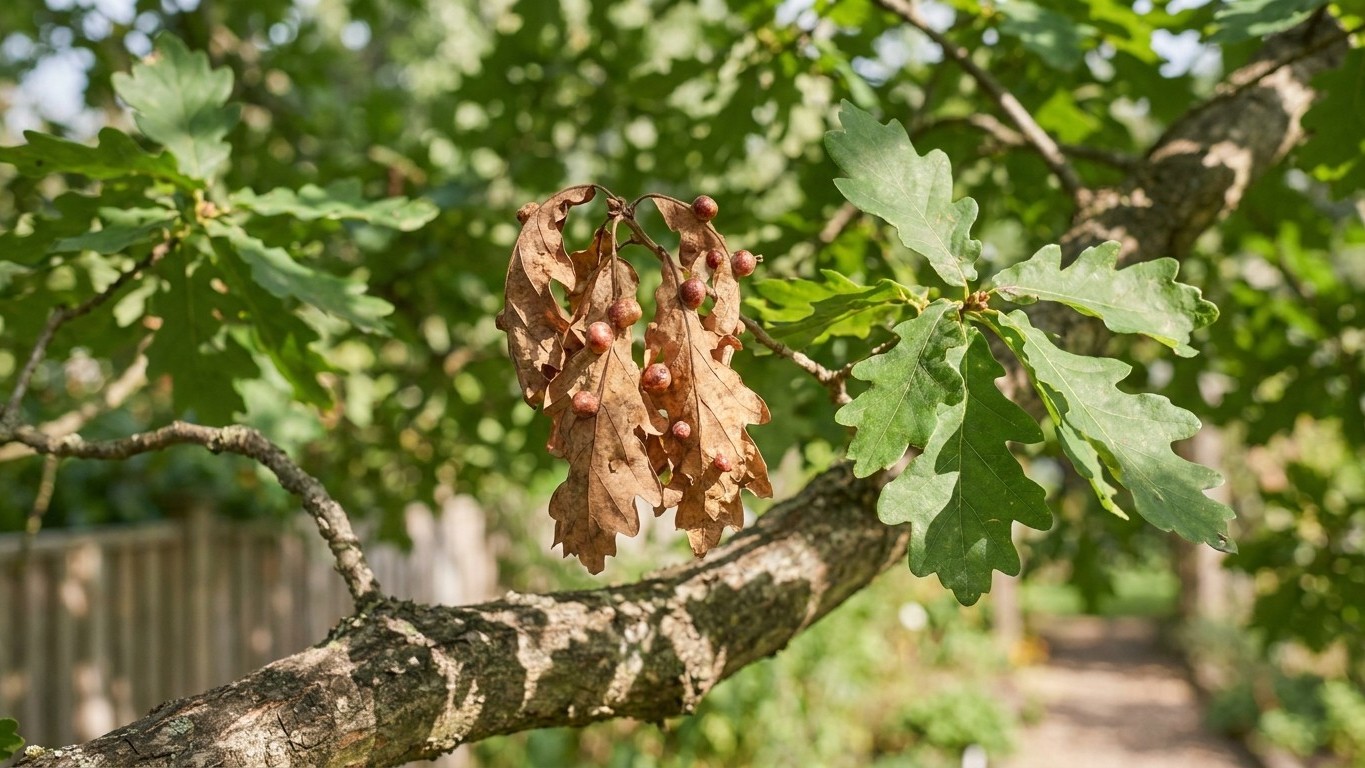

Crypt gall wasps show up on Rhode Island oaks as a late-summer surprise: clusters of brown, wilted leaves clinging to otherwise green branch tips. The insect itself is rarely seen. What stops it is timely pruning of infested twigs before adults chew their way out, paired with keeping oaks healthy enough to shrug off a light infestation.
The weeks to watch

University of Rhode Island Cooperative Extension does not publish a specific emergence window for crypt gall wasp. Its pest calendar, drawn from several URI pages, covers winter moth (feeding at bud-break, adults flying late November to early December), white grubs (root feeding in April and May, with late May as the best treatment window), and viburnum leaf beetle (eggs hatching early May, adults active July through first frost), but nothing on this particular cynipid wasp. That gap matters: it means a Rhode Island gardener won’t find a state-specific date to circle on the calendar, and has to fall back on the general biology of stem-gall cynipids in eastern oaks.
Gall formation inside the twig
Across the broader family of crypt-forming gall wasps, a single generation typically completes its cycle over roughly a year. Eggs laid in oak stem tissue trigger the tree to build a hardened chamber, the “crypt,” around the developing larva. That larva feeds and grows largely out of sight, inside living wood, for most of the year.
Adult emergence and flagging
The visible sign comes later, when maturing wasps chew exit holes through the gall and the bark around it. That disruption cuts off water to the branch tip beyond the gall, and the leaves there brown and wilt while the rest of the canopy stays green, a pattern arborists call flagging. In the mid-Atlantic and southeastern oak range, this tends to show up in late summer into fall; without a published Rhode Island date, that regional pattern is the best available guide.
Reading the calendar from your last frost

Crypt gall wasp isn’t a transplant pest, so it doesn’t track a vegetable garden’s frost-to-planting math the way cutworms or flea beetles do. But its host oaks respond to the same spring warming that determines the frost-free date, and that link is still useful for timing pruning work.
- Start from the reference window: NOAA’s 1991-2020 climate normals put Rhode Island’s last spring freeze probability between April 7 and April 17, based on the Providence airport station. Rural and inland yards, and anywhere with higher elevation, often see frost linger one to two weeks past that.
- Oak bud break in southern New England generally follows within about two to three weeks of that local last-frost mark, give or take a season’s own weather. That bud-break window is a reasonable cutoff for finishing dormant-season pruning of galled twigs, since cutting after growth resumes disturbs the tree more and can miss larvae that have already begun their exit.
Treat both of those as normals, not fixed appointments. A cold spring pushes both frost and bud break later; a warm one pulls them forward.
What it attacks, and what the damage looks like

The first thing most people notice isn’t an insect at all. It’s a cluster of dead, curled leaves still hanging on a branch tip in July or August, surrounded by leaves that look perfectly fine. Look closer at the twig behind that dead foliage and there’s often a small swelling or knot in the bark, sometimes with a tiny round exit hole once the adult has left.
Crypt gall wasps target oaks in general, with particular pressure documented on species in the red oak group. In Rhode Island landscapes and woodlots, that puts these trees at risk:
- Pin oak
- Red oak
- Black oak
- Scarlet oak
- Willow oak
The damage is done entirely by the larva, tucked inside its crypt within the twig. That matters for treatment: by the time flagging is visible, the insect responsible has usually already moved beyond any stage where a surface spray could reach it. The bark and the hardened gall tissue both stand between an insecticide and the larva.
How Rhode Island sits in this pest’s range

There’s no published count of states or range data specific to crypt gall wasp from Rhode Island sources, and URI’s own extension materials, built around winter moth, white grubs, and viburnum leaf beetle, simply don’t address it. That silence is itself informative: this isn’t a species Rhode Island has flagged as a priority ornamental pest, unlike the three insects that dominate the state’s published guidance.
What’s known more broadly is that crypt-forming gall wasps occur wherever their oak hosts grow across the eastern United States, with the flagging symptom studied most closely in the southeastern states, where oak dieback tied to these insects has drawn research attention. Rhode Island sits well within the natural range of red oak, pin oak, and their relatives, so the insect’s presence here is plausible on host-range grounds even without a local monitoring record. Homeowners with mature red oak group trees are watching for a symptom pattern documented elsewhere in the oak’s range, not a confirmed local outbreak.
What actually works against it

- Watch for flagging in late summer. Scan oak canopies in August and September for isolated clusters of dead leaves. Early spotting narrows down which branches need attention before winter.
- Prune out galled twigs during dormancy. Cutting affected branch tips back to healthy wood in late winter, before bud break, removes larvae still developing inside the crypt and before adults have a chance to emerge and start a new cycle nearby.
- Destroy or dispose of pruned wood promptly. Chipping or burning removed twigs (where local rules allow) keeps any surviving larvae from completing development and emerging from a brush pile in the yard.
- Avoid moving infested firewood or prunings off-site. Transporting galled wood is a straightforward way this kind of insect spreads to new areas; leaving cut material on the property, at least until it’s processed, limits that risk.
- Keep host oaks vigorous. Stressed trees, especially those dealing with drought, compacted soil, or root damage, tend to carry heavier gall-wasp loads in general among cynipid pests. Regular watering during dry stretches and avoiding trunk or root injury from mowers and construction supports a tree’s own resistance.
- Skip insecticide once flagging appears. By the time dead leaf clusters show up, the larva responsible is usually gone or about to be, and the damaged twig is already lost. Chemical treatment aimed at this stage has little left to reach.
Common questions
Does crypt gall wasp kill the whole tree? Not typically. The damage is confined to individual branch tips, and mature oaks generally tolerate scattered flagging without lasting harm. Repeated heavy infestation over several years, combined with other stressors, is a different matter and worth flagging to a certified arborist.
Can I tell crypt gall wasp damage from oak wilt or other diseases? Flagging alone isn’t a reliable fingerprint, since several oak problems produce similar isolated branch dieback. Checking the twig behind the dead leaves for a swollen gall or a small round exit hole is the clearer sign that a gall wasp, not a fungal disease, is responsible.
Is there a Rhode Island-specific spray schedule for this pest? No. URI Cooperative Extension’s published pest calendar covers winter moth, white grubs, and viburnum leaf beetle, but doesn’t list a treatment window for crypt gall wasp, and pruning timed to dormancy remains the main tool homeowners have.