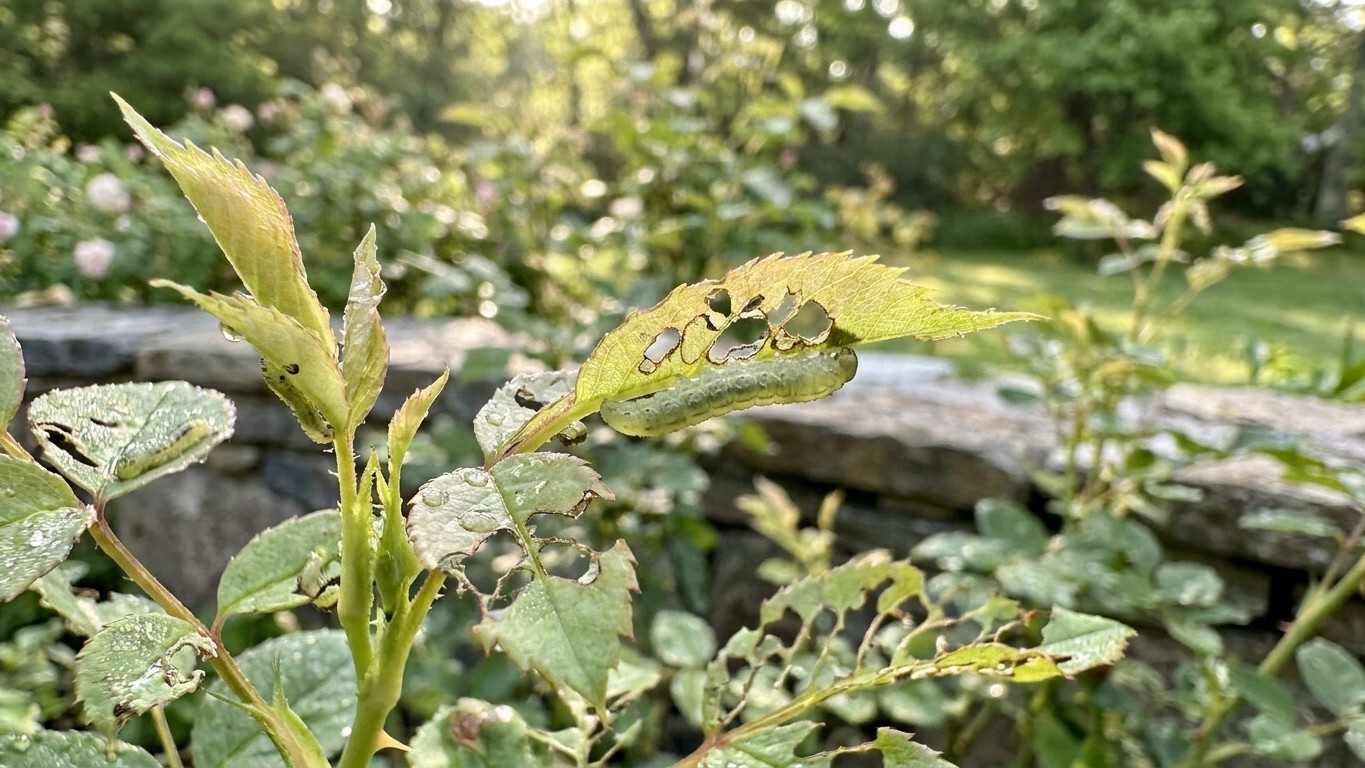

Rose sawfly larvae, often called rose slugs, show up in Rhode Island as new rose foliage expands in late spring, generally sometime between early May and mid-June depending on how fast the season warms. There’s no chemical control needed for most home gardens: hand-picking, a strong water spray, and fall cleanup of fallen leaves stop the damage before it spreads.
The weeks to watch

The University of Rhode Island Cooperative Extension and URI Biocontrol Lab does not publish a specific emergence window for rose sawfly the way it does for winter moth or white grubs. Its pest pages skew toward ornamentals broadly rather than a single dated calendar for this species, so the timing below comes from the general biological pattern for rose sawfly, not a Rhode Island-specific date.
One generation, tied to leaf-out
Rose sawflies in the Northeast typically produce one generation a year. Adults, small non-stinging wasp relatives, emerge as roses begin pushing new leaves and lay eggs into the leaf tissue. The larvae that hatch from those eggs do the visible feeding, and they stay active for roughly three to four weeks before dropping to the soil to pupate. That whole window sits inside late spring and runs into early summer.
Why the exact week moves every year
Because emergence tracks leaf development rather than a fixed date, a warm April pulls the whole cycle earlier and a cold, wet spring pushes it back. A gardener checking rose foliage weekly starting when the first leaves fully unfurl will catch the larvae before skeletonizing damage becomes obvious, which matters because early detection is what makes hand-removal effective.
Reading the calendar from your last frost

Rose sawfly doesn’t answer to a printed date, it answers to soil and air warming enough for rose leaves to flush out. The one date most Rhode Island gardeners already track is the last spring frost, and NOAA’s 1991-2020 climate normals put that window at April 7 to April 17 for the reference weather station used for this data. Suburban and rural yards often see frost linger one to two weeks past that, more at elevation, so treat the range as a normal, not a promise.
The two-step count
- Start from your local last-frost window (April 7 to April 17 at the reference station, later in most yards).
- Add the weeks roses typically need to leaf out fully once frost risk passes, generally three to five weeks, which lands the first rose sawfly larvae somewhere in the second half of May into June.
That arithmetic gives a range, not a single day, and it should. If a cold snap delays leaf-out, the larvae arrive later too. Anyone using fine mesh to keep adults from laying eggs should have it in place as soon as new leaves start to unfurl, and should pull it off once larvae stop appearing and bloom time approaches, since roses need pollinator access to set hips and repeat flower well.
What it attacks, and what the damage looks like

Most gardeners notice the damage before they ever see an insect. Leaves develop a papery, skeletonized look, with the green tissue eaten away between the veins so the leaf resembles lace held up to light. Heavily fed leaves turn brown at the edges and can drop early, which weakens the plant’s ability to store energy for next year’s growth even though it rarely kills an established rose.
The larval stage does essentially all the damage. Adults feed little to none and are rarely seen, so any treatment decision should be made based on larvae present on the foliage, not on catching an adult in the act.
Where to look
- Shrub roses and hybrid tea roses, the most commonly reported hosts
- Climbing roses trained on fences or arbors
- Old garden and rambling rose varieties
- Undersides of lower and interior leaves first, where larvae tend to start feeding
How Rhode Island sits in this pest’s range

Rose sawfly occurs wherever roses grow in temperate climates, and nothing in the sourced material suggests Rhode Island sees it more or less severely than other cool-season rose regions. On this site, Rhode Island is currently the only territory documented for this pest, so there’s no neighboring state’s timing to compare it against yet. That will change as more territory pages get added to this series, but for now the honest answer is that this page stands alone rather than sitting on a spectrum of severity or rank.
What that also means practically: the composite URI guidance behind this page draws from several ornamental-focused pages rather than one dedicated rose-pest bulletin, which is why the timing section above leans on general biology instead of a locally published date.
What actually works against it

Because rose sawfly larvae feed openly on the leaf surface rather than boring into stems or roots, foliar interventions stay effective through the entire larval period, unlike pests that tunnel out of reach early on. Cheapest and simplest measures first:
- Inspect weekly once new leaves unfurl. Catching larvae in their first week of feeding, while damage is still light, makes every following step easier.
- Hand-pick or hose them off. A firm spray of water knocks the soft-bodied larvae to the ground, where they generally can’t climb back up in time to keep feeding, and birds or ground predators pick off many of the rest.
- Prune out and destroy heavily skeletonized leaves. This removes larvae still on the leaf along with the damage, rather than leaving them to finish their feeding cycle elsewhere on the plant.
- Clean up fallen leaves and mulch in fall. Sawfly larvae drop to the soil to pupate, so clearing debris and disturbing the soil surface near rose plantings reduces the number that survive to emerge the following spring.
- Hold off on broad insecticide use. Avoiding unnecessary spraying protects the parasitic wasps and predatory insects that keep sawfly populations in check on their own most years.
One common mix-up is worth clearing up directly: rose sawfly larvae are called “rose slugs” because they resemble small slugs, but they’re insects, not mollusks. Remedies aimed at garden slugs and snails, copper tape, diatomaceous earth, beer traps, have no established mechanism against an insect larva, and nothing in the entomological literature suggests they work here. Skip them and stick to the physical and cultural steps above.
Common questions
Do rose sawflies kill the whole rose bush? Rarely. Even a heavy infestation that skeletonizes most leaves usually leaves the plant able to push new growth the following season, though repeated bad years without any leaf cleanup can weaken a rose’s vigor over time.
Can I spot rose sawfly larvae without special equipment? Yes. Check the undersides of lower leaves in late spring for small, pale green, slug-shaped larvae about a half inch long. A hand lens helps but isn’t required.
Will one round of hand-picking take care of it for the season? Usually, since Rhode Island typically sees one generation per year. Keep checking weekly through the larval window anyway, since eggs laid a few days apart hatch at slightly different times and a second pass often catches stragglers missed the first time.