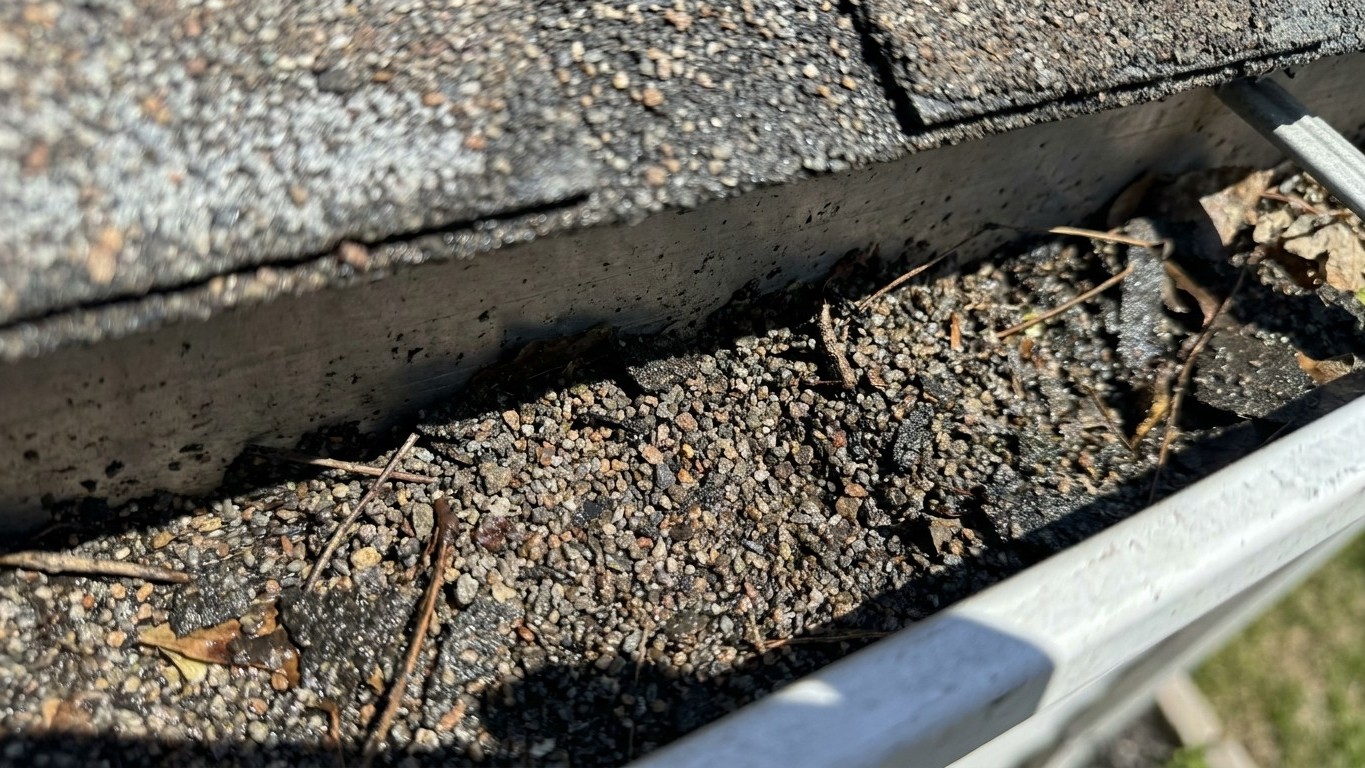

Granules in the gutter don’t automatically mean a failing roof. Every asphalt shingle sheds some grit, especially in its first year, as loose surface granules embedded during manufacturing work themselves free. The real question isn’t whether you find granules, it’s how many, how often, and what the shingles above the gutter actually look like. That distinction, more than the granules themselves, tells you whether to relax or start planning an inspection.
What is actually happening
Asphalt shingles are built with a mat of fiberglass or organic material, coated in asphalt, then topped with a layer of mineral granules. Those granules aren’t decorative. They shield the asphalt underneath from ultraviolet light, add a measure of fire resistance, and give the shingle its color and texture. Asphalt without that protective layer breaks down fast under sun exposure, so the granules are the roof’s actual wearing surface, the part designed to take the abuse so the waterproofing layer underneath doesn’t have to.
A brand-new roof sheds granules because manufacturing leaves a certain amount of loose material sitting on top, not chemically bonded to the asphalt. Rain, wind, and the first few freeze-thaw cycles knock that loose grit free, and it washes into the gutters. This is normal, expected, and not a sign of anything wrong. It typically tapers off as the roof settles.
Granule loss on an older roof works differently. Once the loose surface material is gone, further loss means granules are pulling away from asphalt they were actually bonded to. That’s a sign the shingle’s wearing layer is thinning, and thinning granule coverage exposes the asphalt mat beneath to direct sun and weather. The asphalt then dries out, becomes brittle, and starts to crack. That’s the mechanism that eventually turns granule loss into a leak, though the two events can be separated by a long stretch of time.
Telling the two situations apart from the gutter alone is hard, which is why the amount and pattern of grit matters more than its presence. A handful of loose granules after a storm is different from a steady, heavy accumulation every time it rains, or a gutter that fills with grit even in mild weather.
| Signal | Normal shedding (new roof) | Advanced granule loss (aging roof) |
|---|---|---|
| Granule color | Matches the shingle color | May include darker, tar-like specks from exposed asphalt |
| Pattern over time | Decreases after the first year | Stays steady or increases |
| Shingle surface (viewed from ground) | Uniform color and texture | Patchy, shiny, or discolored areas visible |
| Shingle edges | Flat, tight to the roof deck | Curling, cupping, or lifting |
What you can see without climbing
A full assessment doesn’t require a ladder. Most of what matters can be seen from the ground and from inside the attic, and that’s the safest and most practical order to check things in.
- Scan from the ground with binoculars or a zoomed phone camera. Walk the perimeter of the house and look at the roof plane from several angles, since morning and afternoon light show texture differently. Look for shingles that appear shinier or darker than the rest, patches where the color looks uneven, edges that curl upward, or spots where the black asphalt mat shows through instead of the usual granulated surface.
- Check valleys and edges specifically. Water concentrates in roof valleys and along the lowest edge, so granule loss and wear tend to show up there first. Zoom in on these areas rather than scanning the whole roof at the same distance.
- Photograph the gutter contents over a few weeks. A single after-storm photo tells you little. A series of photos taken after separate rain events shows whether the amount of grit is dropping off (normal) or holding steady (worth watching).
- Move to the attic with a flashlight, in daylight. Turn off the attic light and look up at the roof deck. Any pinpricks of daylight showing through mean there’s a gap somewhere in the roofing material above, not just granule wear.
- Look at the rafters and sheathing for staining. Brown or gray water stains, streaking, or dark trails along the wood point to past or ongoing moisture, even if no light is visible.
- Feel the Insulation near suspect areas. Damp, compressed, or matted insulation is a stronger and earlier indicator of a leak than a visible stain, since staining can take a while to appear.
None of this requires touching the roof surface itself. If any of these checks turn up something questionable, that’s the point to bring in a professional rather than to climb up and look closer.
What it costs to leave it
Ignoring granule loss doesn’t cause immediate damage. The consequences build in a fairly predictable sequence, and understanding that sequence is more useful than guessing at how long it takes.
The asphalt mat, once exposed by thinning granules, dries out under UV exposure and starts to crack. Cracked asphalt no longer sheds water reliably, so small amounts start to seep through at the weakest points, usually where a shingle has curled, cracked, or lifted at an edge or valley. That moisture doesn’t pool visibly on the surface. It travels along the underside of the roof deck, following the path of least resistance, which is why a leak often shows up in the attic or on a ceiling in a spot that isn’t directly below the actual failure point on the roof.
Once water reaches the roof deck, plywood or oriented strand board absorbs it and starts to soften. Repeated wetting and drying cycles weaken the wood’s structure over time, and a persistently damp deck also creates conditions for mold and, in some cases, for wood-decay fungi that can compromise the panel’s strength. Insulation below the deck absorbs moisture too, and wet insulation loses much of its effectiveness, which shows up as higher energy bills before it shows up as a visible stain.
Framing members, the rafters or trusses that hold the roof deck up, are more resistant to short-term moisture than sheathing, but sustained dampness eventually affects them too, especially at joints and connection points where water tends to collect.
None of this happens on a fixed schedule. It depends on how much water gets in, how often, and how well the space ventilates and dries out between rain events. A well-ventilated attic in a dry climate tolerates occasional minor moisture far better than a poorly ventilated one in a humid region. That variability is exactly why a single missed inspection cycle can matter a great deal in one house and very little in another, and it’s why catching granule loss early, while it’s still a cosmetic issue, is worth the ten minutes it takes to check the gutter and the attic.
There’s also a cost dimension beyond the structure itself. Roof damage from wind or hail is typically handled through a homeowner’s insurance policy, and coverage rules, documentation requirements, and filing windows vary by policy and by state. The practical takeaway is to photograph what you observe, note the date, and keep that record on file. What the policy actually covers, and by when a claim needs to be filed, is a question for the insurer and the policy document, not a general rule that applies across the board.
What is not a householder job
Everything described above stops at the edge of the roof surface itself. Getting onto the roof to inspect shingles up close, clear debris from a valley, or check flashing at a chimney is a different task with different risks, and it’s worth being blunt about where the line sits.
Anything above a single story is not a do-it-yourself inspection task. A fall from a two-story roof is a different order of injury than a fall from a single-story one, and the added height changes the equation regardless of how sturdy the ladder feels.
A wet, mossy, steep, or frosted surface is not something to walk on, even on a single-story roof. Moss holds moisture and turns slick almost instantly, frost does the same, and a steep pitch removes the margin for error that makes a gentle slope manageable. Roofing surfaces also lose grip in ways that aren’t obvious until weight is already on them.
Any task that needs both hands while standing on a slope, whether that’s clearing debris, resetting a shingle, or checking flashing, removes the ability to catch a fall or hold a rail. That combination, both hands occupied on an angled surface, is where a large share of preventable roofing injuries happen.
The ground-and-attic routine above exists precisely so none of that is necessary for a first assessment. If what you see from the ground or the attic raises a question, the next step is a proper inspection, not a personal climb. For a fuller walkthrough of what a professional inspection actually checks and how often it makes sense, see our guide to roof inspection. And if the findings point toward repair or replacement, our page on hiring a roofer covers what to ask and how to compare estimates before committing to any work.
Common questions
Is some granule loss in the gutter always normal?
Some is expected, particularly on a roof that’s still fairly new, since loose surface granules from manufacturing wash off during the first rains and freeze-thaw cycles. What’s not normal is a steady, heavy amount that continues well beyond that early period, or granule loss paired with visible curling, cracking, or bare patches on the shingles themselves.
Can I tell how bad it is just by looking at the gutter?
Not reliably on its own. The gutter tells you granules are coming off somewhere, but not where, how deep the wear goes, or whether the roof deck underneath is still protected. Pairing gutter observation with a ground-level scan of the shingles and an attic check for daylight or staining gives a much more complete picture.
Does granule loss mean I need a new roof right away?
Not necessarily. Localized granule loss on a few shingles may be repairable, while widespread loss with exposed asphalt across large sections points toward a more significant issue. Only a hands-on inspection by a roofer can distinguish between the two, since the extent of granule loss is exactly the kind of detail that’s hard to judge accurately from a photo or from the ground.
Should I clean the gutters more often if I’m seeing granules?
Clearing gutters regularly is reasonable regardless of granule loss, since accumulated grit and debris can clog downspouts and cause water to back up under the roof edge. But cleaning the gutter doesn’t address the underlying cause. If granules keep appearing at a steady rate, the useful next step is Documenting the pattern and scheduling an inspection, not simply keeping the gutter clear.