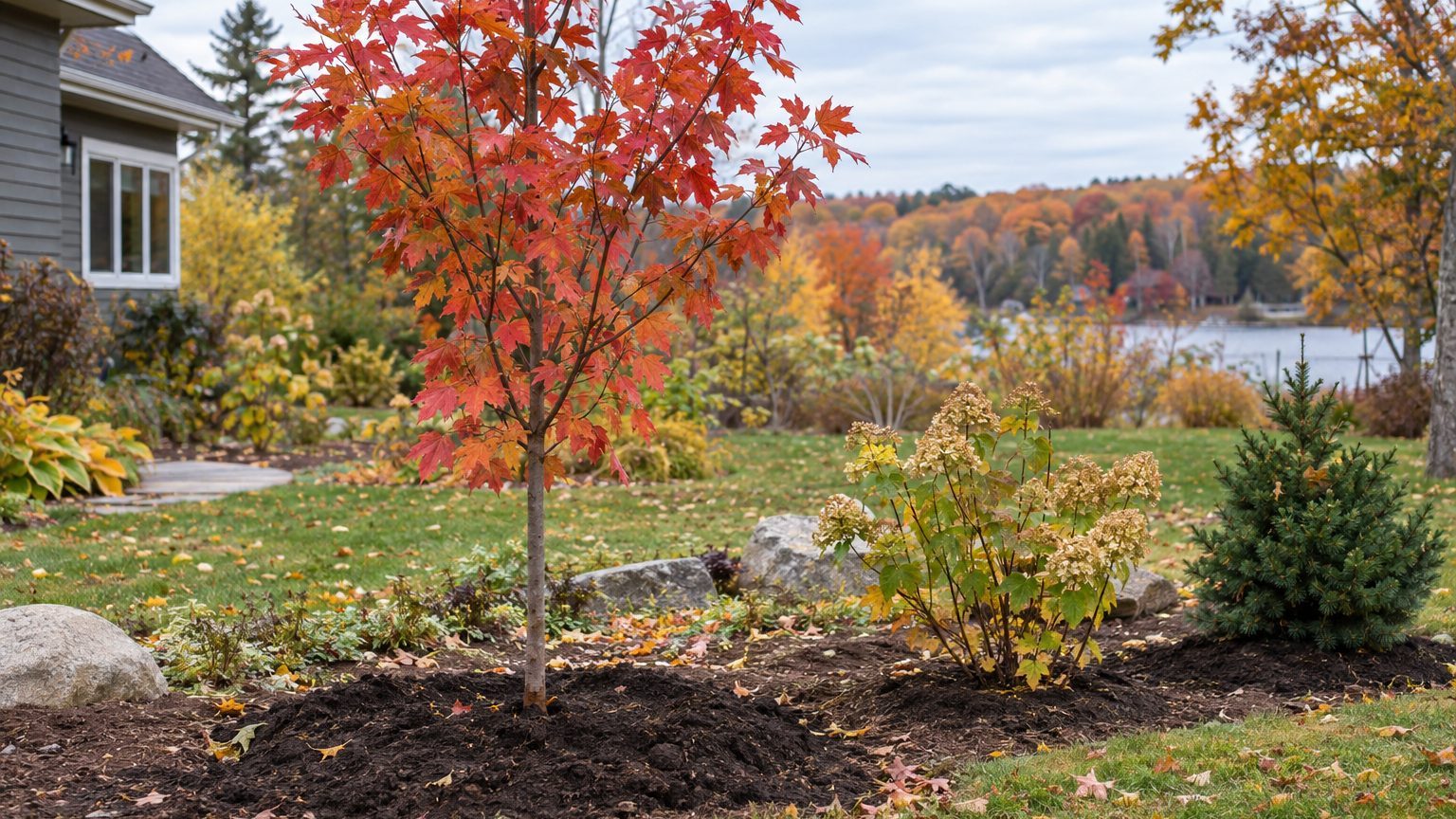

The safe target in Saskatchewan is to have trees and shrubs in the ground six weeks before the first fall frost. Counting back from the Saskatoon average of September 18, that lands on August 7. It is the conservative date. The real limit is the day the soil freezes, which arrives later than the first frost, so hardy container stock planted after August 7 can still work. Colder northern districts reach every one of these dates earlier.
The deadline in Saskatchewan
Roots do not follow the air temperature. A tree can sit through a frosty September night with its top growth shutting down while the roots keep pushing into soil that is still workable and above freezing. Soil holds summer heat long after the air gives it up, and that gap is the whole reason fall planting works on the prairies. The deadline is not about the first cold snap. It is about leaving enough weeks for roots to anchor before the ground locks up.
How the six-week rule works
Cornell Cooperative Extension puts the rule this way: “Fall is an excellent time for transplanting, provided you get them to their new home at least 6 weeks before the ground freezes, allowing them time to establish roots before winter dormancy.” The rule counts back from frozen ground, a soil condition, and not from a frost, which is an air temperature. Soil freezes after the first frost, so the true cutoff sits later than any date you calculate from frost.
To turn that into something you can put on a calendar, use the first fall frost as a conservative stand-in. Environment and Climate Change Canada’s Canadian Climate Normals for 1981-2010, read at the Saskatoon SRC station, put the average first fall frost on September 18. Six weeks earlier is August 7. Aim to have trees and shrubs planted by about August 7, six weeks before the average first fall frost of September 18. Planting later than that is a gamble that gets worse each week, not an automatic failure.
Read that September 18 figure as the midpoint of a window. It is a mean, so in one year out of two the first frost falls later than that, and in the other it falls earlier. It is no guarantee of a safe date. A cold year can bring frost well ahead of it, and a long warm fall can stretch the planting window by weeks.
Reading the date for your own district
The figure comes from one station. A province is not one climate, and northern or upland districts run weeks behind Saskatoon. Colder ground means an earlier first fall frost and an earlier freeze-up, so the deadline moves earlier, not later, the farther north or higher you go. A gardener in a cold northern district should treat August 7 as a ceiling rather than a target, and finish well before it.
Winters here are serious. The mean daily minimum of the coldest month at Saskatoon is -20.7 °C (ECCC normals, 1981-2010), and Natural Resources Canada places the city in Canadian plant hardiness zone 3a. That is the Canadian system, built on seven climate variables, and it is not a USDA zone. A late-planted shrub will face that cold with a young root system, which is why the calendar matters more here than in milder provinces. The neighboring province keeps its own schedule, covered in How Late Can You Plant Trees and Shrubs in Fall in Alberta?, and you can check the dates behind this one in First and Last Frost Dates in Saskatchewan.
What to plant late, and what to wait on
Past the conservative date, what you plant matters more than when. Nursery stock sold in containers keeps its root system intact, so the plant barely notices the move. Balled and burlapped trees lose part of their roots in the digging but arrive with a compact, protected mass. Either one, if it is fully hardy for the region, can still establish in September while the soil is workable. Bare-root plants and anything stressed or rootbound fare worse and are better left for spring.
Safe bets for late planting
Hardiness is the filter. A plant that is rated for Saskatoon’s Canadian zone 3a, or for colder zones, has a real chance of handling its first winter. Plants with a thin margin do not. Natural Resources Canada states plainly that there are no simple conversions between the Canadian and USDA systems, and that Canadian zone 4a overlaps nine USDA zones, from 3a to 7a. A tag written with a USDA number from a catalog or a border-town nursery is therefore not a reliable guide for a Saskatchewan yard. Look for the Canadian zone, or ask the nursery which one applies.
| Plant type | Late planting verdict | Reason |
|---|---|---|
| Hardy deciduous shrubs in containers | Good, while soil is workable | Roots intact, little transplant shock, leaves already dropping |
| Hardy deciduous trees, balled and burlapped | Good if planted early enough to root | Dormant tops lose little water, roots keep growing in cool soil |
| Perennials rated for zone 3a | Good with a mulch layer | Small root mass settles quickly |
| Borderline plants for zone 3a | Wait for spring | Need a full season to build hardiness before a cold winter |
| Evergreens (spruce, pine, juniper) | Risky after the six-week target | Needles lose water all winter while frozen roots cannot replace it |
Plants to hold until spring
Borderline plants are the clearest case. The coldest-month average of -20.7 °C is a mean of daily lows, so individual nights run colder, and a plant at the edge of its range can survive an easy winter and die in a harsh one. Such a plant needs a full season of settled roots before it faces that test. Spring planting gives it exactly that.
Evergreens are the other problem group. A spruce or pine keeps its needles, and the needles keep losing water through winter. Roots that have not yet spread into the surrounding soil cannot keep up once that soil freezes. After the August 7 target, hold borderline plants and evergreens until spring, and keep late fall planting for hardy deciduous stock. If you must plant an evergreen late, choose a container-grown one and expect to protect it, as the next sections explain. The broader basics of site, hole depth and handling are laid out in Planting and Caring for Trees, Shrubs and Perennials.
Watering and mulch until the ground freezes
A fall-planted tree has one job before winter, which is to grow roots. It is not trying to grow taller or push out new leaves. Any energy it spends goes underground, into the soil that is still warm enough to work in. That shapes everything you do in the weeks after planting: you are feeding root growth, not top growth, so skip the urge to prune heavily or to fertilize for a flush of new shoots.
Water deeply, right up to freeze-up
Water slowly and deeply so moisture reaches the whole root zone, then let the top of the soil dry slightly before the next soaking. Keep this going through fall, not just through the first few weeks. Prairie autumns are often dry, and a new root system has only a small volume of soil to draw from. A last deep watering once the leaves have dropped and just before the soil freezes sends the plant into winter with moisture in reserve. That matters most for evergreens, which keep losing water all winter.
Frozen soil is the signal to stop. Watering into ground that is already solid just sheets off and does nothing. Until that point, check the soil a few inches down rather than judging by the surface or by whether it has rained lately.
Mulch in a ring, not a volcano
Mulch evens out soil temperature and slows moisture loss. NC State Extension’s Gardener Handbook (chapter 11, Woody Ornamentals) gives two guidelines. For weeds: “A 2-inch to 3-inch layer of mulch suppresses most annual weed seeds and makes it easy to hand-pull any that do germinate.” And for trees: “Provide a 3-inch layer of mulch to reduce water loss and maintain uniform soil moisture and temperature around roots.” Spread mulch 2 to 3 inches deep in a wide ring around the plant, not more.
The shape matters as much as the depth. Pull the mulch back so it does not touch the trunk or the stems, leaving a small gap around the base. Piled against the bark, it holds moisture on the trunk and invites rot and gnawing pests. That cone-shaped pile, the so-called volcano, does harm and gains nothing, since deeper mulch is not better mulch. Spread it out wide instead, out to the drip line if you can. Mulching Without Killing the Plant covers materials and common mistakes in more detail.
What goes wrong
The first failure is the plainest one: planting too late for this climate. A tree set in after the soil is nearly frozen has no weeks left to root, and the ground simply locks it in place with nothing holding it. The six-week target of August 7 exists to prevent that, and the colder your district, the earlier the margin runs out. If you find yourself digging after the first hard frosts, the plant is likely better off stored or left until spring.
Winter burn on evergreens
Winter burn shows up as brown, dried needles, usually on the side facing sun and wind. It happens when the plant loses more water through its needles than frozen roots can deliver. A late-planted evergreen has the least root reach and so is the most exposed. Deep watering until freeze-up, a mulch ring, and a spot sheltered from the prevailing wind all reduce the risk without eliminating it.
Heaving and dry falls
Repeated freezing and thawing pushes shallow root balls up out of the ground, a process called frost heave. It breaks fine roots and exposes the rest to dry air. A planting hole set at the proper depth, firmly backfilled, with an even mulch layer on top, slows the swings in soil temperature that drive it. In spring, check for plants that have lifted and press them back gently once the soil has thawed.
Dry falls do quieter damage. A new tree that goes into winter with parched roots has little to fall back on. Keep watering until the ground freezes, even if the leaves are gone and the weather feels like the season is over.
Common questions
Can I still plant a tree in October in Saskatchewan?
The six-week target of August 7 has long passed, so planting now is a gamble, but not a closed door. If the soil is still workable and thawed, a fully hardy container-grown deciduous tree or shrub can still make some root growth. Water deeply, mulch 2 to 3 inches deep in a ring, and expect less margin than an earlier planting. Skip borderline plants and evergreens, and once the ground is frozen solid, wait for spring.
Is August 7 the same date across the province?
No. It comes from the Saskatoon SRC station’s average first fall frost of September 18. Northern and upland districts run weeks behind that station, with an earlier first fall frost and an earlier freeze-up, so their deadlines come earlier too. Treat the date as a midpoint for Saskatoon and subtract time as you go north. More local timing questions are collected in the Saskatchewan guides.
Does zone 3a mean the same thing as a USDA zone?
It does not. Zone 3a is the Canadian hardiness zone Natural Resources Canada assigns to Saskatoon, calculated from seven climate variables, while the USDA system uses one. NRCan publishes that there are no simple conversions between the two, so match plant tags to the Canadian system whenever you can.
Are these frost and temperature figures current?
They are the official published normals. The Canadian normals used here, for the first fall frost and the coldest-month minimum of -20.7 °C, cover 1981-2010, while the hardiness zone comes from the later 1991-2020 period. US figures from other sources often use 1991-2020, so numbers from the two countries are not always measured over the same years and should not be compared line by line.
Related guides
- How Late Can You Plant Trees and Shrubs in Fall in Manitoba?
- How Late Can You Plant Trees and Shrubs in Fall in South Carolina?
Sources : fromsoiltosoul.ca