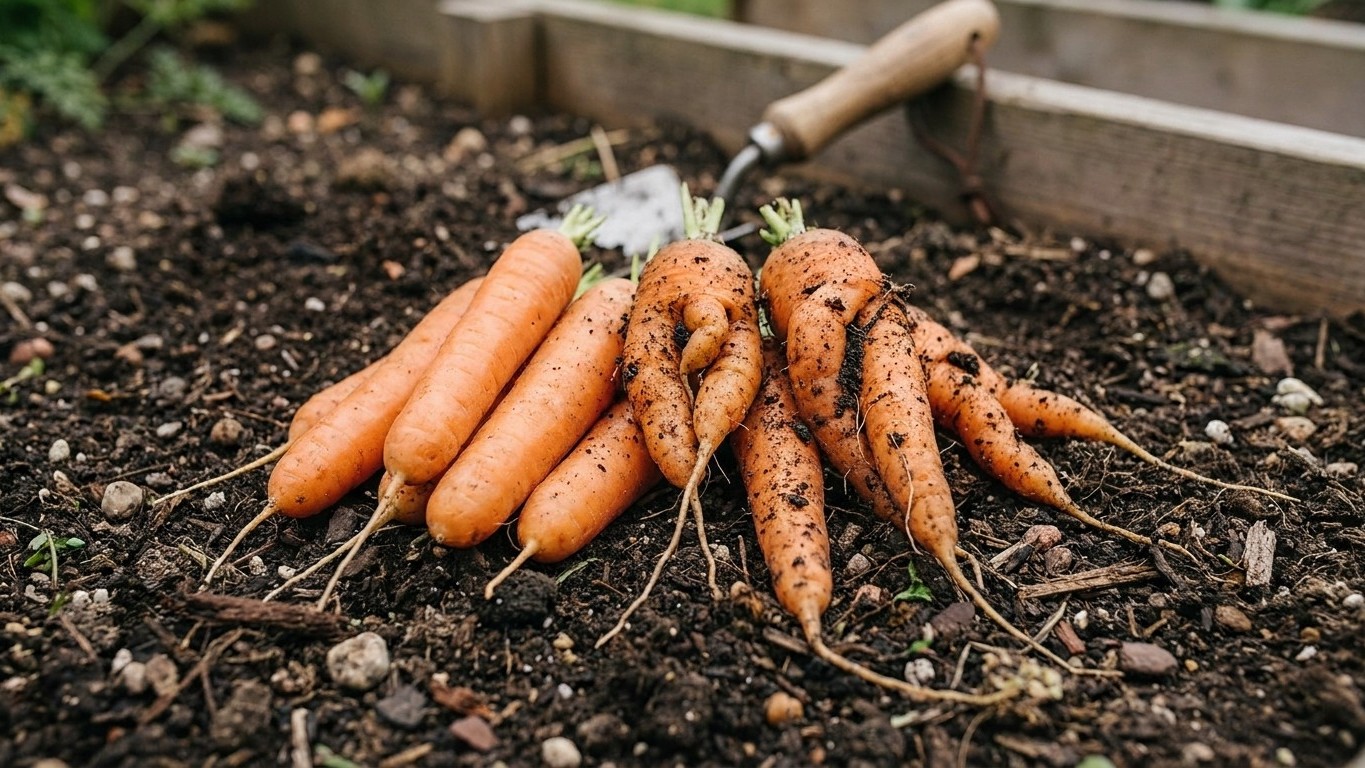

Pull carrots when the roots are as thick as you want them. In a short prairie season that means about 65 to 75 days after seeding for young, tender roots, or the 70 to 100 days printed on seed packets for full size. Lift them before the ground freezes hard. Keeping them is a separate job: cut the tops off, then hold the roots at 33 °F and high humidity. Under those conditions they can last for months. In a warm kitchen they last days.
Keeping them, and for how long
Clemson Cooperative Extension’s Home & Garden Information Center gives the most useful storage numbers for home gardeners. Its carrot guidance reads: “Harvest carrots about 65 to 75 days after planting… Store them at 33 °F and high humidity to prevent wilting. Bunched carrots (plants with tops on) can be stored for about 10 to 14 days.” Three numbers there matter: the harvest window, the storage temperature, and the short life of carrots stored with their tops on.
What temperature and humidity keep carrots longest?
Write down 33 °F. That is one degree above the freezing point of water, so it is much colder than a cellar usually runs. Carrots stored at 50 °F sprout and go soft in a fraction of the time they would last cold. The high humidity matters because a carrot is mostly water, and dry air pulls that water out through the skin. A root that has gone rubbery was usually stored in air that was too dry.
Treat any storage duration as a ceiling reached only under ideal conditions. If the temperature drifts up, the humidity drops, or the roots went in bruised, the carrots will not last as long. A batch that holds for months in a steady, cold, humid spot may be limp in weeks in a spot that is a few degrees warmer or noticeably drier.
Why do the tops have to come off first?
The leaves keep working after the carrot leaves the ground. They go on drawing moisture out of the root, and the root has nothing to replace it. That is why Clemson’s figure for bunched carrots is only about 10 to 14 days. Carrots with the tops removed keep far longer, up to months when the cold and humidity are right.
So cut the tops off the day you pull. Slice them close to the shoulder of the root with a knife or pruning shears. Twisting them off is quicker but can tear the crown. Leave the greens in the garden bed or toss them on the compost pile.
Sort the roots as you trim. Anything cracked, gnawed, or nicked by the fork goes to the kitchen first, because damaged roots rot and can spoil their neighbors. If something has been chewing on your crop, What Eats Carrot in Saskatchewan, and When explains what to look for and when the damage tends to start. Only unblemished roots should go into long storage.
Where in the house that actually is
A number like 33 °F is easy to read and hard to find in a real house. Each place carrots might go has its own problem, and most of them miss the mark.
A heated room, including the kitchen counter, the pantry off the kitchen, or a finished basement, is far too warm. Carrots there sprout and soften within a short time. A garage swings with the weather, and that is a particular problem on the prairies, where a mild afternoon can be followed by a deep freeze overnight. A carrot that freezes and thaws turns mushy, so an unheated garage is a gamble from late fall on.
The refrigerator comes closest for a modest harvest. Many fridges run somewhat warmer than 33 °F, and the door and top shelf run warmest. The crisper drawer, low in the cabinet, is usually the coldest and most stable spot. Seal the trimmed carrots in a perforated plastic bag, or wrap them in a slightly damp towel inside a bag, so the humidity stays high. That works for a few pounds, but not for a whole row.
For a bigger harvest, the best candidate is an unheated basement room against an outside wall, or a cold room built for storage. These can stay cool and steady through a Saskatchewan fall, but they vary a lot from house to house. A cold room near the furnace is not a cold room at all.
Whichever spot you choose, put a thermometer there and read it for several days before the carrots go in. Check it in the morning and the evening, and again after the first hard cold snap. If it reads at or below freezing, move the carrots. If it runs well above 33 °F, treat the carrots as short-term food and eat them first. A cheap thermometer costs less than a lost harvest.
How do you know carrots are ready to pull in Saskatchewan?
Count from seeding. Carrots are sown in place and never transplanted, so the 70 to 100 days on a seed packet start the day the seed goes into the ground. Clemson’s guidance is to harvest about 65 to 75 days after planting, which gives smaller, tender roots. Leaving them in longer gives bigger roots, up to the packet’s full count. Both are reasonable, depending on whether you want baby carrots or storage carrots.
The best check is to look. Brush the soil back from the top of one root. The shoulder should be about as wide as the size you want. If it is still thin, wait another week and look again. Sample one carrot instead of guessing; it is a good excuse for a snack.
Prairie falls turn cold fast, and frozen ground makes digging hard on the roots. Plan to have them out of the bed before the soil freezes solid. If you are unsure of the local timing, a local garden club or agricultural extension office can tell you what a typical fall looks like in your area.
Will the soil make a difference at harvest?
It can. The most common soil across the province’s mapped farmland is Chernozem, a deep, dark grassland soil rich in organic matter. The typical surface there is loam to silt, with 43 percent sand, 22 percent clay, and 35 percent silt, about 4.0 percent organic matter, a median pH of about 6.8, and good drainage. That is a friendly starting point, and carrots lift easily from loose, well-drained ground.
Utah State University Extension says carrots want deep, sandy, well-drained soil rich in organic matter, and that heavy or rocky soil makes the root fork. A 22 percent clay content is more than carrots like, so a heavier patch can still give forked or stubby roots. The province-wide profile is only a starting point. River bottoms and any ground a builder has scraped or filled will be different, and your own bed may be nothing like the median.
A jar test settles it at home. Fill a straight-sided jar about one-third with soil from the bed, top it with water, shake it, and let it settle for a day. The sand, silt, and clay form separate layers, and a thick clay layer tells you to expect trouble. Heavy soil calls for plenty of compost and double digging, or a raised bed, not a different seed. Will Carrots Fork in Saskatchewan Soil? goes through the options. For the full growing calendar, start with Growing Carrots in Saskatchewan.
Common questions
How many days from seeding until carrots can be pulled?
Clemson Extension puts harvest at about 65 to 75 days after planting, and seed packets generally give 70 to 100 days. Both counts start at seeding, because carrots are never transplanted. Pull earlier for tender roots and later for larger ones.
Should I cut the tops off before storing carrots?
Yes, right away. The leaves keep pulling moisture out of the root, so carrots stored with their tops on last only about 10 to 14 days. With the tops off, carrots held cold and humid can last for months.
Can I store carrots in a garage or a root cellar?
Only if a thermometer shows the spot holds close to 33 °F without freezing. A garage usually swings too much with the weather, and many cellars run too warm. At 50 °F, carrots sprout and soften quickly. If the spot does not hold steady, use the refrigerator for what you can and eat the rest first.
Why did my stored carrots go limp?
Dry air, warmth, and leftover tops are the usual causes. Carrots lose water fast when the air is dry, so store them at high humidity in a bag or damp wrap. Warm storage speeds the softening. Roots that went in with their greens still attached lose moisture to the leaves.